


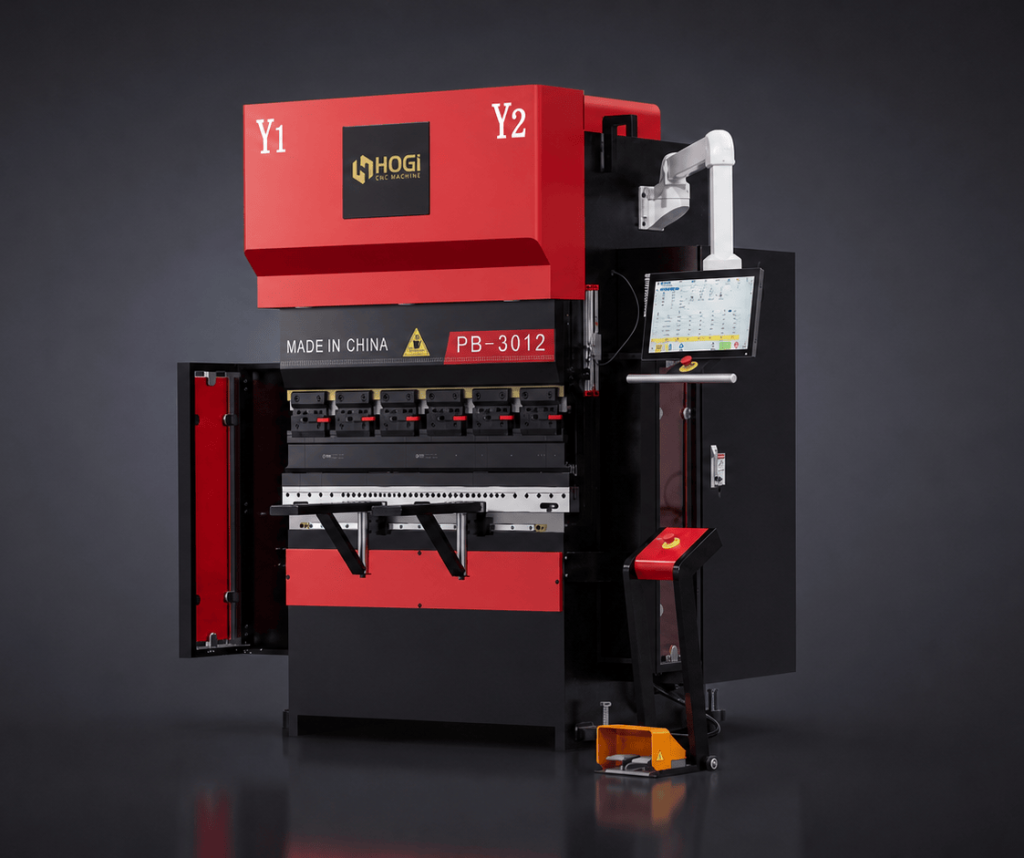
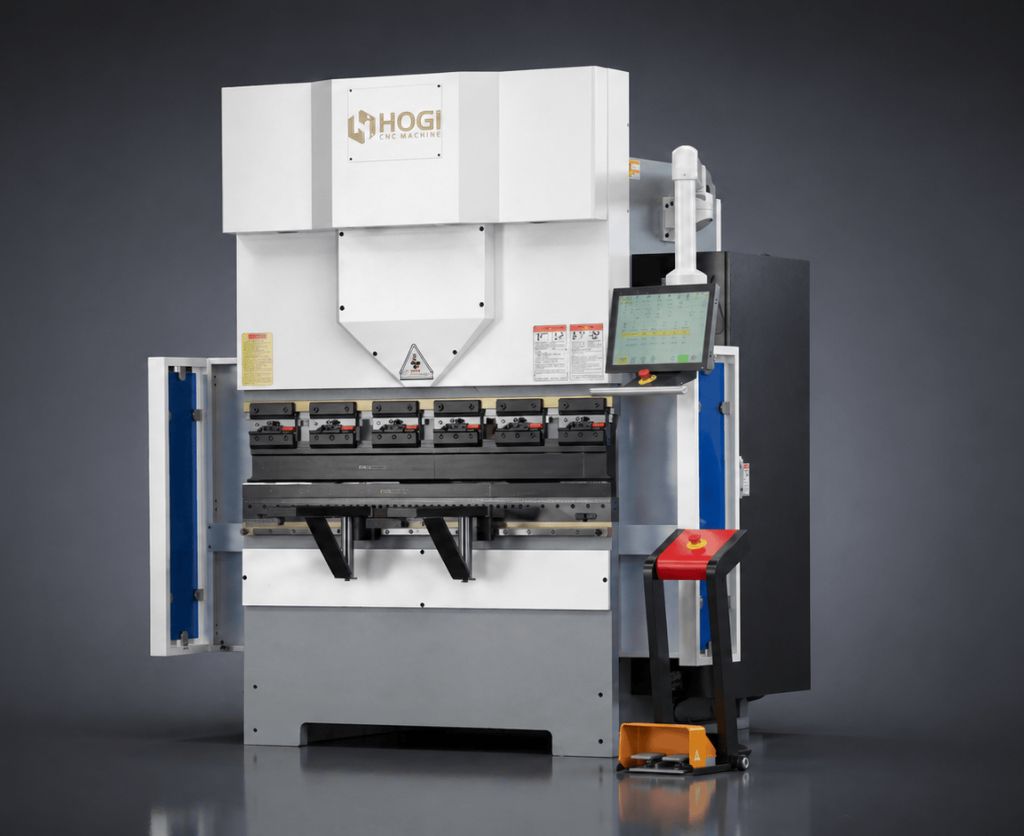
HOGI Mini press brake bending machine 20Ton 30Ton 40Ton 50Ton 55Ton 60Ton 63 Ton 70Ton
HOGI 30ton press brake (typically ranging from 30 to 35 tons of bending force) is a compact, highly precision-focused machine tailored for bending thin sheet metal, small electronic components, brackets, and intricate hardware.
Because of their smaller footprint and fast cycle times, these machines are staple workhorses in precision engineering, electronics enclosures, and prototype shops.
Here is a technical overview of capacities, tooling, and typical specifications for a 30-ton press brake.
1. Bending Capacity Guideline
A machine’s bending capacity is a function of tonnage, material thickness, and die opening (V-opening). For a standard 30-ton machine bending mild steel (assuming a standard V-opening equal to 8 \times material thickness):
Max Thickness: Typically up to 2.5\text{mm} to 3\text{mm} (11 to 12 gauge) mild steel over short lengths.
Bending Length: Usually limited to 1000\text{mm} to 1600\text{mm} (3.2 to 5.2 feet).
Thicker Materials: It can bend thicker material (e.g., 4\text{mm}), but only at very narrow widths (e.g., small brackets under 200\text{mm} wide) or by significantly widening the V-die, which increases the inner bend radius.
2. Typical Technical Specifications
While exact specs vary by manufacturer (e.g., Amada, Trumpf, Bystronic, or high-end CNC hydraulic/electric variants), a standard 30T machine generally features:
Tonnage: 300\text{ kN} (30 Metric Tons)
Bed Length: 1250\text{mm} \sim 1600\text{mm}
Distance Between Housings: 1000\text{mm} \sim 1300\text{mm}
Stroke Length: 100\text{mm} \sim 150\text{mm}
Open Height (Daylight): 300\text{mm} \sim 370\text{mm}
Approach Speed: High speed (often up to 150\text{mm/s} – 200\text{mm/s} on electric servo models) to maximize throughput on small parts.
3. Drive Types: Hydraulic vs. Full Electric
4. Ideal Tooling & Application Setup
Segmented Tooling: Because 30T press brakes are heavily used for making small boxes, chassis, and complex enclosures, segmented (gooseneck) punches are highly recommended to allow for deep four-sided box forming without wall interference.
Precision Backgauges: A multi-axis CNC backgauge (X, R axes at minimum; Z1, Z2 preferred) is critical for small parts where flange dimensions are tight and require frequent shifting.
Front Support Arms: Less critical for heavy lifting, but helpful when stabilizing thin, wide sheets to prevent “whip-up” deformation during fast bends.
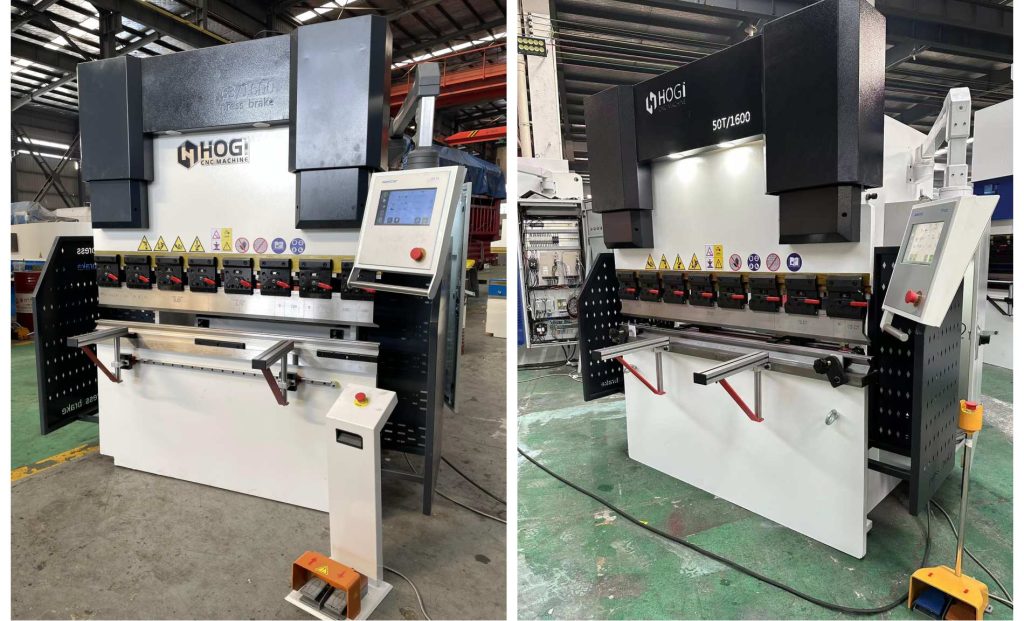
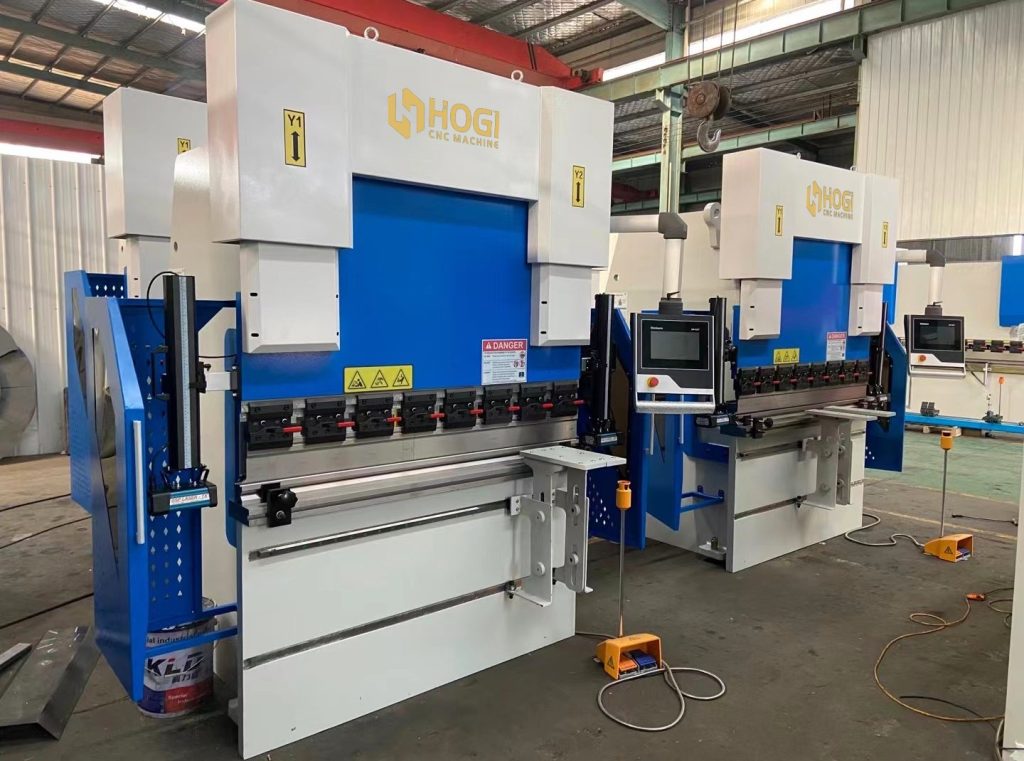
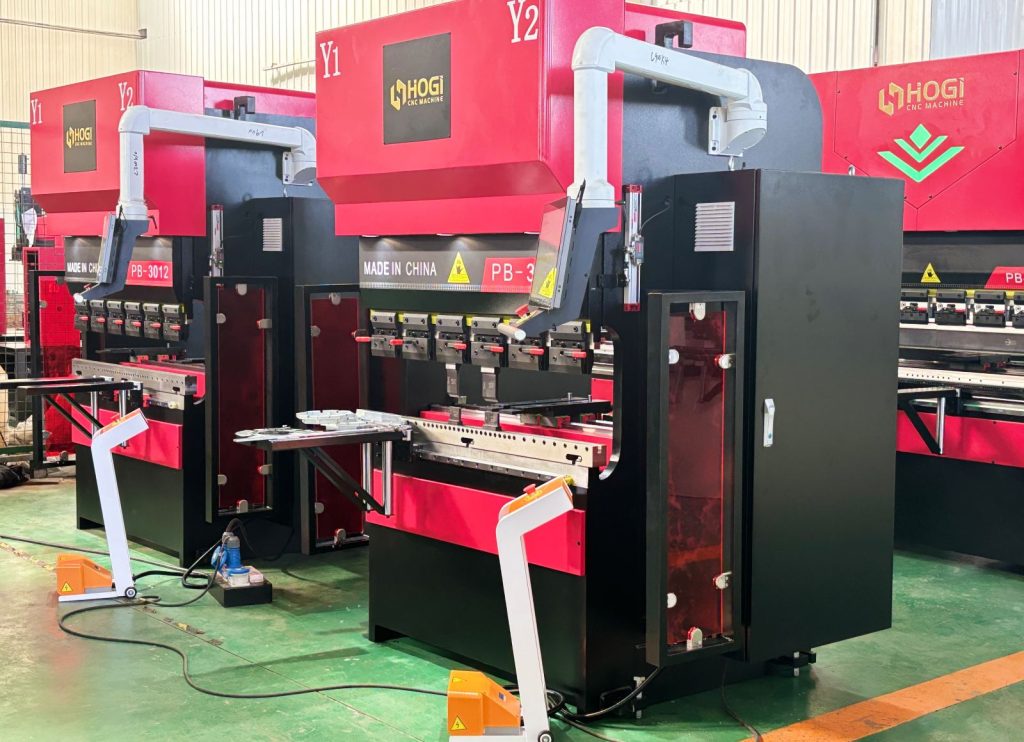
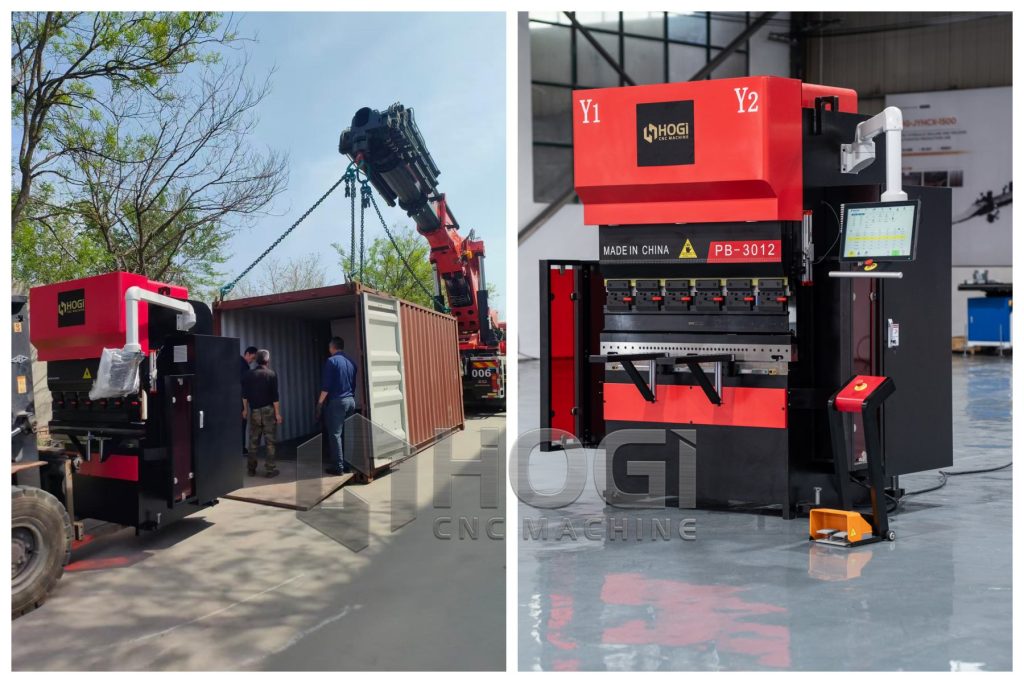
Compared to large, heavy-duty press brakes, HOGI small press brakes (typically referring to compact models with a pressing force of 30 metric tons or less and a table length of 1.2 meters to 1.6 meters) are playing an increasingly important role in modern precision sheet metal fabrication.
Particularly amid the trend toward “high speed, high precision,” and “human-machine collaborative automation,” the advantages of small press brakes are particularly significant:
Analysis of Core Advantages
1. Unmatched Speed and High Production Efficiency
Hogi Small Press Brakes:
Extremely fast rapid retraction and downward pressure speeds: Often equipped with servo direct-drive or high-speed hydraulic systems, the ram speed (rapid descent, working stroke, and return stroke) is typically 1.5 to 2 times that of large machines.
Agile backgauge response: Extremely high positioning speeds on the X and R axes significantly reduce non-machining wait times when bending multiple bends or complex small workpieces.
2. Small footprint and flexible workshop layout
High space utilization: Small press brakes have a compact structure; some monoblock models can even be moved as a whole using a forklift.
An excellent choice for Lean Production: They can be easily integrated into “U-shaped production lines” or combined with laser cutters and punch presses to form compact work cells, reducing material handling distances within the workshop.
3. High precision, better suited for precision machining
Minimal frame deflection: Due to the smaller worktable and throat depth, the mechanical structure experiences far less deformation under pressure compared to larger machines. Typically, no complex deflection compensation system is required to ensure extremely high bending straightness and angle consistency.
Micrometer-level positioning: Ideal for small workpieces with extremely tight tolerance requirements (e.g., within ±0.5°), such as electronic component housings, medical devices, and precision instruments.
4. Low Energy Consumption and Low Maintenance Costs
Significant energy savings: Many modern small-sized press brakes utilize **hybrid (Dual Drive) or all-electric servo (All-Electric) technology. Motors consume power only when the foot pedal is pressed and the ram is moving; standby power consumption is extremely low, reducing electricity costs by more than 50%.
Low Oil Consumption: The oil tank capacity of the hydraulic system is much smaller than that of larger models, resulting in lower oil change and maintenance costs, as well as a reduced risk of oil leaks and overheating.
5. Ergonomic and Automation-Friendly
Reduced Operator Fatigue: Operators can easily operate the machine while seated or standing naturally, enjoying better visibility and easier access to small workpieces, resulting in lower physical strain.
The Perfect “Robot Bending” Partner:
Since using large robots to handle small workpieces is overkill, small bending machines are ideally suited for forming automated bending cells with lightweight industrial robots or **collaborative robots (cobots)**. Robots perform small gripping motions quickly, maximizing efficiency for high-frequency, repetitive bending operations.
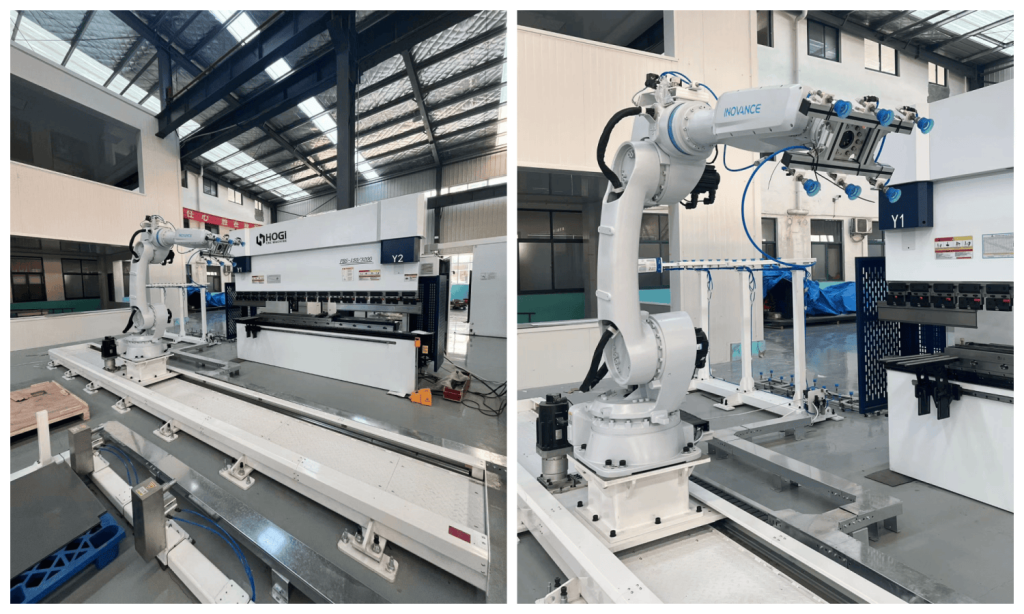
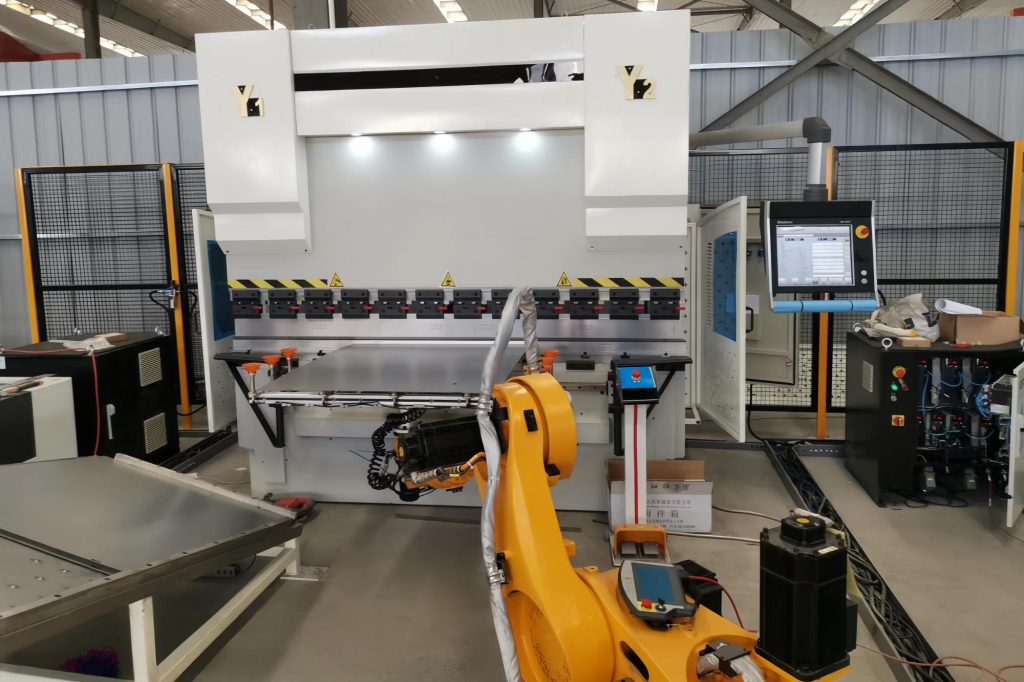
The following is a comprehensive analysis of the core technologies, advantages, and system components of robot bending:
Core System Components
HOGI complete robotic bending workstation typically consists of the following core components:
Industrial Robot: Typically a 6-axis or 7-axis high-precision robot with a long reach, enabling flexible sheet metal gripping, flipping, tracking, and stacking.
CNC Press Brake: Responsible for applying bending pressure and forming the sheet metal using dies.
Robot Gripper (End-Effector): Typically, electric suction cup grippers, pneumatic suction cup grippers, or mechanical clamps are used.
Positioning Table (Alignment Table): After the sheet metal is picked up, it is first precisely positioned on the positioning table
Turning Frame: When a workpiece requires bending on both sides,
Core Technology: Bending Follow-up The most technically challenging aspect of robotic bending is the bending follow-up algorithm.
When the press brake’s ram descends, the metal sheet warps upward. At this point, the robot must support the sheet as it moves upward,
If the robot moves too fast, it will pull the sheet out of shape or damage the die;
if the robot moves too slowly, the sheet will slip out of the gripper or exert a massive reverse impact force on the robot arm.
Modern robotic bending systems are equipped with dedicated bending follow-up software modules that can read data from the bending machine’s linear
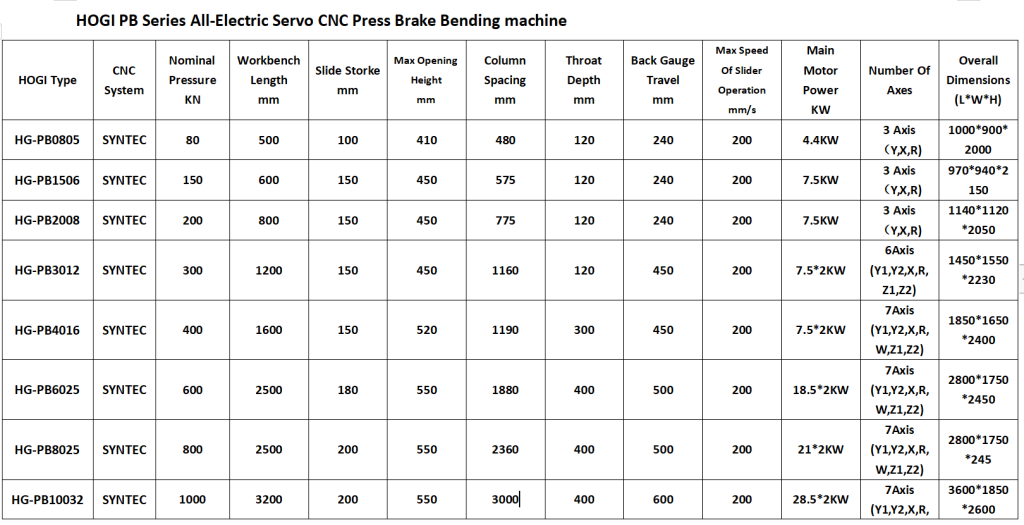
HOGI PB Series Models All electric Servo CNC Press brake Pure electric Bending machines
Specifications
Video