


HOGI CNC Metal Spinning machine Flow forming machine
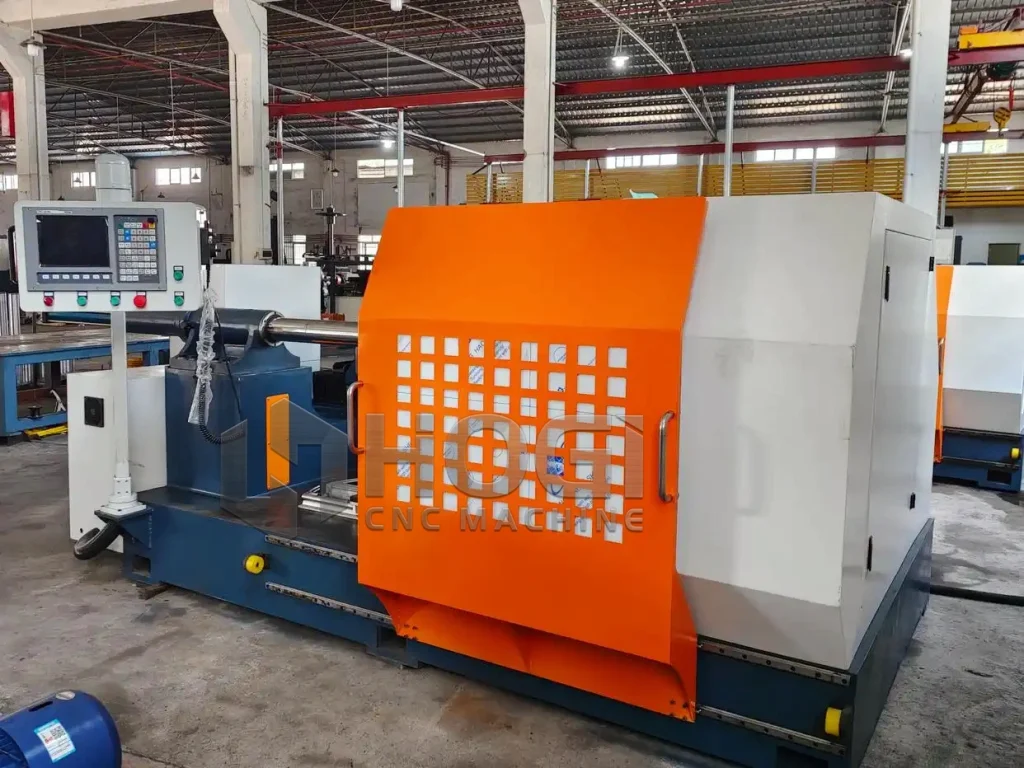
HOGI CNC spinning machine is an advanced industrial forming system that uses digital program control to shape metal sheets or tubes into various axisymmetric parts. It achieves this by applying pressure with a spinning roller to the rotating workpiece, inducing continuous plastic deformation.
Compared to traditional stamping processes, CNC spinning offers significant advantages, such as reduced tooling requirements, high material utilization, and the ability to produce complex, non-standard shapes.
I. Working Principle of the CNC Spinning Machine
The core process of CNC spinning can be summarized as “rotation + compression”:
1. Clamping: The circular metal blank (sheet or tube) is securely clamped between a precision mandrel (the core mold) and the tailstock center.
2. Rotation: The spindle drives both the mandrel and the metal blank to rotate at high speed.
3. Forming: The CNC system controls the tool carriage—equipped with a spinning roller—to execute longitudinal and transverse feed movements along a pre-programmed path. The roller applies immense localized force, pressing the metal blank tightly against the mandrel; the material extends and undergoes plastic deformation layer by layer, ultimately taking on the desired geometric shape.
Main Types of HOGI CNC Spin Forming Processes
Based on changes in metal thickness and stress conditions during processing, these processes are primarily classified into the following two types:
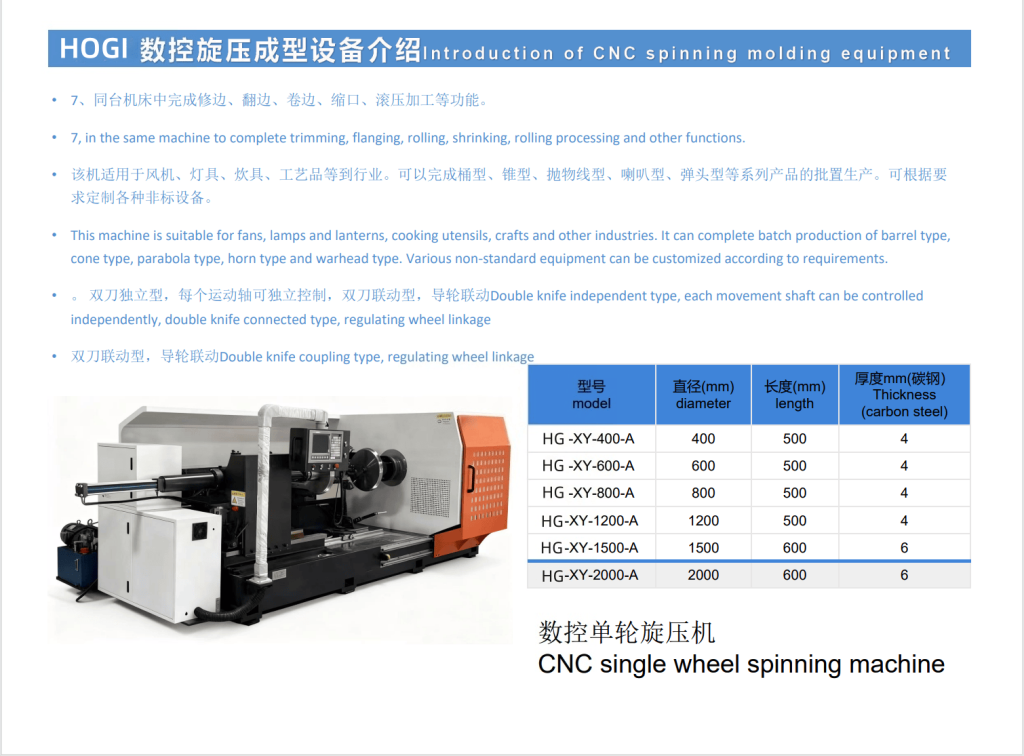
1. Conventional Spinning
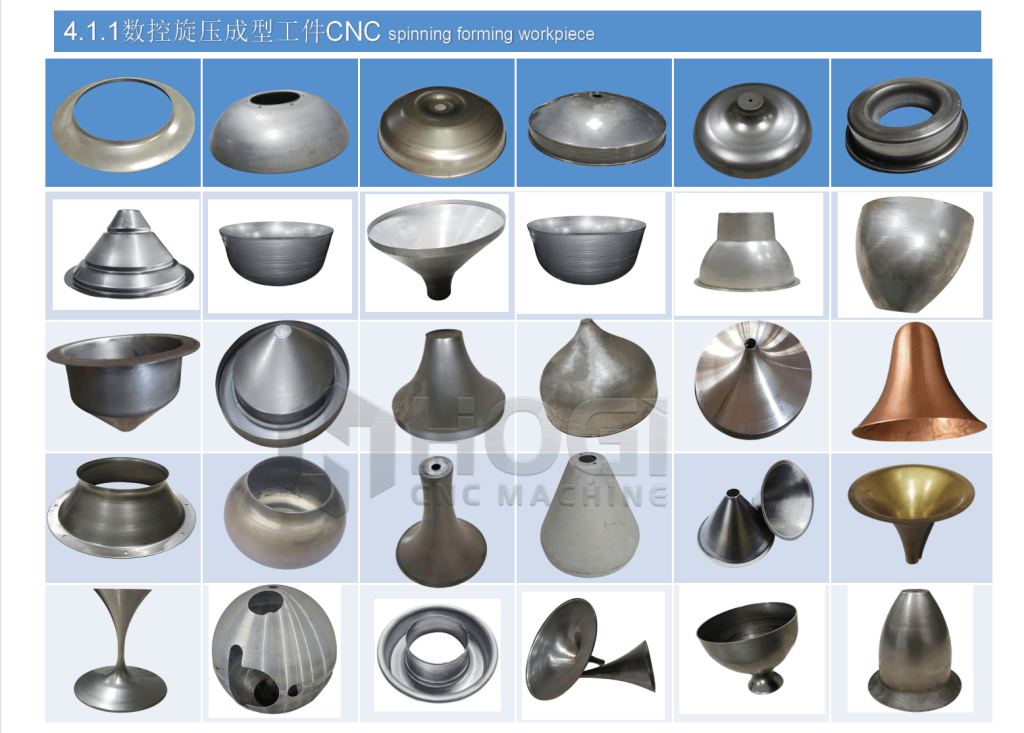
Process Characteristics: During processing, the thickness of the blank remains essentially unchanged (or changes only slightly), with the primary focus on altering the blank’s diameter and shape. Common Applications: Funnels, lampshades, vases, cookware, heads, etc.
2. Flow Forming / Shear Spinning
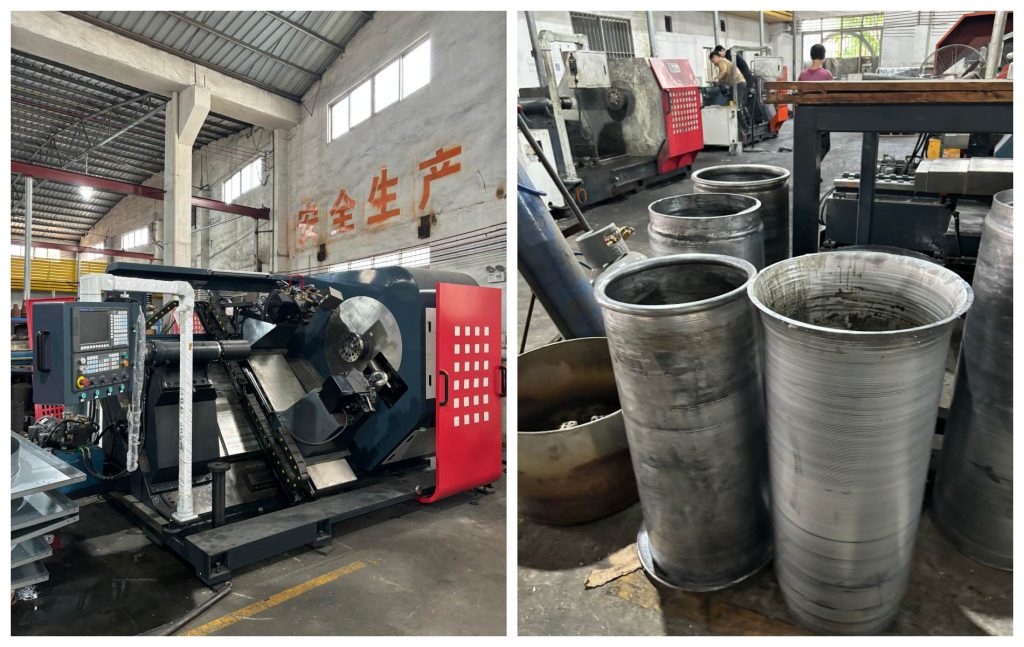
During the process, the diameter of the blank remains essentially unchanged, but its thickness is forcibly reduced as the metal is stretched axially. This method is commonly used for high-precision, high-strength tubular or cylindrical components. Common Applications: Automotive wheels, gas cylinders, military missile bodies, drive shaft pulleys, etc.
Key Components of HOGI CNC Spinning Machine
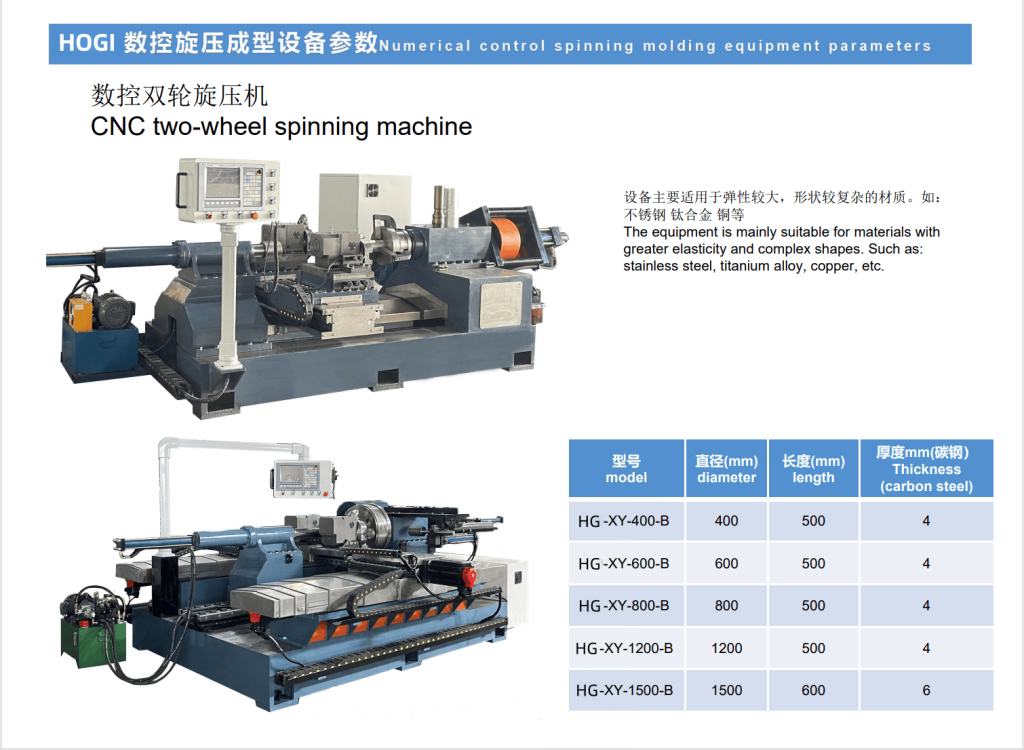
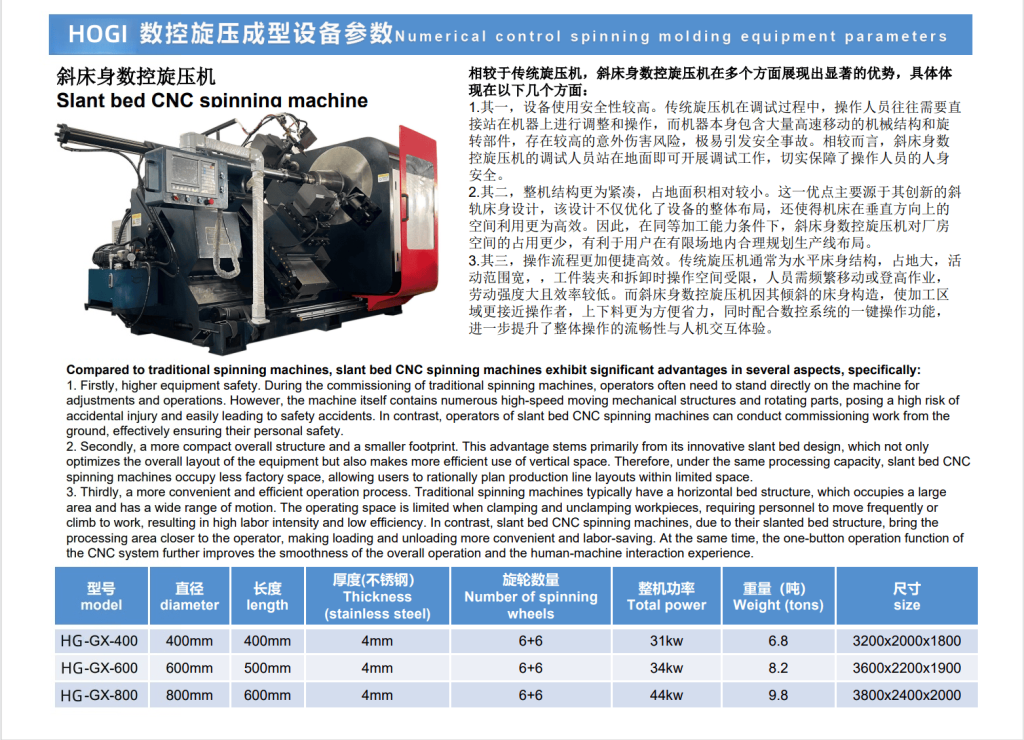
A high-performance CNC metal Spinning machine typically consists of the following parts:
Bed and Spindle System: Provides highly rigid support and stable high-speed operation, withstanding the enormous radial and axial forces generated during spin forming.
CNC Control System: The “brain” of the machine (e.g., Siemens, Fanuc, or a dedicated spinning system), responsible for precisely controlling the spinning wheel’s motion path. It typically supports “record/teach” functionality (where an operator manually performs a cycle once, and the system automatically records and generates the machining program).
Spinning Wheel Holder (typically a dual or multi-holder configuration): Equipped with spinning wheels made of cemented carbide or high-wear-resistant steel, these perform high-precision forming driven by servo motors and hydraulic systems.
Hydraulic Tailstock: Used to axially clamp the blank, ensuring the material does not shift or fly out during high-speed rotation.
Auxiliary Devices: Such as automatic lubrication systems and blank heating devices (used for hot spinning of hard metals like titanium alloys and high-strength steel).
IV. Core Application Industries and Products
CNC Spinning machines are widely used in industries with high requirements for airtightness, strength, and surface finish:
Automotive and Transportation: Aluminum alloy wheel rims, pulleys, clutch housings, and exhaust pipes.
Lighting and Home & Kitchen Appliances: Aluminum lampshades, reflector bowls, stainless steel pressure cookers, frying pans, and sinks.
HVAC and Fan Industry: Fan inlets (Venturi inlets), fan housings, and diffusers.
Aerospace and Energy: Rocket engine nozzles, missile casings, high-pressure seamless gas cylinders, and chemical tank heads.
Advantages and Limitations of HOGI CNC Spin Forming Machines
👍 Advantages
1. Extremely low tooling costs: Only a single core die is required (typically made of ordinary steel, or even hardwood or nylon). Compared to the rigid dies used in stamping processes, which can cost tens of millions to hundreds of millions of yuan, spin forming is ideally suited for high-variety, small-batch production or new product development.
2. Improved material properties: After spinning and extrusion, the metal’s internal grains undergo streamlined lattice stretching, significantly enhancing the product’s mechanical strength, hardness, and wear resistance.
3. Wide range of applications: It can easily produce conical, spherical, and double-curvature irregular parts that cannot be demolded using conventional stamping.
👎 Limitations
1. Lower production efficiency compared to stamping: As a point-by-point forming process, it takes tens of seconds to several minutes to process a single product, making it unsuitable for ultra-large-scale assembly line production requiring hundreds of pieces per minute.
2. Shape limitations: In the vast majority of cases, only axisymmetric rotational parts can be processed (although non-circular spinning technology now exists, it is extremely costly and difficult to implement).
Technical Support & Services
🔧Installation & Commissioning
Professional on-site setup and calibration of your flanging punching machine for optimal performance.
📋Operator Training
Hands-on training for CNC programming, punching pattern setup, and routine maintenance procedures.
⚙️Permanent Lubrication Support
Factory-sealed bearings — no maintenance needed. Replacement service available when required.
🔄Custom Mold Design
Design and manufacturing of custom flanging molds and punching dies for specific customer requirements.
🛡️2-Year Warranty
Comprehensive warranty coverage on CNC system, hydraulic components, and structural frame.
Video
HOGI Automatic Hydraulic Flanging Punching Machine — Live Demonstration
HOGI CNC Automatic metal spinning machines integrate the following core automation technologies:
1. Automatic Loading and Unloading System (Auto Loading & Unloading):
Robot Integration: Typically works in conjunction with multi-axis industrial robots (such as ABB, Fanuc, and KUKA) or gantry robots. The robot automatically picks up circular sheet metal blanks and feeds them into the spin forming machine; once processing is complete, it automatically removes the finished products and stacks them neatly.
In-line Production: The system can be seamlessly integrated with upstream processes (laser cutting, blanking, and stamping) and downstream processes (trimming, flanging, and cleaning) to form a fully automated sheet metal forming production line.
2. CNC “Teach-in” and Fully Automatic Programming:
Equipped with advanced CAD/CAM software interfaces, it can directly import 3D drawings to generate spinning trajectories.
Supports teach-in: An experienced operator manually spins a product, and the system automatically records and optimizes all force parameters and trajectories. Subsequently, with a single-button start, the machine can replicate the high-precision finished product 100%.
3. Multi-Station Tool Holder and Composite Machining:
Equipped with an automatic tool-changing (spinning wheel) system. A single machine can simultaneously mount roughing spinning wheels, finishing spinning wheels, trimming cutters, and flanging wheels.
Single clamping, fully automated processing: spinning → automatic trimming → automatic flanging/beading, with no manual intervention required during the process.