


HOGI CNC Flat iron clamp bending machine hoop forming machine
Main Operating Principles and Process
The equipment utilizes a multi-axis servo control system and centralized PLC management. Raw flat steel material in coil or strip form is fed into the machine via feed rollers and automatically undergoes the entire set of processes according to a preset program:
* Automatic straightening and feeding: Servo motors drive the feed rollers to ensure precise feed length (accuracy up to ±0.2 mm).
* Punching and Corner Cutting (Optional Feature): The punching module punches mounting holes, notches, or marking holes at specified locations according to instructions.
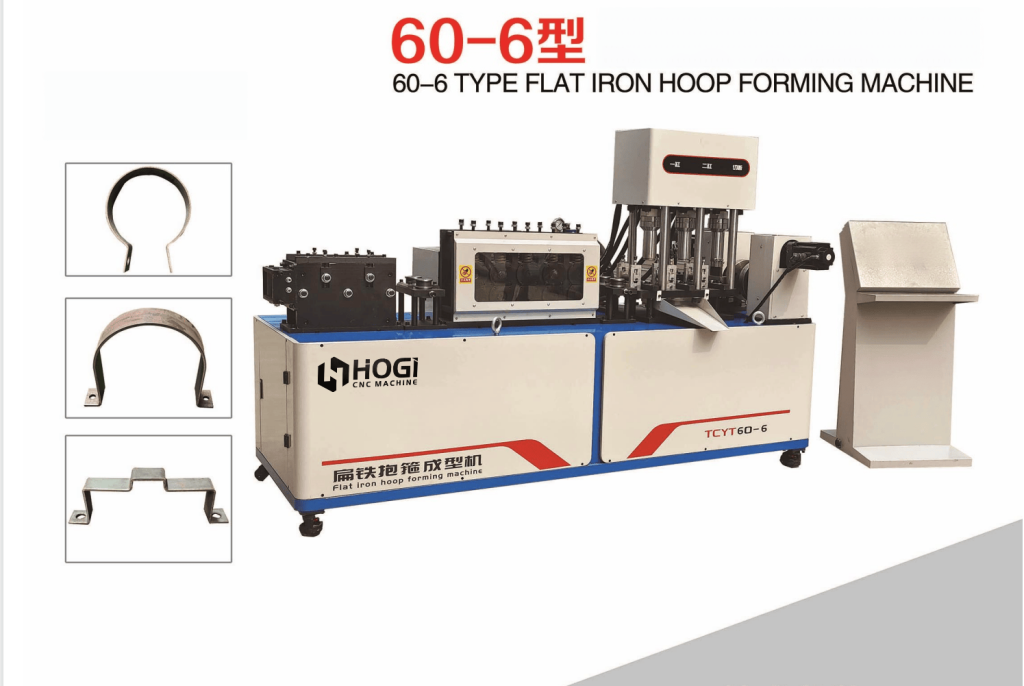
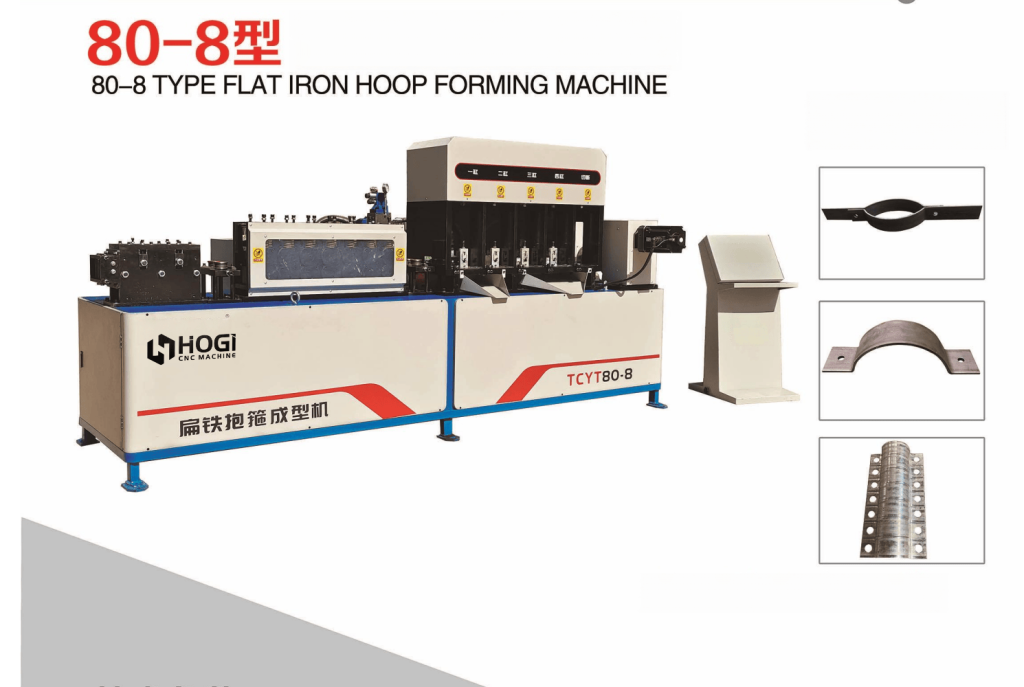
* CNC Rolling/Bending Forming: Using a three-roll or four-roll forming structure or servo bending dies, the material is bent into circles, arcs, or semicircular clamps with mounting tabs according to a preset radius of curvature.
* Hydraulic/Servo Cutting: After forming is complete, the cutting tool rapidly shears the material, and the finished product is automatically ejected.
Core Advantages of the Equipment
* High Efficiency and Labor Savings: Replacing the traditional “manual cutting–punch press hole punching–manual rolling” discrete processes, a single machine can replace 3–5 workers, increasing production efficiency by more than threefold.
* High Precision and Consistency: Servo motors control material feeding and bending angles, ensuring tight forming tolerances and effectively resolving the issues of inconsistent diameters and misaligned ends associated with traditional manual rolling.
* Flexible Production: When changing clamp diameters or punch spacing, there is no need to frequently replace mechanical dies; production can be quickly switched by simply modifying parameters on the touchscreen.
* High Material Utilization: CNC technology precisely calculates nesting lengths, significantly reducing scrap from cutting losses.
Main Machine Gallery
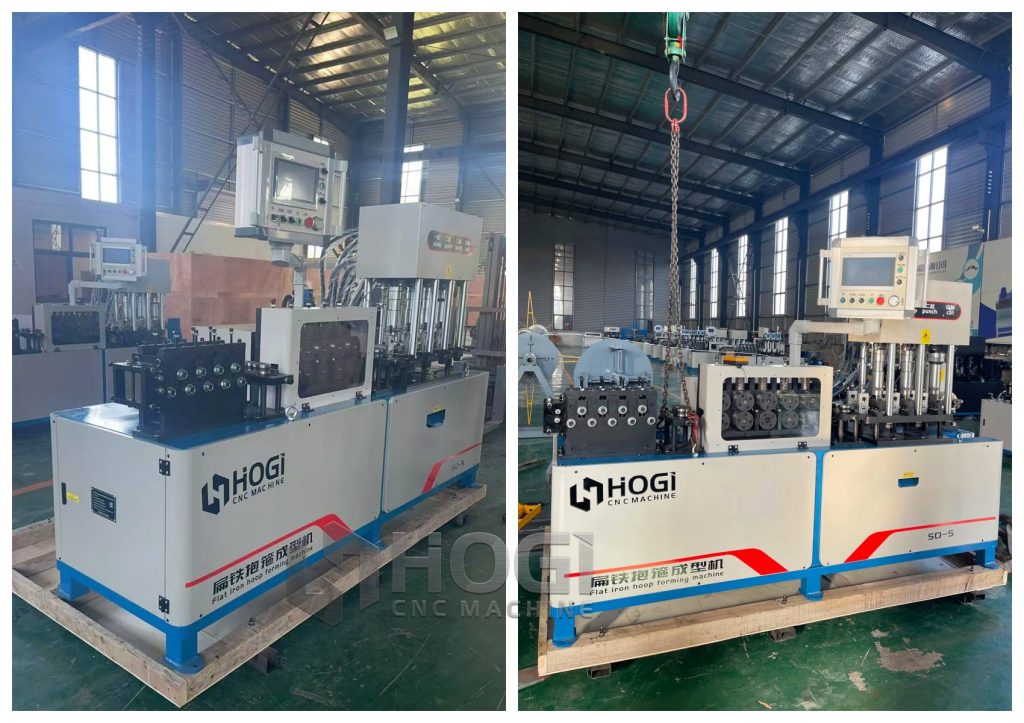
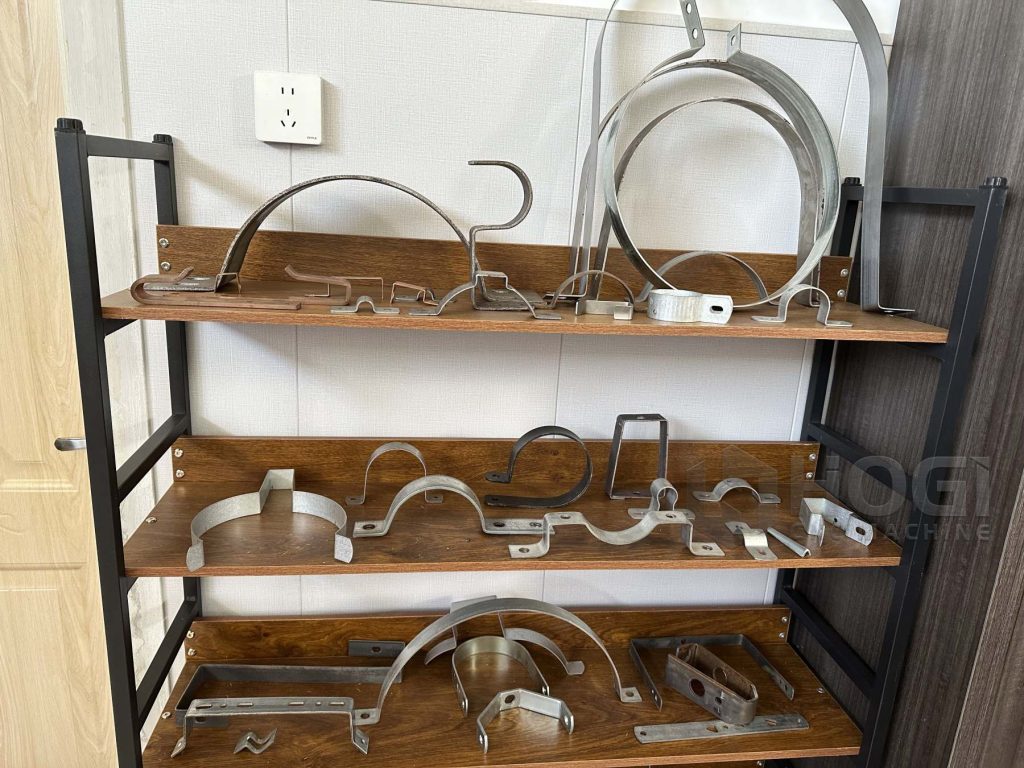
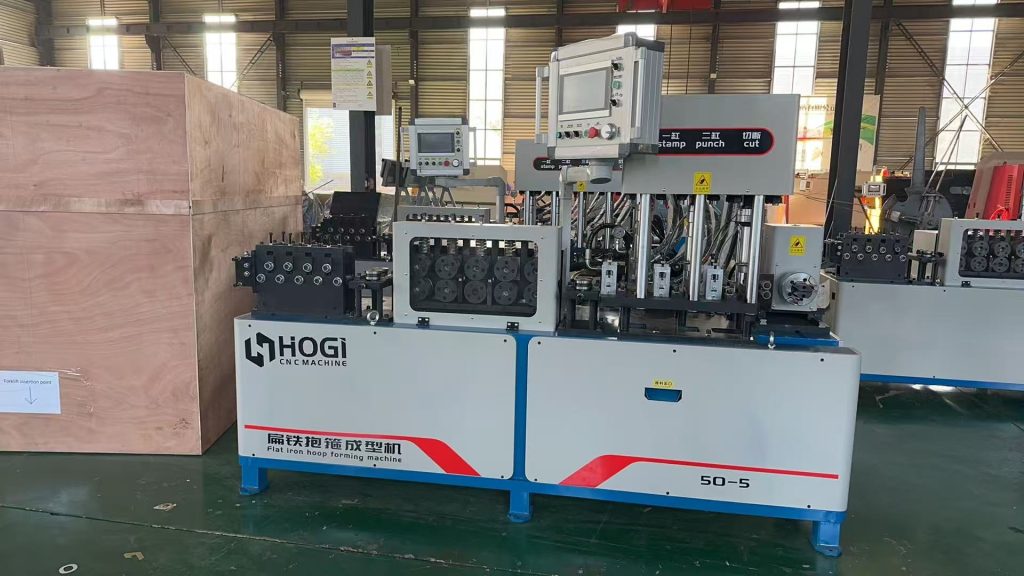
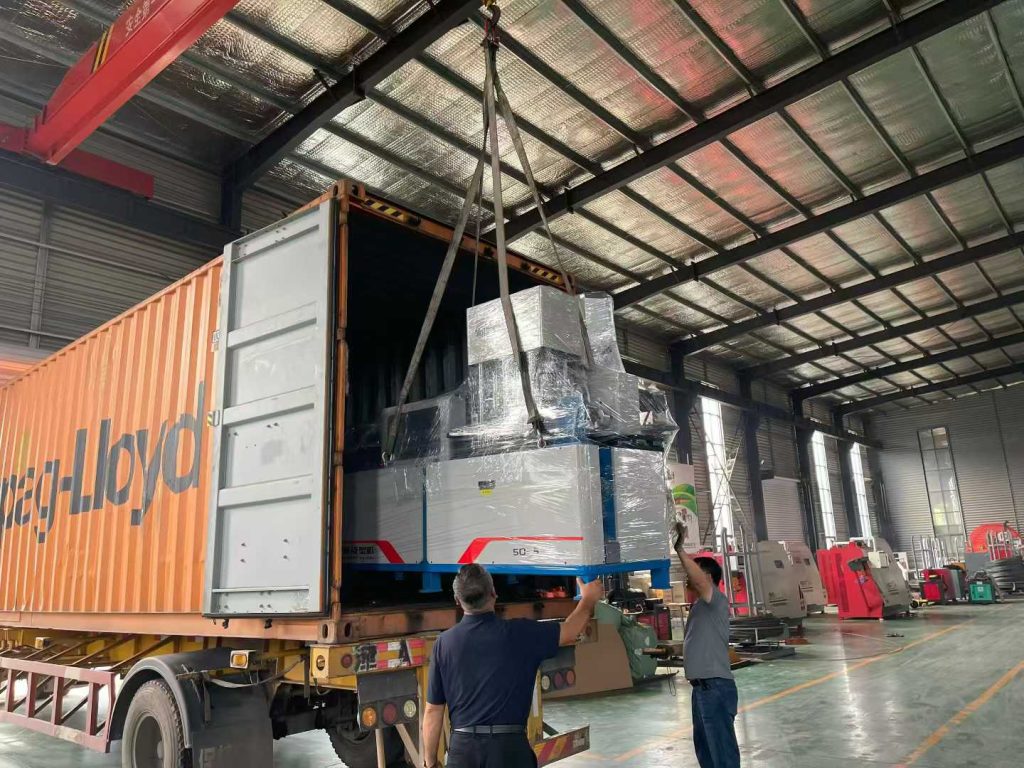
Details Gallery
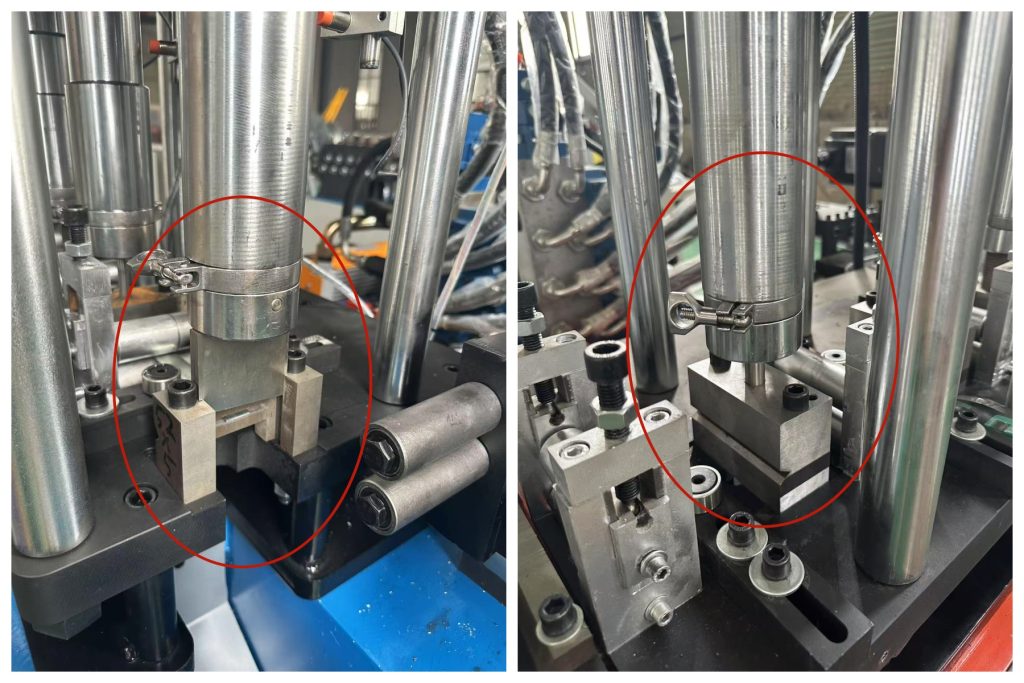
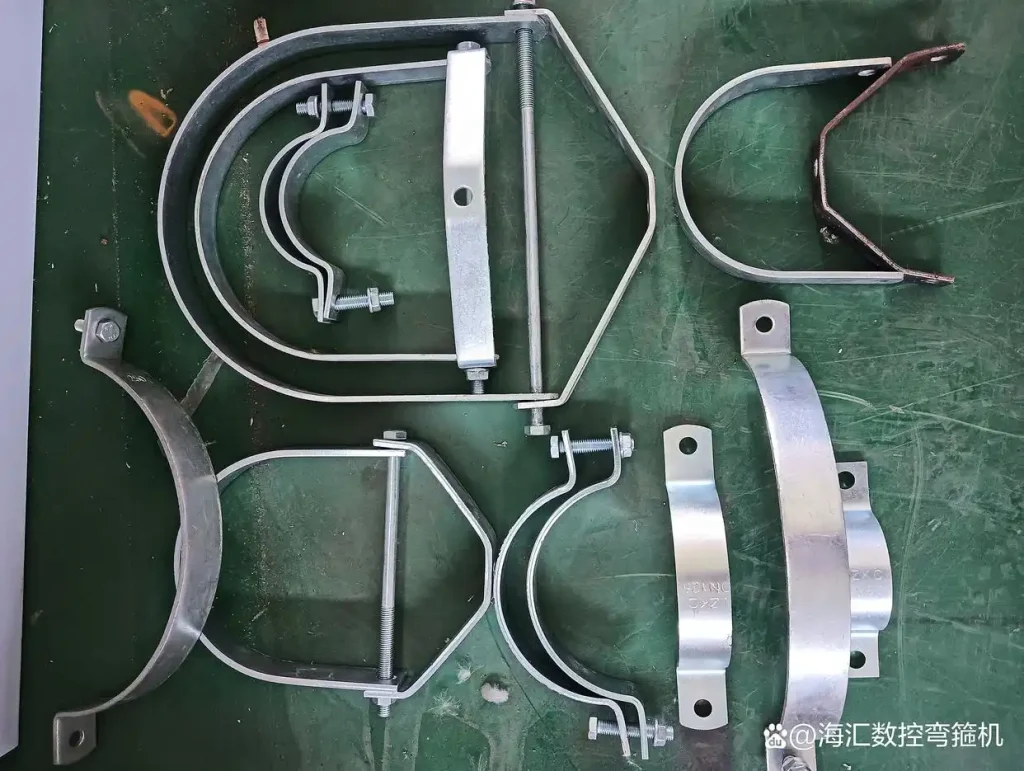
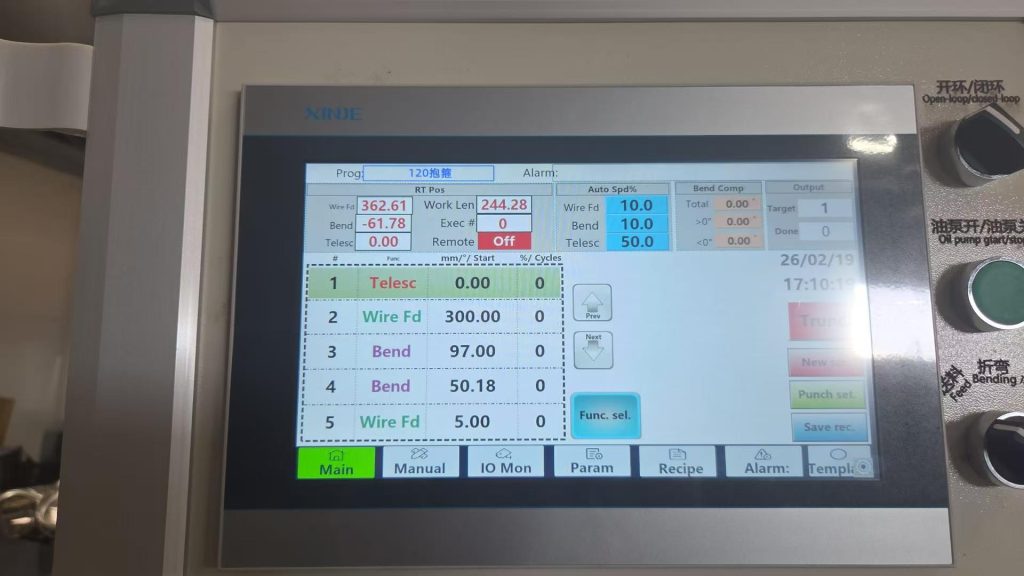
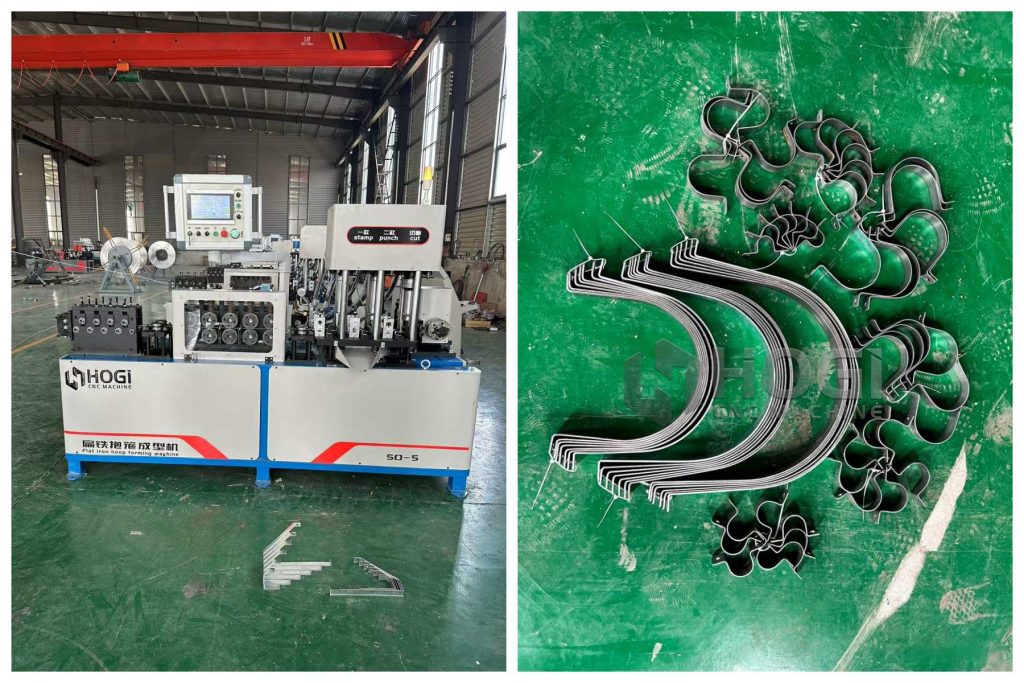
Technical Advantages
HOGI CNC Flat Bar Ring Bending/Clamp Forming Machine utilizes digital control technology and an automated mechanical structure. Compared to traditional manual or standard semi-automatic ring-bending equipment, it offers significant advantages in terms of production efficiency, machining precision, and operating costs.
I. Full-Process Automation for Significantly Improved Production Efficiency
* One-Stop Forming: Integrates multiple processes—including automatic feeding, straightening, punching/cutting, CNC arc rolling (bending), and cutting—into a single unit, enabling automated continuous operation where “flat bar goes in, clamps come out.”
* Doubled Production Capacity: With a short cycle time per machine—typically completing the processing of a standardized hoop in just a few seconds—production efficiency is 3 to 5 times higher than that of traditional separate processes (cutting–punching–rolling).
II. Servo Precision Control Ensures High Accuracy and Consistency
* High Repeatability: Both the feeding and bending axes are driven by servo motors, allowing feeding accuracy to be controlled within ±0.2 mm and ensuring precise, error-free bending angles.
* Seamless Alignment: This overcomes the issues common in traditional manual rolling—such as edge curling, misalignment, and inconsistent diameters—significantly improving the finished product’s pass rate and facilitating subsequent welding and installation.
III. Digital Parameter Tuning for High Production Changeover Flexibility
* Parametric Programming: When switching between clamps of different diameters or curvatures, there is no need to frequently disassemble mechanical stops; diameter, arc length, or angle parameters can be modified directly on the PLC industrial touchscreen.
* Quick Multi-Module Switching: Punching positions, spacing, and quantity can all be freely set in the program, enabling rapid response to small-batch, multi-specification custom orders.
IV. Reduced Labor Costs and Physical Strain
* Labor Savings: With a high degree of automation, a single operator can simultaneously oversee 2–3 machines, completely eliminating the reliance on skilled technicians.
* Enhanced Safety: Manual feeding on traditional punch presses and coiling machines poses significant safety hazards; CNC fully closed-loop or automatic safety guard designs significantly reduce the risk of workplace injuries.
V. Maximized Material Utilization
* Precise Nesting and Material Savings: The CNC system precisely calculates cutting lengths based on the set arc length, reducing scrap from material ends.
* Continuous Coil Processing: Supports direct, continuous feeding and processing of coiled round bars or steel strips. Compared to cutting flat iron to fixed lengths before processing, this method virtually eliminates waste from offcuts.
Typical Applications
* Power and Telecommunications Engineering: Guy wire clamps, single/double utility pole clamps, and fiber optic cable clamps.
* Heating, Ventilation, and Air Conditioning (HVAC) Systems: Round duct clamps and flange connection clamps.
* Piping and Municipal Engineering: Fire sprinkler pipe hangers, drainage pipe clamps, and construction scaffolding couplers.
Operating Considerations
As highly efficient machine that integrates high-pressure hydraulics, powerful mechanical bending, and electrical servo control, the HOGI CNC flat bar bending machine requires strict adherence to operating procedures during operation to ensure production safety, extend the equipment’s service life, and maintain machining accuracy.
The following are key precautions for equipment operation:
I. Pre-startup Inspection and Preparation
1. Safety Inspection:
Verify that the equipment guard, emergency stop button (E-stop), and photoelectric safety devices are all in normal, operational condition.
Remove foreign objects, metal shavings, and debris from rotating parts, roller dies, and around the cutting blades to ensure the machine is clean.
2. Hydraulic and Lubrication Systems:
Check that the hydraulic oil level is within the normal range indicated on the dipstick and that the oil temperature is normal.
Apply the specified lubricant to sliding and rotating parts such as guide rails, lead screws, and feed roller bearings.
3. Securing Dies and Cutting Tools:
Inspect the forming rollers, punching punches, and cutting tools for looseness, chipped edges, or excessive wear, and ensure that all bolts are securely tightened.
4. Air Supply and Power Supply:
Verify that the system voltage is stable and that the air supply pressure (if cylinder-assisted) is within the set operating range (typically 0.4–0.7 \text{ MPa}).
Frequently Asked Questions
What is the difference between a 4-roller and a 3-roller rolling machine?
Which materials can the machine process?
What is the minimum cylinder diameter?
Is full-servo drive available on every model?
Can the machine be integrated with an automatic welding line?
Why Choose HOGI 4-Roller Rolling Solutions
HOGI develops customized automatic rolling equipment, intelligent welding equipment and processing production lines for HVAC, ventilation, fan, pipeline and environmental engineering applications. The company provides both full-servo CNC and hydraulic CNC four-roller solutions to match different processing ranges and production targets.
For thin sheets and small-diameter cylinder work, the full-servo W12HG configuration provides a compact rolling solution with CNC clamping adjustment. For thicker plate work, the HGW hydraulic CNC configuration provides four-roll synchronized forming for stainless steel and carbon steel applications.
HOGI can also support production-line planning where rolling equipment must connect with cutting, welding, material transfer and downstream fabrication processes.
Technical Support & Services
Machine Selection
Configuration guidance based on material, thickness, width, yield strength and required cylinder diameter.
Installation Support
Commissioning guidance for machine setup, roller adjustment, CNC parameters and production preparation.
Operator Training
Practical instruction for plate loading, pre-bending, rolling programs, inspection and routine operation.
Line Integration
Engineering support for rolling, cutting, feeding, welding and handling equipment integration.
Request Machine Specifications
HOGI CNC Flat Iron Hoop Making Machine (Fully Automatic Flat Steel Hoop Forming Machine)
Also known as: CNC Hoop Making Machine, Flat Iron Hoop All-in-One Machine, Clamp Forming Machine; English: CNC Flat Iron Hoop Making Machine
Integrated Process: Straightening—Feeding—Punching—Bending and Forming—Cutting. Coiled flat iron is fed directly into the machine, and finished hoops are discharged directly, replacing multiple separate machines such as straightening machines, punching machines, bending machines, and cutting machines.
I. Workflow
Coiled flat iron → Hydraulic straightening → Servo-driven fixed-length feeding → Punching (1–2 holes, interchangeable dies) → CNC Bending and Circular Forming (Circular/Semicircular Clamps) → Hydraulic Cutting → Finished Product Discharge
II. Processing Range of Mainstream Models (Key Selection Criteria)
Model Flat Bar Width Flat Bar Thickness Applicable Clamp Inner Diameter
Model 50 20–50 mm 2–5 mm Φ20–Φ300 mm
Model 60 20–60 mm 2–6 mm Φ30–Φ400 mm
Model 80 40–80 mm 4–8 mm Φ50–Φ500 mm
Model 100 40–100 mm 4–10 mm Φ50–Φ500 mm
Customizable based on customer products!
Selection Guidelines: Do not operate the machine at full capacity for extended periods at its maximum processing width and thickness; allow for some margin. The larger the machine, the larger the minimum forming diameter; larger machines cannot produce very small clamps.
III. Core Configuration
1. Control System: PLC + touchscreen CNC. Enter the clamp diameter, flat bar width and thickness, and hole spacing to start production directly; some models support remote networking, and operators can operate the machine after simple training.
2. Drive System: Servo-driven feeding and positioning; hydraulic punching, bending, and cutting; feeding accuracy of approximately ±0.2 mm.
3. Modular Dies: Simply swap dies to adjust hole diameters, create beveled or arched edges, or add a steel stamp marking function.
4. Power: Total machine power is approximately 11–15 kW (oil pump + servo motor).
IV. Application Industries
• Electric Power: Utility pole clamps, crossarm clamps
• Solar Power: Solar mounting system clamps
• Piping: Pipe clamps, tank mounting clamps
• Telecommunications, seismic support brackets, guardrail fasteners
V. Comparison of CNC Models vs. Traditional Separate-Unit Equipment
✅ Advantages
1. All-in-one design: compact footprint, minimal labor requirements, and high efficiency;
2. Dimensions and parameters can be adjusted on-screen, enabling quick specification changes;
3. Consistent finished products with minimal tolerances;
4. Direct production from coil stock—no need for pre-cutting.
HOGI CNC 4-Roller Metal Plate Rolling Machine Video
What the Demonstration Helps You Evaluate
This video provides a visual reference for the HOGI four-roller plate rolling process and related cylindrical fabrication applications. It can help production teams evaluate equipment layout, plate movement, workpiece handling and the potential connection between rolling and downstream welding operations.
- Plate positioning: Observe how a four-roller arrangement supports plate clamping and controlled movement during the forming process.
- Pre-bending workflow: Review the relationship between side roller movement, edge pre-bending and final cylindrical forming.
- Rolling-line planning: Use the demonstration as a reference when considering how rolling equipment may connect to cutting, seam welding or material-handling stations.
- Application fit: Consider the process for HVAC duct sections, fan housings, tanks, cylindrical pipe components and other rolled sheet-metal parts.
Model Selection Before Project Planning
The video should be reviewed together with the machine specification page. The full-servo W12HG configuration and hydraulic HGW configuration have different processing ranges, roller diameters, drive methods, rolling speeds and minimum-diameter capabilities. Material grade, thickness, width, yield strength and required cylinder diameter should be confirmed before selecting a model.
Production Line Integration
HOGI can configure four-roller plate rolling equipment as a stand-alone solution or as part of a broader fabrication line. For projects that include coil feeding, plate cutting, cylindrical rolling, longitudinal seam welding and workpiece transfer, the full line layout should be planned around part size, required throughput and available floor space.