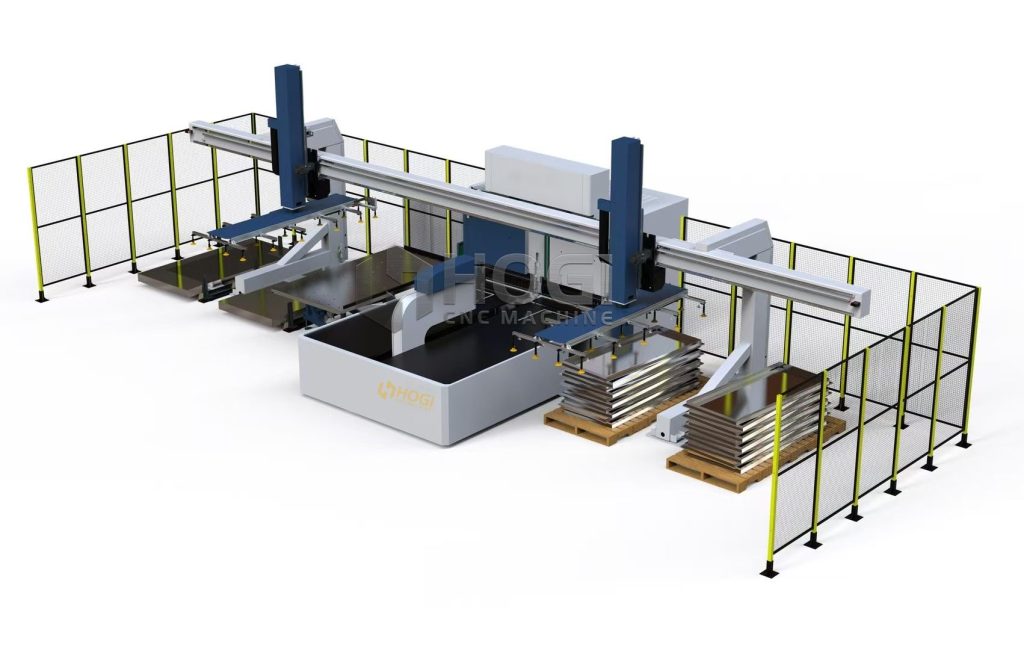
HOGI Bending Centers specialize in solving complex sheet metal forming and bending challenges in metal fabrication. It finds extensive application in steel cabinet enclosures (file cabinets, tool cabinets, protective covers, electrical cabinets, communication cabinets, gas cabinets, water meter cabinets…), kitchen appliances (refrigerators, air conditioners, stoves…), furniture, ventilation, refrigeration, purification, door manufacturing, decoration, elevators, and other related metal forming sectors. It is suitable for bending diverse types of workpieces.
Smart Flexible Bending Center Feeding System: (Multiple options available) Suction cup feeding offers simplicity, convenience, ease of operation, and safety.
The Smart Flexible Bending Center features extensive hardware and software interfaces, enabling integration with standard robotic arms available on the market. Specific models can be selected based on the user’s actual requirements. It supports various loading/unloading methods: manual loading/unloading, gantry robot loading/unloading, and robotic arm loading/unloading.
The intelligent flexible bending center employs universal bending dies. Through multi-axis concurrent servo control, it achieves bending of various shapes, including complex forms. It can bend right angles, non-right angles, arcs, upward/downward folds, and other complex combinations.
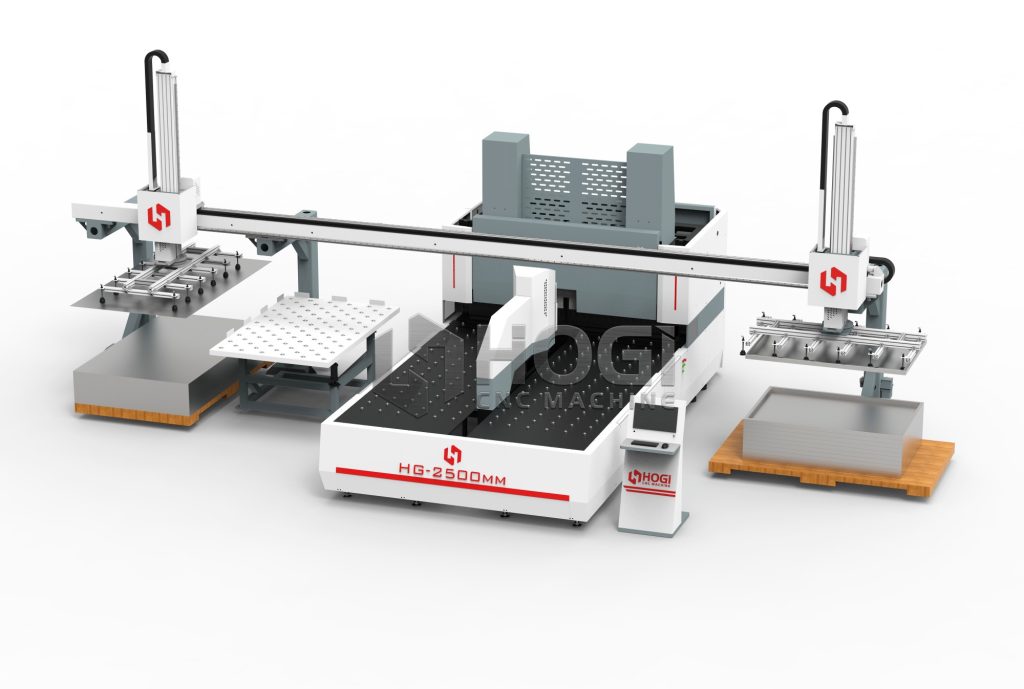
Core Components and Production Process
1.Bending Machine: Multi-axis fully servo-driven, equipped with universal universal bending dies for tooling changes without stopping production; integrated angle correction, sheet thickness/offset load detection, and deflection compensation, achieving precision up to ±0.1mm.
2.Automated Loading/Unloading System: Primarily utilizes six-axis robotic arms (cycle time ≤8 seconds, positioning accuracy ±0.2mm) or gantry manipulators, integrated with 3D vision positioning, to automatically perform raw material retrieval, positioning, finished product unloading, and palletizing.
3.Intelligent Control and Software: Supports offline programming, 3D simulation, and adaptive process libraries; integrates with MES/ERP systems to enable cloud-based monitoring, predictive maintenance, and data traceability.
4.Typical Process: Raw Material Warehouse → Automatic Feeding → Vision Positioning → Multi-Axis Bending → Automatic Unloading → Palletizing / Sorting, with minimal or no human intervention throughout the entire process.
Pre-production Preparation Phase
1.Process Programming and Import: Engineers import 3D drawings of workpieces via offline programming software to generate bending process paths, angle parameters, and press brake compensation values, then transmit these to the equipment control system; they also call upon the process library to match sheet metal material and thickness parameters.
2.Fixture and Material Preparation: Confirm universal bending die is in position (no die change required). Inspect automatic loading/unloading grippers/suction cups for compatibility with sheet specifications. Neatly stack raw material sheets into the automatic loading magazine and calibrate positioning reference points.
3.System Self-Test and Calibration: Perform full-axis zero return upon startup, 3D vision positioning calibration, robotic arm travel limit detection, and safety light curtain verification. Simulate single-step bending operations to confirm no interference.
Automated Production Execution Phase (Closed-Loop Process)
1.Automatic Feeding: The gantry/six-axis robotic arm retrieves sheet metal from the storage area. Through vision scanning, it completes sheet positioning, dimensional correction, and front/back identification before precisely delivering the material to the bending center workstation.
2.Flexible Bending Processing: Multi-axis servo-linked equipment performs continuous bending according to preset processes, automatically compensating for deflection and correcting bending angles in real time. The entire process requires no manual intervention and no downtime for die changes.
3.Automatic Unloading and Transfer: After bending is complete, the robotic arm picks up the finished parts, removes scrap/defective pieces, and stacks qualified parts onto unloading pallets or conveyor lines.
4.Online Inspection (Optional): Equipped with laser goniometer/vision inspection systems to perform sampling/full inspection of finished product bending angles and dimensional accuracy. Data is transmitted back to the system for closed-loop process correction.
Final stages of production
1.Automatic clearing: Robotic arm removes residual materials from the workbench, while material inventory and counting statistics are tracked in the storage area and unloading zone.
2.Data Archiving: Equipment automatically logs processing quantities, labor hours, process parameters, and anomaly records, uploading them to the MES/ERP system to enable production traceability.
3.quipment Standby / Shutdown: After completing an order, the equipment enters an energy-saving standby state; following the conclusion of batch production, perform routine maintenance and shut down the system.
Production Process and Core Features
1.Fully automated/unmanned operation throughout the entire process, requiring only one pre-production programming session per batch
2.Changeovers require only switching process files, eliminating mold changes for flexible adaptation to multiple product varieties.
3.Full data traceability, compatible with smart factory digital management systems
Core Competencies and Product Advantages #panelbender
Production Efficiency Advantage
- Rapid changeover: A single universal mold adapts to multiple workpiece specifications, eliminating downtime for mold changes and reducing changeover time from hours to minutes.
- Continuous Unmanned Operation: Automated loading/unloading + automatic bending + automated palletizing, enabling 24/7 continuous operation with single-shift output far exceeding traditional bending machines.
- Stable cycle time: Robot cycle time ≤ 8 seconds, eliminating manual operation fluctuations for consistent yield rates
Cost and Investment Advantages
1.Labor Replacement: A single machine replaces 5–10 traditional bending operators, significantly reducing labor costs.
2.Reduced consumables: Eliminates frequent mold changeover losses and extends mold lifespan; precise process compensation significantly lowers scrap rates.
Quality and Precision Advantage
1.Full servo closed-loop control: Real-time bending angle compensation with precision up to ±0.1mm, ensuring high batch consistency.
2.Automatic alignment correction: Integrates sheet thickness detection, deflection compensation, and vision-based positioning to eliminate manual clamping errors.
3.No impact damage: Automated gripping and transfer prevents scratches and deformation on sheet metal surfaces.
Digitalization and Adaptability Advantages
1.Supports offline programming and 3D simulation, enabling zero trial-and-error before production.
2.Interoperable with MES/ERP/WMS systems to enable full production data traceability and cloud-based monitoring
3.Compatible with cold-rolled steel, stainless steel, aluminum, copper, and other materials, suitable for sheet metal components across multiple industries.
Product Features
Flexible characteristics
1.A single machine accommodates multi-product, small-batch, and mixed-batch production lines.
2. No special dies required for straight-angle, curved, crimped, and irregular bending
3.Adapt to different sheet sizes with flexible switching of workpiece specifications
Features of Automation
·Standard 3D vision positioning with automatic skew correction, front/back recognition, and material shortage detection
Gantry / Six-axis robotic arm coordination to complete the entire process: loading → positioning → bending → unloading → palletizing
Features automatic material clearing, abnormal alarm, and safety interlock functions
Structural and Operational Maintenance Characteristics
1.Compact body with minimal footprint, suitable for retrofitting traditional factories and smart workshops
2.Fully servo-driven, low energy consumption, and quiet operation
3.Predictive maintenance and self-diagnostic capabilities reduce downtime risks and simplify operations and maintenance.
Security Compliance Features
Equipped with triple safety protection: safety light curtains, laser scanning, and mechanical limit switches
Complies with industrial safety standards, ensuring unmanned operation with no operational safety hazards
Application Industries:
Core Mainstay Industries
1.Sheet Metal Fabrication and Custom Sheet Metal: Designed for high-mix low-volume production and rapid changeover requirements, it accommodates various non-standard enclosures, cabinets, and structural components, serving as a core application scenario for equipment.
2.New Energy Equipment: New energy cabinets, battery boxes, energy storage cabinets, photovoltaic mounting structures/enclosures, demanding high precision, consistency, and automated production.
3.Elevator Manufacturing: Bending components such as elevator door panels, car wall panels, door frames, and control panels, characterized by stable batch production and high standardization of specifications.
4.HVAC / Air Conditioning: Air conditioner outdoor casings, evaporator/condenser sheet metal, ventilation ducts, fan housings—suitable for high-efficiency bending of thin sheets.
5.Electrical Equipment: High and low voltage switchgear cabinets, box-type transformer enclosures, terminal boxes, and electrical cabinet frames require strict bending precision and structural strength.
Key Extended Industries
1.Smart Home & Kitchen & Bath: Stainless steel cabinets, bathroom hardware, smart appliance housings, washing machine control panels, cooktop panels.
2.Construction Machinery / Agricultural Machinery: Excavator guards, agricultural machinery covers, hydraulic oil tank housings, construction machinery cab sheet metal components.
3.Automotive and Components: Commercial Vehicle / New Energy Vehicle Body Panels, Battery Pack Enclosures, Chassis Sheet Metal, Charging Station Housings.
4.Logistics and Warehousing Equipment: Shelf uprights / beams, logistics containers, sorting machine sheet metal, storage cages, industrial cart components.
5.Electronic Enclosures: Server chassis, communication base station housings, 5G cabinets, electronic instrument enclosures, suitable for precision thin-sheet bending.
Other General Industries
Medical devices (equipment enclosures, examination table casings, medical cart sheet metal)
Security equipment (surveillance cabinets, access control enclosures, security boxes)
Office furniture (steel desks, filing cabinets, partition sheet metal)
Rail transit (subway/high-speed rail interior sheet metal, equipment enclosures, platform screen door components)