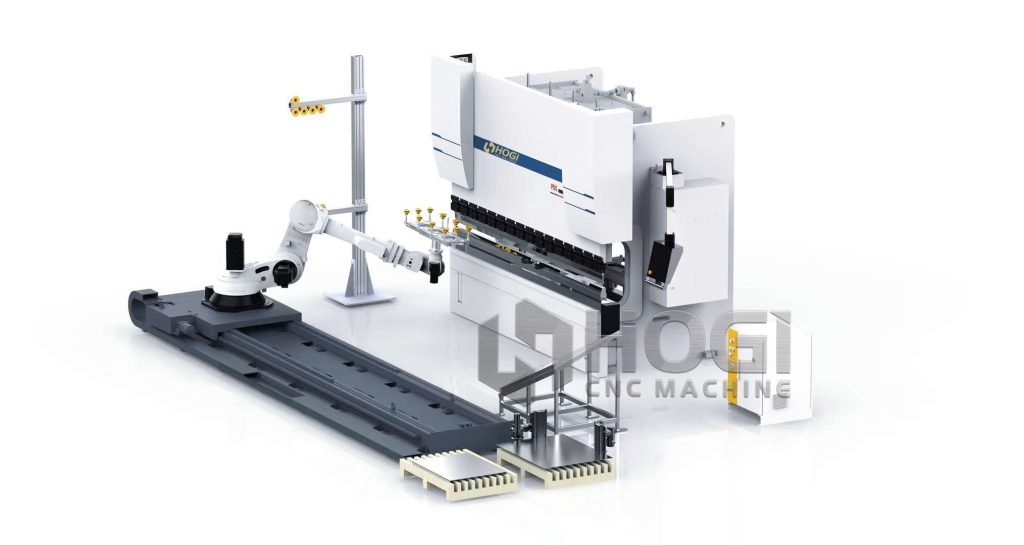
Amid the wave of traditional manufacturing transitioning toward intelligent transformation, fully automated robotic bending machine factories are emerging as a key breakthrough in the metal processing sector. By integrating industrial robots, intelligent control systems, and high-precision bending equipment, these factories achieve full-process automation from raw material feeding to finished product output. Compared to traditional manual operations, processing efficiency increases by 3-5 times, with product precision maintained within ±0.1 millimeters. Capable of continuous 24-hour operation, these factories provide highly efficient and reliable solutions for industries including automotive, home appliances, and aerospace. #robotbendingmachine
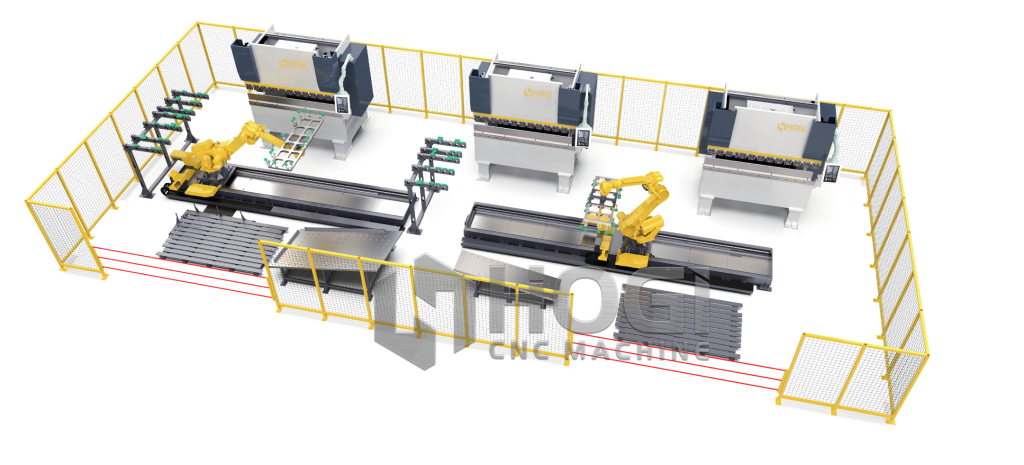
Core Equipment: Intelligent Collaboration Between Robots and Bending Machines The core of the fully automated robotic bending machine lies in the deep collaboration between “robots and bending machines.” Industrial robots precisely locate sheet metal positions through vision recognition systems, while specialized end-effectors at the robotic arm’s tip adapt to metal plates of varying thicknesses and materials. The bending machine employs servo motor drives coupled with multi-axis motion control systems to execute complex angle bending operations according to preset programs. For instance, in automotive sheet metal processing, the system can simultaneously handle multiple bending surfaces, reducing single-piece processing time from 15 minutes in traditional methods to just 3 minutes.
Three Major Technological Advantages Redefine Manufacturing Logic
1. Dual Enhancement of Precision and Stability: Manual bending is prone to operator fatigue and skill variation, whereas robotic programming ensures consistent angle and depth for every bend. Data from an appliance manufacturer shows that adopting fully automated bending reduced defect rates from 2.3% to 0.5%, significantly cutting rework costs.
2. Flexible Production Capability: Through rapid tooling change systems and digital twin technology, factories can switch between different product lines within 10 minutes. For example, transitioning from air conditioner casing bending to elevator door panel processing requires only adjusting robot path parameters and bending die settings—no equipment re-calibration needed.
3. Data-Driven Closed-Loop Optimization: Real-time data—including torque, displacement, and temperature—generated during processing is uploaded to the cloud. AI algorithms analyze this data to predict equipment wear and optimize process parameters. After implementation at one factory, Overall Equipment Effectiveness (OEE) increased by 18% while maintenance costs decreased by 25%.
HOGI Robotics: Premium Manufacturer of Fully Automatic Bending Machines – Setting New Industry Standards Through Technological Innovation
Amidst the wave of intelligent transformation in manufacturing, robotic fully automatic bending machines have emerged as core equipment in metal processing due to their high precision and efficiency. By integrating robotic arms, CNC systems, and sensor technology, these machines achieve full automation from sheet positioning to bending forming. This not only significantly boosts production efficiency but also propels the industry toward flexible, customized manufacturing. Selecting a premium manufacturer with solid technical expertise and reliable service is a critical step for enterprises seeking to reduce costs and enhance efficiency.
I. Core Advantages of Fully Automated Robotic Bending Machines: Dual Breakthroughs in Efficiency and Precision
Traditional bending processes rely on manual operation, resulting in low efficiency and inconsistent product quality due to variations in worker skill levels. In contrast, fully automated robotic bending machines achieve millimeter-level error control through precise positioning of robotic arms and real-time feedback from CNC systems, making them particularly suitable for mass-producing high-precision components. For instance, in automotive sheet metal processing, this equipment rapidly completes complex curved surface bending. Single-piece processing time is reduced by over 60% compared to traditional equipment, while scrap rates are controlled below 1%. Furthermore, its 24/7 continuous operation capability further unlocks production potential, helping enterprises manage peak order pressures.
II. Technical Expertise of Premium Manufacturers: Comprehensive Optimization from Hardware to Software
Assessing a manufacturer’s quality requires evaluation across three dimensions: First, hardware configuration—including robotic arm load capacity, servo motor response speed, and bending die material and precision. For instance, equipment with high-rigidity cast iron frames effectively minimizes vibration impacts on processing accuracy. Second is the software system: premium CNC systems must support multi-axis coordination, path optimization, and self-diagnostic functions to ensure stability under complex conditions. Finally, customization capability is crucial—industries vary significantly in bending angle, depth, and speed requirements. A manufacturer’s ability to adjust equipment parameters according to client process needs directly determines its market competitiveness.
III. Industry Applications: Broad Coverage from Automotive Manufacturing to Home Appliance Production
Robotic fully automatic bending machines have penetrated multiple sectors. In the automotive industry, they process large sheet metal components like doors and hoods, collaborating with welding robots to achieve automated production of body-in-white. In home appliances, these machines rapidly bend refrigerator shells and air conditioner panels, meeting flexible production demands for small batches and diverse product lines. In aerospace, their capability to process high-strength materials like titanium and aluminum alloys provides technical support for lightweight structural component manufacturing. Statistics show that companies adopting fully automatic bending machines reduce product delivery cycles by an average of 40% and cut labor costs by over 50%.
IV. How to Select High-Quality Manufacturers: Triple Verification of Technology, Service, and Reputation
Faced with numerous manufacturers in the market, enterprises should conduct a three-step screening process: First, verify technology by requesting sample parts processed by the equipment or visiting their client sites to directly assess precision and stability. Second, evaluate service capabilities, including pre-sales customization, in-sales installation and commissioning, and post-sales maintenance response times—reputable manufacturers typically offer on-site service within 72 hours. The third step involves reputation reference, leveraging industry forums and case studies to understand the manufacturer’s standing among peers, thereby avoiding project delays or cost overruns due to poor selection.
The intelligent upgrade of manufacturing relies on advanced equipment. Selecting a high-quality manufacturer of robotic fully automatic bending machines with proven technology and reliable service is not only key to boosting production efficiency but also a crucial step toward Industry 4.0. If you’re seeking a suitable partner, consider the above dimensions alongside your specific needs to make a more informed decision.
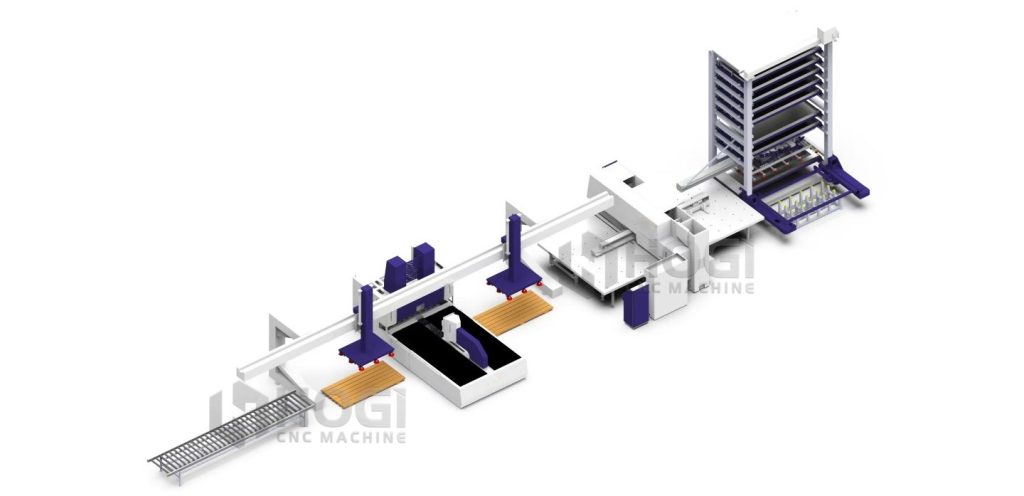
Application Scenarios: From Mass Production to Custom Manufacturing
In the automotive sector, robotic fully automatic bending machines achieve high-precision processing of complex curved surfaces like bumpers and wheel arches. In home appliances, they swiftly respond to small-batch, multi-variety orders—such as custom door bending solutions for different refrigerator models. In aerospace, their processed titanium and aluminum alloy components are used in critical structures like aircraft landing gear and satellite mounts. Notably, by integrating with 3D printing, some factories have achieved “print-bend-assemble” integrated production, reducing new product development cycles by 60%.
Future Trends: Advancing Toward “Dark Factories”
With the convergence of technologies like 5G, digital twins, and edge computing, fully automated robotic bending machine factories are evolving into “dark factories.” Future facilities will achieve end-to-end unmanned operations featuring autonomous equipment decision-making, automated material delivery, and real-time quality inspection. For instance, seamless integration between AGVs and robots reduces raw material transport time from warehouse to processing station to just 30 seconds. Utilizing augmented reality (AR) technology, engineers can remotely debug equipment in virtual environments, resolving over 80% of routine malfunctions.
Transitioning from “replacing humans with machines” to “empowering with intelligence,” fully automated robotic bending machine factories are redefining the boundaries of metal processing. For manufacturing practitioners, understanding this technological trend is not only key to navigating industry shifts but also essential for enhancing competitiveness. Whether upgrading traditional factories or planning new production lines, breakthroughs can be found in this domain. Now is the time to delve deeper into this technology and inject new momentum into your enterprise’s transformation and upgrading!
As the wave of smart manufacturing sweeps across the globe, sheet metal processing—a traditional manufacturing segment—is undergoing profound transformation. From automotive bodies to communication equipment enclosures, from appliance casings to precision instrument brackets, sheet metal products are ubiquitous. Driving this sector’s shift from labor-intensive to technology-intensive operations are sheet metal automation enterprises—by integrating robots, intelligent software, and advanced processes, they inject new momentum of efficiency, precision, and flexibility into manufacturing.
Core Value of Sheet Metal Automation Enterprises: Solving Traditional Processing Pain Points
Traditional sheet metal processing relies on manual operation of punch presses, bending machines, and welding equipment, suffering from three major issues: First, low efficiency with lengthy processing cycles per piece; second, insufficient precision with manual error rates as high as 5%-10%; third, poor flexibility, struggling to adapt to small-batch, multi-variety customization demands. By integrating industrial robots, 3D laser cutters, and intelligent bending units, sheet metal automation enterprises establish digital production lines that boost processing efficiency by 3-5 times while maintaining precision within ±0.1mm. These systems enable 24/7 continuous operation and rapid changeovers, fundamentally transforming traditional manufacturing models.
Technological Convergence: The Three ‘Ace in the Hole’ of Automation Enterprises
The competitiveness of sheet metal automation enterprises stems from three key technological convergences: First, the synergy between robots and vision systems, where 3D vision guides robots to grasp and weld complex curved surfaces, solving the challenge of processing irregularly shaped parts. Second, digital twin technology, which simulates manufacturing processes in virtual environments to optimize process parameters in advance, reducing trial-and-error costs. Third, IoT and big data analytics, enabling real-time monitoring of equipment status and production data to achieve predictive maintenance and quality traceability. For instance, one company deployed smart sensors to reduce equipment failure rates by 40%, saving over one million yuan annually in maintenance costs.
Industry Impact: The Leap from ‘Manufacturing’ to ‘Smart Manufacturing’
The rise of sheet metal automation enterprises has not only reshaped production processes but also driven upgrades across the entire industrial chain. For downstream customers, automated production means shorter delivery cycles, more stable quality, and lower overall costs. For upstream suppliers, it drives raw material standardization and supply chain collaboration. More profoundly, this transformation is lowering manufacturing barriers—small and medium-sized enterprises can now compete on equal footing with large corporations by leasing automated equipment or adopting modular solutions. Statistics show that companies adopting automation achieve an average 60% reduction in product defect rates and 75% decrease in customer complaints.
Amid the wave of traditional manufacturing transitioning toward intelligent transformation, sheet metal automation factories are reshaping the metal processing industry with their unique technological allure. From automotive bodies to home appliance casings, from precision instruments to architectural decorations, sheet metal products are ubiquitous. The integration of automation technology not only significantly boosts production efficiency but also pushes processing precision beyond the limits of human manual operation. This article takes you inside these factories to uncover the technological secrets behind their high-efficiency operations.
Automated Equipment: The “Intelligent Brain” of Sheet Metal Processing
Traditional sheet metal processing relied on standalone equipment like punch presses and shears, requiring operators to manually position sheets and adjust parameters—a process that was not only inefficient but also demanded extremely high skill levels. The core advantage of automated manufacturing plants lies in their intelligent production lines, comprising CNC machines, laser cutters, robotic bending systems, and automated welding lines. For instance, laser cutters instantly melt metal with high-energy beams, achieving millimeter-level precision through CNC systems—cutting 3-5 times faster than traditional punches. Robotic bending systems automatically execute complex shapes via multi-axis coordination, maintaining tolerances within 0.1 millimeters. This collaborative operation propels sheet metal processing from the “manual era” into the “intelligent era.”
Data-Driven: From “Experience-Dependent” to “Precision Control” Another major breakthrough in automated manufacturing plants is the full-process digital management of production data. Previously, workers adjusted equipment parameters based on experience. Now, the Manufacturing Execution System (MES) collects real-time operational data from each machine—including processing speed, energy consumption, and tool wear—and analyzes it through algorithms to optimize production workflows. For instance, when the system detects reduced cutting efficiency in a laser cutter, it automatically prompts replacement of the cutting head. During order surges, it dynamically adjusts production line cadence to ensure seamless workflow integration. This “data-driven” model not only minimizes human error but also boosts production efficiency by over 40%. Flexible Production: The “Savior” for Small-Batch Orders In the era of personalized consumption, market demand for sheet metal products is increasingly diverse, with small-batch, multi-variety orders growing in prominence. Traditional factories often struggle to handle such orders due to high equipment changeover costs. Automated manufacturing plants, however, achieve production line flexibility through modular design and rapid tooling change technology. For instance, robotic bending systems can pre-program multiple bending sequences. Switching products requires only loading the corresponding program, reducing changeover time from two hours to just ten minutes. Laser cutters can rapidly adjust cutting paths via software without tooling changes. This flexibility enables factories to simultaneously process dozens of different specifications, meeting the market’s demand for “customization.”