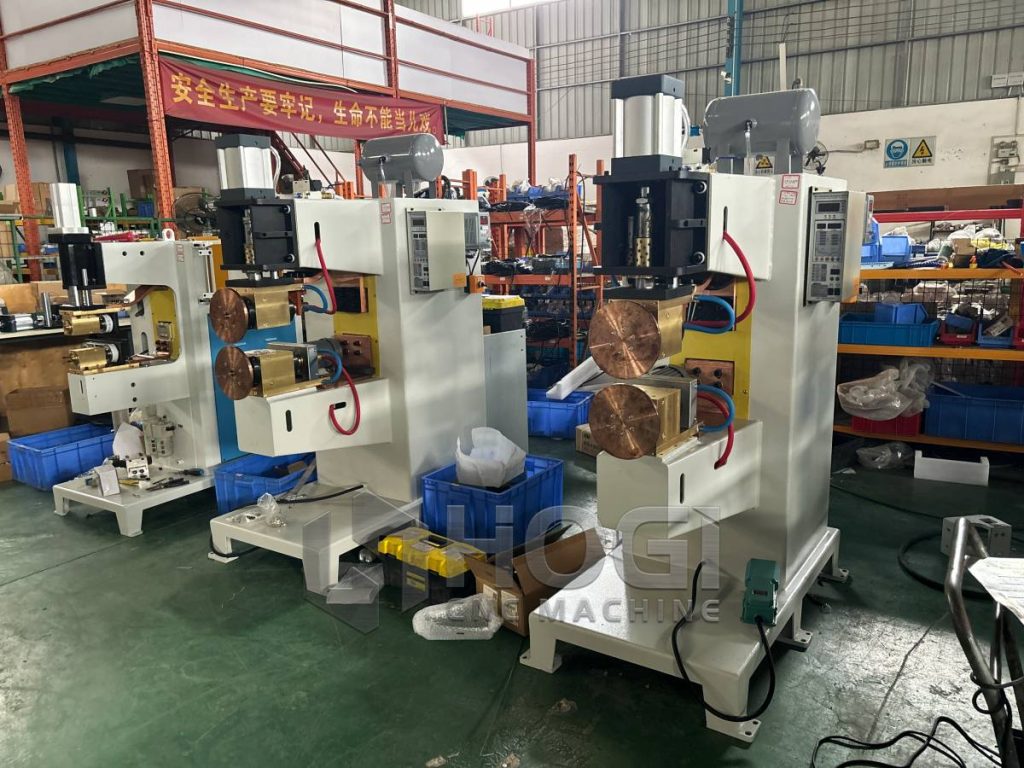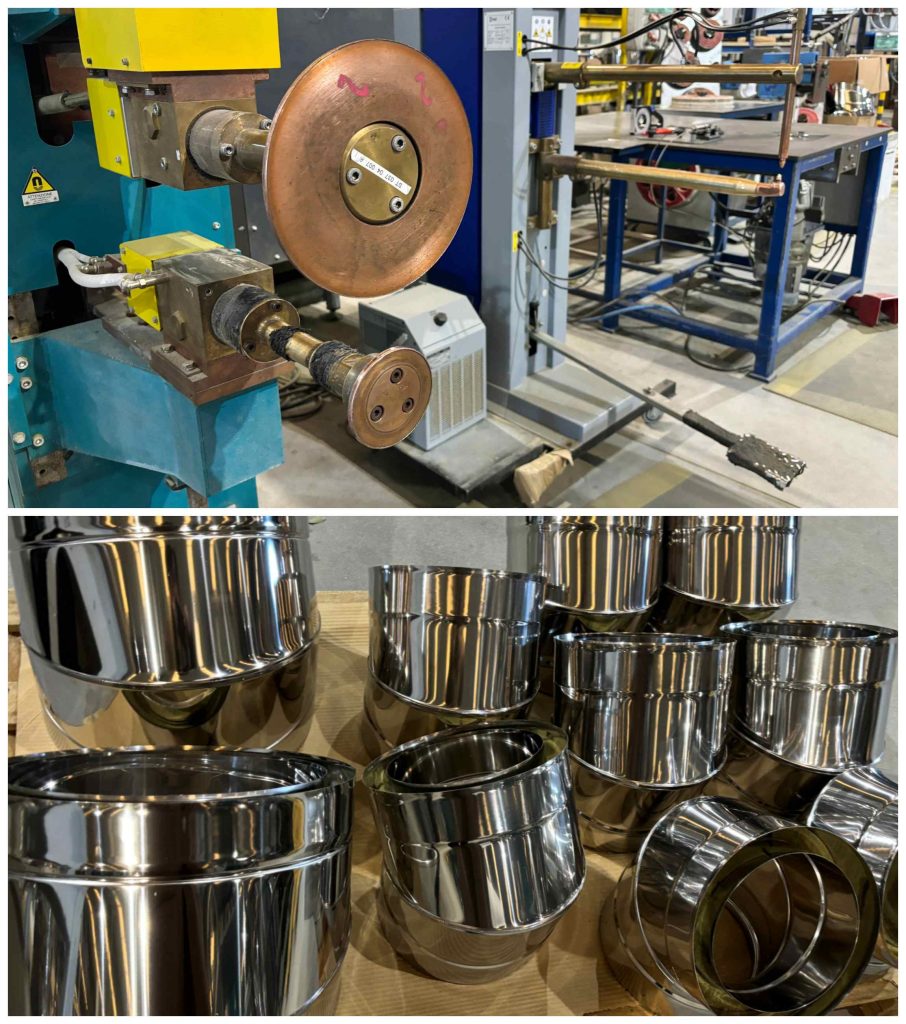
In automotive, home appliance, and metal structural component manufacturing, traditional power-frequency spot welders often cause issues such as excessive spatter, unstable weld cores, and rapid electrode wear due to significant current fluctuations, slow response times, and high energy consumption. These problems not only compromise welding consistency but also drive up rework and maintenance costs. Meanwhile, medium-frequency spot welders, leveraging high-frequency DC output and millisecond-level control capabilities, are rapidly becoming standard equipment in automated production lines. Hogi Company outlines their three core advantages.
- Welding quality is more stable, particularly suited for high-strength materials. Conventional welding machines output 50Hz AC, with thermal input interrupted at each zero-crossing point per half-cycle. In contrast, Haifei’s medium-frequency spot welding machines rectify grid AC into DC output exceeding 1000Hz, featuring current ripple <5% and energy repeatability accuracy of ±2%. When welding materials such as galvanized steel sheets and DP980 high-strength steel, the CPK value for fusion diameter increases from 0.9 with power frequency welders to over 1.6, meeting the stringent standards of OEMs.
- Energy-efficient and high-performance, reducing overall operating costs Medium-frequency inverter technology significantly reduces core and copper losses. Haifei medium-frequency spot welders save 30%–50% more energy than conventional power-frequency machines of equivalent capacity. Based on a single unit welding 5,000 spots daily, annual electricity savings exceed ¥12,000. Additionally, high thermal efficiency extends electrode lifespan by 2–3 times, reducing downtime for cap replacement and improving OEE.
- Rapid Response, Seamless Robot Integration Conventional power frequency welders typically have discharge cycles ≥0.3 seconds, making them incompatible with high-speed robotic cycles. Haifei’s medium-frequency spot welders achieve discharge times as short as 0.05 seconds, enabling simultaneous movement and charging. They integrate seamlessly with robots from FANUC, ABB, and others. After retrofitting a white body production line, single-station cycle time decreased from 48 seconds to 36 seconds, boosting annual capacity by 25%. IV. Intelligent Control and Data Traceability for Smart Manufacturing Built-in SPC modules continuously capture parameters like current, voltage, pressure, and dynamic resistance. Data is automatically archived by VIN code or batch for quality traceability and process optimization. This fulfills IATF 16949 and customer flight audit requirements—capabilities unattainable with conventional welders. Conclusion: Not an “Update,” but an ‘Upgrade’ The adoption of medium-frequency spot welders represents more than equipment replacement—it signifies a leap in manufacturing philosophy from merely “being able to weld” to achieving “high-quality, stable, and fully controllable welds.” For modern factories pursuing high quality, efficiency, and low costs, this transformation is inevitable.
Performance Advantages of Medium-Frequency Inverter DC Resistance Welding Machines:
The medium-frequency inverter DC resistance welding control system converts three-phase AC power into DC after rectification. This DC is then inverted into a 100Hz square wave via an IGBT-based inverter circuit, which is fed into the primary winding of the welding transformer. The transformer steps down and rectifies this waveform into a DC output with minimal ripple, supplying the electrodes to weld the workpieces. The inverter adjusts the duty cycle of the IGBTs based on feedback from the primary or secondary welding current, thereby achieving constant current throughout the welding process.
The welding transformer features significantly reduced weight and extended electrode life, enabling effective welding of materials such as aluminum and galvanized metals with excellent results. It is particularly suited for three-layer board welding, extremely thin materials, and precision welding applications: minimal spatter and enhanced current control improve joint quality.
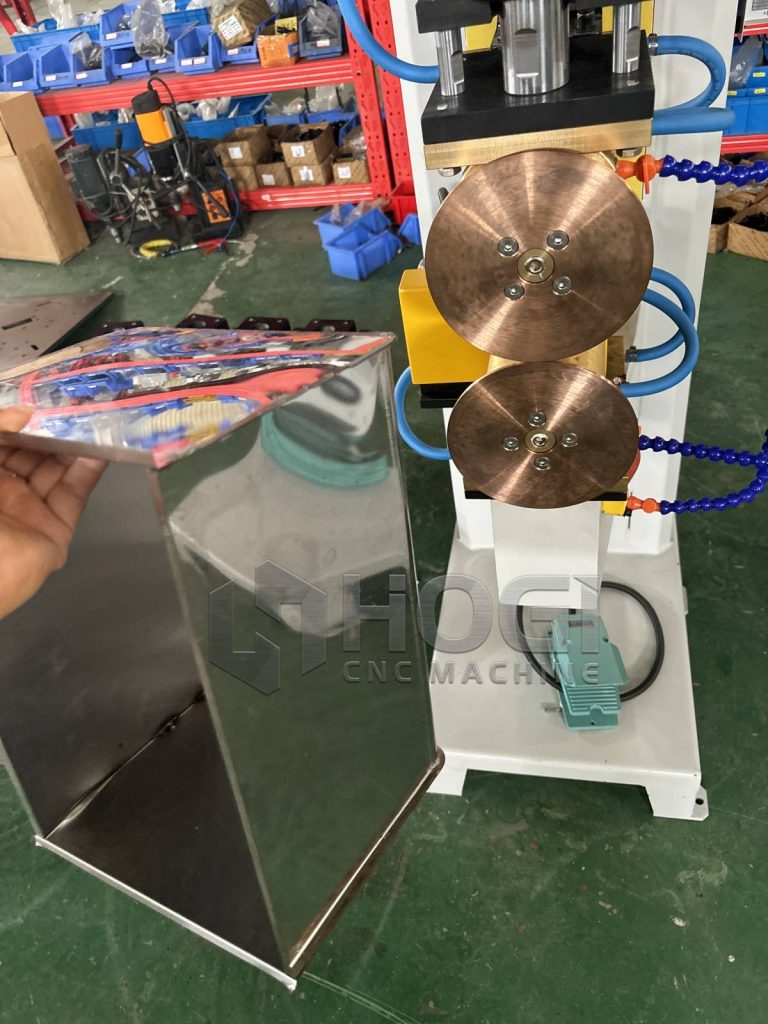
Keywords: Medium-frequency DC spot welder, Medium-frequency DC projection spot welder, AC/DC spot welder, Medium-frequency DC resistance welder, Medium-frequency welder, Medium-frequency welding.
Medium-frequency spot welders are advanced welding equipment widely used in modern industrial production.
Compared to traditional welding equipment, medium-frequency spot welders have secured a significant position in the field of metal material welding due to their unique advantages.
HGMF-50 Medium-Frequency DC Spot Welder Product Name Medium-Frequency Spot Welder Equipment Application Beyond welding common materials like steel, iron, and stainless steel, it is widely used for welding non-ferrous metals such as copper, silver, nickel, and their alloys. It is particularly suitable for spot welding high-strength steel, hot-formed steel, galvanized sheet metal, and spot welding of nuts and bolts. Product Model HGMF-50 Maximum Short-Circuit Current 18KA Rated Duty Cycle 20% Secondary Voltage 9.6V Rated Capacity 80kVA.
- Working principle
The working principle of medium-frequency spot welders primarily relies on electromagnetic induction heating technology. During welding, the medium-frequency power supply converts utility-frequency AC power into medium-frequency AC power. This electrical energy is then transformed into the medium-frequency DC required for welding via a transformer and rectifier. This DC current is then transmitted through electrodes to the workpieces to be joined. The resistance heat generated as current flows through the workpieces (Q = I^2Rt) rapidly heats the contact surfaces to a molten state. Applying pressure via the electrodes fuses the molten metals together, achieving the welding objective.
- Technical features
- High Efficiency and Energy Savings: Medium-frequency spot welders utilize medium-frequency power supplies, featuring high power factor and superior energy conversion efficiency. Compared to traditional welding equipment, they deliver significant energy savings. Additionally, these welders offer rapid heating and high welding efficiency, shortening production cycles and boosting overall productivity.
- Welding Quality Stability: During the welding process, medium-frequency spot welders maintain stable current and voltage waveforms, making welding parameters easy to control and ensuring consistent weld quality. Additionally, these welders offer advantages such as minimal welding spatter, reduced deformation, and a low defect rate.
- Easy to Operate: The medium-frequency spot welder employs an advanced control system that enables automated adjustment of welding parameters and real-time monitoring. Simultaneously, the equipment is simple to operate and easy to master, reducing operational complexity and skill requirements.
- Environmental Protection and Energy Efficiency: Medium-frequency spot welders generate minimal noise and fumes during operation, resulting in low environmental impact. Additionally, the equipment incorporates energy-saving designs that reduce energy consumption and production costs.
- Application areas
Medium-frequency spot welders are widely used in automotive manufacturing, home appliance production, hardware manufacturing, aerospace, and other industries.
In the automotive manufacturing sector, medium-frequency spot welders are primarily used for body welding, chassis welding, and similar processes;
In the home appliance manufacturing sector, medium-frequency spot welders are mainly employed for welding the outer casings of appliances such as refrigerators and washing machines;
In the hardware manufacturing sector, medium-frequency spot welders are chiefly utilized for welding and joining metal materials;
In the aerospace sector, medium-frequency spot welders are applied for precision welding in aircraft, rockets, and other aerospace vehicles.
- Future Development
With continuous advancements in industrial technology and growing demand for welding applications, the development prospects for medium-frequency spot welders are exceptionally promising. In the future, medium-frequency spot welders will evolve toward greater efficiency, environmental sustainability, and intelligent operation. Specifically, future medium-frequency spot welders will feature the following characteristics:
- Intelligent: By incorporating advanced control and sensor technologies, the system enables automatic adjustment and optimization of welding parameters, thereby enhancing welding quality and efficiency. Additionally, the equipment will feature remote monitoring and fault diagnosis capabilities, facilitating user-friendly equipment management and maintenance.
- Modular Design: Future medium-frequency spot welders will adopt a modular design, making equipment maintenance and upgrades more convenient. Additionally, this modular approach reduces both manufacturing and repair costs.
- Green and Eco-Friendly: Future medium-frequency spot welders will place greater emphasis on environmentally friendly and energy-efficient design. For instance, adopting more sustainable materials and manufacturing processes to reduce environmental pollution during production and operation; optimizing energy consumption structures to enhance energy utilization efficiency; and so forth.
- Diversification: As market demands continue to evolve and upgrade, future medium-frequency spot welders will move toward diversification. For instance, developing medium-frequency spot welders suitable for different materials and processes; expanding the application of equipment in fields such as new energy and new materials.
In summary, as an advanced welding device, medium-frequency spot welders play an increasingly vital role in modern industrial production. Looking ahead, with continuous technological advancements and growing market demand, medium-frequency spot welders will maintain their leading position and find broader applications across more industries.
- Characteristics of Roll Welding Machines Roll welding machines are highly efficient and precise welding equipment, featuring the following key characteristics:
- Efficiency: The roll welding machine employs advanced welding technology to complete large-scale welding tasks in minimal time, significantly boosting production efficiency.
- Precision: Equipped with a precise control system, the roll welding machine ensures stable parameters throughout the welding process, delivering high-quality welds.
- Automation: Featuring automated devices, the roll welding machine enables automated feeding, welding, and unloading, reducing labor costs, minimizing human intervention, and enhancing product quality.
- Flexibility: Suitable for welding diverse materials like stainless steel and aluminum alloys, while accommodating various workpiece shapes, offering strong versatility.
- The working principle of a roll welding machine primarily involves the following steps:
- Preparation: Position the workpiece to be welded on the roller welding machine’s workbench. Adjust the workpiece’s position and angle to ensure alignment with the welding rollers.
- Roller Movement: After starting the roller welding machine, the welding rollers begin rotating and advancing forward, making contact with the workpiece surface while applying controlled pressure.
- Welding Process: During movement, the friction heat generated by the welding rollers melts the workpiece surface to achieve fusion. The machine’s internal control system adjusts welding speed and temperature according to preset parameters to ensure weld quality.
- Cooling and Solidification: After welding, the workpiece requires sufficient time for cooling and solidification to ensure the strength and stability of the welded joint.
- Applications of Roll Welding Machines Roll welding machines are widely used across various industrial sectors, including but not limited to the following areas:
- Automotive Manufacturing: Roll welding machines play a vital role in the automotive industry, welding components such as vehicle bodies and chassis to ensure structural integrity.
- Shipbuilding: Roll welding machines are suitable for welding large steel plates in shipbuilding, enhancing welding efficiency and quality to ensure vessel safety and stability.
- Petrochemical Industry: In petrochemical applications, roll welding machines are frequently used for welding pipelines, storage tanks, and other equipment to meet stringent requirements for sealing integrity and corrosion resistance.
- Power Equipment: Roll welding machines also find extensive use in power equipment manufacturing, such as welding transformers and switchgear, ensuring the reliable operation of electrical systems.
- Advantages of Roll Welding Machines Compared to traditional welding methods, roll welding machines offer the following advantages:
- Enhanced Production Efficiency: The roll welding machine employs automated production methods, significantly boosting production efficiency while reducing manufacturing costs.
- Improved Product Quality: Equipped with precise control systems and stable welding parameters, the roll welding machine ensures high-quality welded joints and minimizes defect rates.
- Reduced Labor Intensity: By automating the welding process, the roll welding machine lowers physical demands on workers and improves the working environment.
- High Adaptability: Suitable for welding diverse materials and workpiece shapes, roll welding machines offer strong versatility and adaptability.
Roll welding machines, as highly efficient and precise welding equipment, play a vital role in industrial production.
With the advancement of technology and industrial development, roll welding machines will continue to undergo optimization and upgrades, bringing greater convenience and value to industrial production.
- Input power parameters
The input power parameters for medium-frequency spot welders primarily include voltage and frequency. Typically, the input voltage is three-phase 380V, with a frequency of 50Hz. These parameters form the foundation for the equipment’s normal operation. Users should ensure compatibility with local power supply conditions when selecting and using the equipment.
- Rated power
Rated power is one of the key parameters for medium-frequency spot welders, determining the equipment’s welding capacity and load capability. Typically, the rated power of medium-frequency spot welders ranges from 10 to 200 kVA, with specific values depending on the model and application. When selecting equipment, users should determine the required rated power based on actual production needs and factors such as the thickness and material properties of the workpiece.
- Welding Current and Welding Time
Welding current and welding time are two critical parameters for medium-frequency spot welders, directly impacting welding quality and efficiency. The magnitude of welding current should be determined based on the thickness and material properties of the workpiece, as well as the required weld strength. Generally, higher welding current enables faster welding speeds, but excessively high current may compromise weld quality. Welding time refers to the duration during which current flows through the workpiece, determining the heat-affected zone and the properties of the welded joint. The selection of welding time should be based on factors such as the material’s thermal conductivity, workpiece thickness, and the required weld strength.
- Electrode Pressure and Electrode Stroke
Electrode pressure refers to the force exerted by the electrode on the workpiece during welding. It enhances the tightness of the welded joint and prevents spatter generated during the welding process. The magnitude of electrode pressure should be determined based on the hardness and thickness of the welded material, as well as the required weld strength. Electrode travel, on the other hand, denotes the distance the electrode moves during welding, which dictates the shape and dimensions of the welded joint.
- Cooling System
Medium-frequency spot welders generate significant heat during operation. To ensure the stability and longevity of the equipment, a corresponding cooling system must be installed. The primary function of the cooling system is to reduce equipment temperature by circulating coolant. Users should regularly inspect the coolant flow rate and temperature during operation to ensure the cooling system functions properly.
- Control Method
The control methods for medium-frequency spot welders primarily include manual control and automatic control. Manual control is suitable for simple welding tasks, allowing users to manually adjust parameters such as welding current, welding time, and electrode pressure as needed. Automatic control is suitable for complex welding tasks, enabling the equipment to automatically complete the welding process according to preset programs, thereby enhancing production efficiency and welding quality.