


Automated Sheet Metal Bending Equipment (Robotic Bending Cell / Fully Automatic Bending Center)
Standardized, comprehensive production workflow for fully automated sheet metal bending
The entire line comprises: upstream loading → sheet positioning and bending → robotic flipping for multi-stage bending → in-line angle inspection → unloading and palletizing → finished product dispatch. There are two mainstream solutions:
1. Robotic bending cell (CNC press brake + 6-axis robot)
2. Fully automated flexible bending center (integrated automated bending line)
一,Preliminary Preparations (Pre-startup Digitization Procedures)
1. Drawing Import: CAD/STEP sheet metal drawings are imported directly into the bending system; the software automatically performs unfolding, calculates bend allowance and springback coefficients, determines the bending sequence, and checks for interference/clearance.
2. Program Storage: Programs for different workpieces are saved with unique IDs; switching products requires only a one-click recall, eliminating the need for machine re-setup.
3. Automatic Tooling Configuration: Bending centers automatically change upper and lower tools; for standard robotic bending machines, the appropriate tooling is manually pre-installed.
4. Parameter Presets: Parameters such as sheet thickness (cold-rolled steel, stainless steel, or aluminum), material hardness, tonnage, backgauge position, and follower support settings are automatically matched.
5. Safety Self-Checks: Comprehensive self-checks cover light curtains, laser angle sensors, robot collision detection, and material storage sensors.
二,Automatic feeding process
Option A: Automated Sheet/Stack Loading (High-Volume)
1. A vacuum-equipped robotic arm picks up individual sheets from the stack; an air-blast separation system prevents picking up multiple sheets.
2. Sheets are conveyed to an alignment platform for four-sided positioning, deburring, and leveling.
3. A barcode scanner reads the work order, and the system selects the corresponding bending program.
Option B: Simplified Manual Loading (Small-to-Medium Batch Cells)
Operators place a full stack of sheets onto the rack, and the robot automatically picks them up layer by layer; continuous manual monitoring is not required.
三,Panel Conveying and Precision Positioning
1. A robot uses suction cups to grip the sheet and transport it to the bending machine’s worktable.
2. The CNC backgauge automatically moves into position, and side-positioning pneumatic cylinders clamp the sheet in place.
3. Laser sensors measure the sheet’s length and width, detect any misalignment, and automatically adjust the gripping coordinates.
4. A servo-driven sheet support system is used for thin sheets to prevent sagging or deformation.
四,Automated Bending and Forming (Core Process)
1. The ram descends to complete the first bend;
2. In-process closed-loop angle monitoring: lasers or cameras measure the bending angle in real time;
3. The system automatically calculates material springback and makes real-time micro-adjustments to ram stroke compensation, ensuring the target angle is achieved in a single pass;
4. A robot automatically lifts, flips, and rotates the workpiece to complete the second and third bends, as well as the bending of all four sides into a box shape;
5. Complex workpieces requiring multiple bends are flipped cyclically, eliminating the need for manual flipping or material support throughout the process;
6. Real-time 3D software monitoring during the bending process; the machine stops and triggers an alarm immediately if interference is detected.
五,Finished product discharge and diversion
1. Upon completion of all bending operations, the robot grips the finished workpiece and removes it from the bending zone;
2. Diversion into two paths:
Conforming parts: Conveyed to the palletizing area;
Non-conforming parts (angle deviation): Automatically sorted to the scrap/re-inspection area and stacked separately.
六,Automatic Palletizing and Storage
1. Use suction cups or grippers to neatly stack finished sheet metal parts according to specifications;
2. Sort and layer workpieces by model, with capabilities for labeling and scanning to link them to work order information;
3. Signal a forklift for transfer once a stack is full, and automatically cycle in new materials to empty stations.
七,Data Upload and Process Flow
1. The equipment uploads real-time data—including production output, yield rate, processing duration, and operational metrics—to the MES system;
2. Production reports are generated automatically, and work orders are fully traceable;
3. It interfaces with downstream processes, enabling automatic transfer to laser marking, welding, and coating lines.
八,Production Line Cycle / Unattended Mode
For large-volume, stable orders, the system can run in a continuous, automatic 24-hour cycle: it provides early warnings before the sheet stock is depleted, eliminating the need for night-shift operators and requiring only periodic inspections.
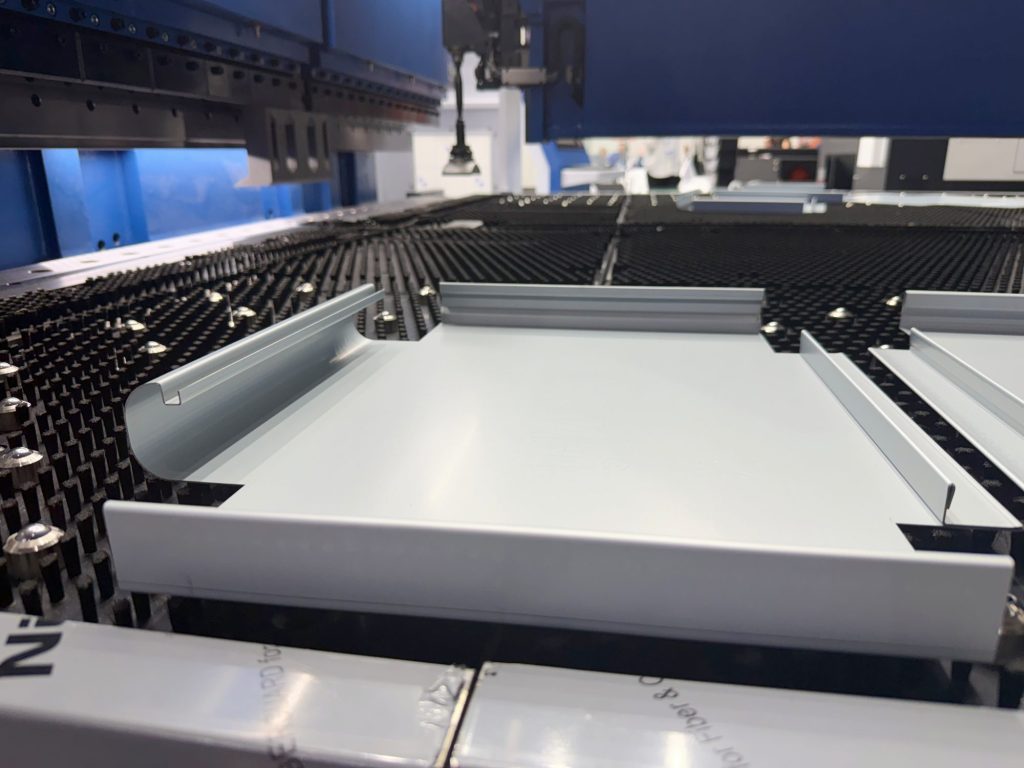
Hogi Advantages of Automated Sheet Metal Bending Equipment
一,Production efficiency has improved significantly.
1. Continuous unmanned production: Equipped with material-feeding robots, automatic loading/unloading systems, and material storage units, the system enables 24-hour unmanned operation (including night shifts) without requiring constant manual supervision; batch processing proceeds without the need for frequent manual intervention or machine downtime.
2. Rapid tool changing and parameter adjustment: The CNC system features a vast library of built-in bending programs; importing drawings triggers automatic calculation of bending compensation, stroke, and angles. Automatic rapid tool changing reduces changeover time for small-batch, high-variety production by over 70%.
3. Synchronized multi-process integration: The system integrates seamlessly with upstream laser cutting or shearing and downstream palletizing or welding lines, enabling automated material flow across the entire sheet metal production line and eliminating waste associated with material handling and waiting between processes.
4. High single-bend precision and reduced rework: Parts are formed accurately in a single pass, eliminating the need for repeated trial bends or adjustments; the cycle time per part is 30%–100% faster than manual operation.
二,Bending dimensions and angles are highly stable, ensuring strong consistency in the finished product.
1. Automatic Closed-Loop Angle Compensation: Equipped with angle sensors and linear scales, the system detects spring-back in real-time and automatically adjusts the ram stroke, ensuring accuracy regardless of fluctuations in steel plate thickness or material hardness.
2. Exceptional Repeatability: Offers a repeatability of ±0.01mm, ensuring virtually zero deviation in bending angles and dimensions across batches of hundreds or thousands of parts—unlike manual bending, which is prone to significant errors caused by variations in force, technique, and operator fatigue.
3. Consistent Batch Appearance: Delivers uniform bend straightness and arc quality, eliminating the indentations and distortions often caused by uneven manual force; this significantly improves the yield rate for high-end cabinets, chassis, and equipment enclosures.
三,Significantly reduce reliance on skilled workers and save on labor costs.
1. Easy for beginners to operate: Simply import CAD drawings and start the program—no need for veteran bending specialists with years of experience. General operators handle loading, unloading, and inspections, resulting in low labor skill requirements.
2. Reduced labor requirements: With a standalone robotic bending cell, a single operator can oversee 2–3 bending machines, whereas traditional manual operations require at least one skilled worker per machine.
四,Low labor intensity and superior occupational safety.
1. Avoidance of heavy manual labor: Manually lifting large or thick sheet metal is strenuous; robotic systems handle automatic gripping, flipping, and positioning, eliminating strain from bending and lifting and reducing occupational ailments affecting the lower back and shoulders.
2. Significant reduction in safety accidents: Manual feeding carries risks such as hand crushing, pinching, or lacerations from steel plates; automation incorporates safety light curtains, zoned guarding, and anti-collision programming, ensuring no personnel need to be in close proximity to the die slide during operation.
3. Isolation from harsh working conditions: Workers are no longer required to operate in close proximity for extended periods within environments characterized by dust, oil, and noise, thereby improving the workshop’s working environment.
五,High material utilization rate; reduces sheet material waste.
1. Pre-simulation and verification: Bending software enables 3D simulation of the entire bending process, allowing for the early detection of potential interference, incorrect bends, or dimensional errors, thereby preventing material waste caused by discovering issues only after the job has started on the machine.
2. Precise spring-back calculation: The system automatically selects the appropriate spring-back coefficient based on the material—such as stainless steel, cold-rolled sheet, aluminum, or galvanized sheet—minimizing defective parts and reducing the scrap rate.
3. Optimized nesting: Data is integrated with laser cutting nesting systems, allowing for the unified planning of the entire sheet metal assembly and reducing offcut waste.
六,Digital management facilitates factory control over production capacity.
1. Real-time Data Collection: Automatically records production output, yield rates, bending cycle times, equipment faults, and tool usage counts, while integrating with MES production systems.
2. Production Traceability: Links each product batch to specific bending programs, processing times, and equipment parameters, enabling rapid root-cause analysis in the event of quality issues.
3. Flexible and Controllable Scheduling: Automatically assigns work orders and adapts to small-batch rush orders or mixed-order production, facilitating management’s calculation of labor hours and costs.
七,Suitable for complex, high-precision sheet metal components.
1. Complex, multi-stage bending completed in a single pass: Handles multiple bends, box shapes, U-shapes, Z-shapes, and arc bends; the robot automatically flips the sheet, eliminating the need for manual repositioning.
2. Stable processing of ultra-thin and ultra-thick sheets: Thin sheets are less prone to slipping or deformation, while high-tonnage bending of thick sheets ensures precise shape control—tasks that are difficult to manage manually.
3. Stable mass production of small, precision sheet metal parts: Automated bending consistently meets customer tolerance standards for high-specification products such as precision instrument housings, communication cabinets, and charging station enclosures.
八,Lower long-term comprehensive production costs
High initial equipment investment, but significant long-term returns:
Reduced scrap and waste, saving on material costs;
Increased production capacity, doubling output within the same factory footprint;
Long equipment service life and simple maintenance; increased night-shift production without additional labor costs.
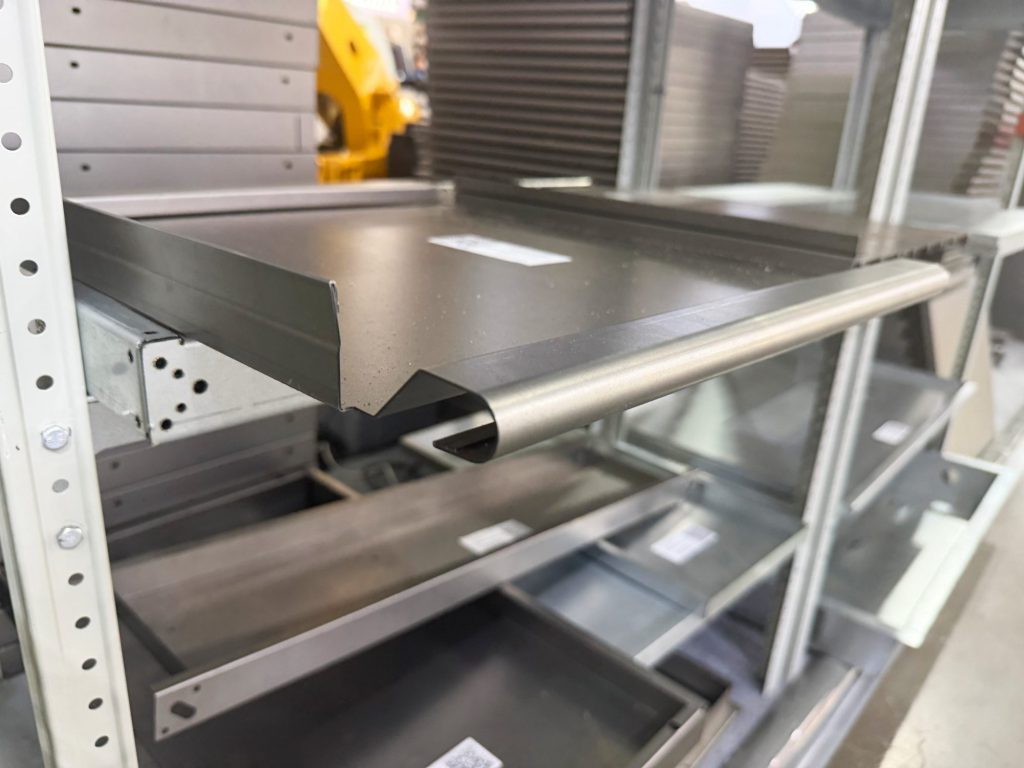
Comprehensive List of Industries Served by Automated Sheet Metal Bending Equipment
1. Electrical Equipment / High & Low Voltage Power Distribution Cabinet Industry
Typical products: Switchgear, power distribution boxes, lighting distribution boxes, meter boxes, PLC control cabinets, outdoor waterproof cabinets. Reasons for suitability: High-volume production of individual models, standardized bending dimensions, complex multi-bend profiles, and heavy sheet metal (labor-intensive for manual handling); automated 24-hour production ensures consistent bending angles and minimizes assembly gaps.
2. Telecommunications / Data Center Industry
Typical products: Server cabinets, 5G base station housings, network switch chassis, filter housings, outdoor telecom cabinets, cable trays. Reasons for suitability: Strict tolerance requirements, stable batch production, frequent use of film-coated stainless steel or aluminum sheets; automated bending prevents surface marks, making it ideal for unmanned night-shift production.
3. New Energy Industry
Typical products: PV inverter housings, energy storage battery cabinets, EV charging station housings, battery swapping equipment sheet metal, PV mounting brackets, battery trays. Reasons for suitability: High-volume production, primarily aluminum or galvanized steel materials prone to significant springback; equipment features closed-loop angle compensation, significantly improving the yield rate.
4. Home Appliance & Refrigeration Industry
Typical products: Air conditioner outdoor unit casings, refrigerator side panels, washing machine cabinets, freezer liners, stainless steel range hood panels, oven casings. Reasons for suitability: Standardized mass production, frequent use of thin sheets, high aesthetic requirements; automated bending eliminates manual tool marks and twisting, making it suitable for integration into assembly lines.
5. Stainless Steel Kitchenware / Commercial Kitchen Equipment
Typical products: Commercial cooking ranges, combi-oven cabinets, stainless steel sinks, exhaust hoods, storage cabinets, supermarket fresh-food equipment housings. Reasons for suitability: Brushed stainless steel surfaces are prone to scratching (automated bending prevents marks); large, heavy sheets are handled by robots instead of manual labor.
Industries involving small-to-medium batch, high-mix customization (prioritizing bending centers / flexible automated lines)
6. Elevator Sheet Metal Industry
Typical products: Elevator car walls, door frames, control panels, hall call panels, machine room equipment guards. Suitability: Moderate batch sizes per item, diverse styles, high requirements for surface aesthetics; automatic tool changing enables rapid model switching, while matte stainless steel finishes ensure a uniform, attractive appearance.
7. Steel Office Furniture Industry
Typical products: Filing cabinets, tool cabinets, safes, shelving units, archive cabinets, metal desk frames. Suitability: High volume of standard parts, multi-bend box-shaped components; robots handle automatic part flipping, allowing a single operator to manage multiple machines.
8. HVAC (Heating, Ventilation, and Air Conditioning)
Typical products: Air handling unit (AHU) casings, fan housings, purification equipment cabinets, dust collection system sheet metal, fresh air unit casings. Suitability: Thin sheets and long dimensions prone to deformation during manual handling; automated follower bending ensures straightness.
9. Construction Machinery / Agricultural Machinery
Typical products: Excavator cab guards, loader housings, agricultural equipment cabinets, counterweight guards, fuel tank mounting brackets. Suitability: Heavy plates and large components involving extremely high manual lifting strain; heavy-duty robots handle heavy sheets, minimizing safety risks.
10. Rail Transit / Bus Sheet Metal
Typical products: Subway interior panels, bus equipment cabinets, locomotive control cabinets, carriage structural metal components. Suitability: Long dimensions and strict precision standards; stable batch production suitable for integrated flexible sheet metal production lines.
11. Door Manufacturing & Decorative Building Materials
Typical products: Stainless steel security doors, residential entrance door frames, metal decorative wall panels, outdoor equipment weather-proof enclosures. Suitability: Primarily aesthetic components requiring uniform bending angles; suitable for high-volume assembly line production.
High-end, precision, niche industry (high-precision fully automatic bending cell)
12. Medical Device Sheet Metal
Typical products: Medical equipment housings, sterilization equipment cabinets, testing instrument covers, stainless steel operating room consoles. Suitability: Clean-grade stainless steel sheets; strict tolerances; small-batch, multi-model production; oil-free and mark-free finish; digital programs allow for long-term storage and traceability.
13. Automotive / New Energy Vehicle Parts
Typical products: New energy vehicle battery trays, automotive body sheet metal guards, charging station components, truck toolboxes, interior metal parts. Suitability: Lightweight aluminum sheets / high-strength steel; complex multi-stage bending; 3D simulation to predict interference; reduced scrap during trial bending.
14. Instrument and Automation Equipment Guards
Typical products: Machine tool protective housings, test instrument chassis, custom automation frames, laser equipment covers. Suitability: High-mix, low-volume production; frequent model changes; automatic tool-changing bending centers enable changeovers in minutes.