


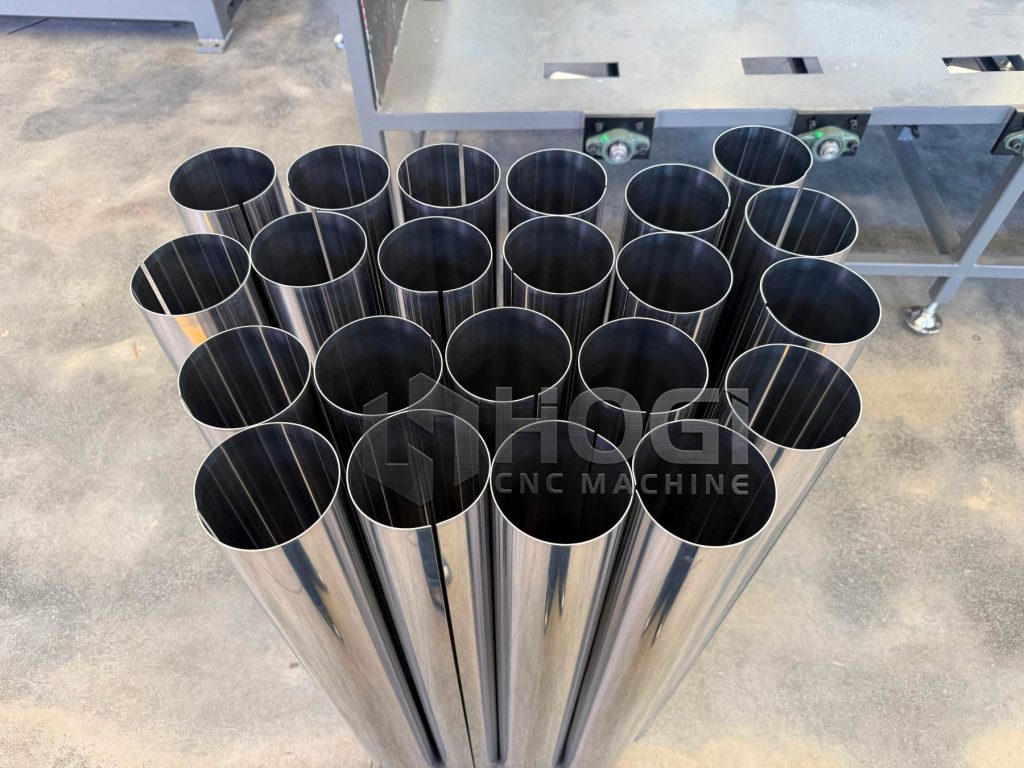
(Standard configuration: CNC four-roll plate bending machine + lifting-type longitudinal seam welding machine; automated production line for shells/shell sections; suitable for fan casings, stainless steel cylinders, water tanks, dust collector housings, and pressure vessel shell sections.)
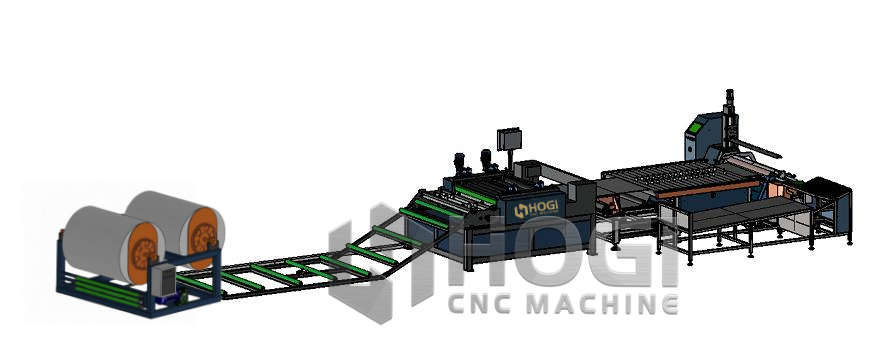
Step 1: Automatic loading, sheet separation, conveying, and centering:
The sheet stack is placed on the raw material rack, and a robotic arm equipped with magnetic grippers automatically separates and picks up individual sheets to prevent multiple sheets from being fed simultaneously. The sheet is placed onto a conveyor roller table, where its surface is air-cleaned to remove iron filings and dust. Servo-driven positioning guides on both sides automatically advance to center and align the sheet, ensuring its centerline coincides with the center of the plate rolling machine’s rolls.
Function: Prevents misalignment, cylinder distortion, and weld seam mismatch during the rolling process. The roller table automatically conveys the sheet, feeding it precisely into the working zone of the CNC four-roll plate rolling machine.
Process 2: Fully automatic pre-bending and rolling using a CNC four-roll plate bending machine (Core Process)
Once the plate is in position, the lower rolls lift while the upper roll descends to clamp the plate;
Leading-edge pre-bending: The CNC system calculates the required downward pressure and springback compensation based on plate thickness, material properties, and the target internal diameter; the rolls move back and forth slightly to pre-bend the leading edge, eliminating any flat section; Continuous rolling: The two lower rolls actively rotate to feed the plate while the upper roll gradually descends according to the programmed settings; the plate undergoes continuous plastic deformation, progressively forming an open-ended cylinder; Trailing-edge pre-bending: The plate does not require flipping; the four-roll configuration allows for the pre-bending of the trailing edge directly, ensuring no residual flat sections at either end of the cylinder; In-process dimensional verification: The system monitors roll positions in real-time and automatically compensates for elastic springback to ensure dimensional accuracy of the cylinder diameter; upon completion of forming, the upper roll retracts, and the unloading mechanism on the discharge side engages;
The open-ended cylinder is discharged via internal support rollers and transported to the next workstation. #hogimachine
Process 3: Cylinder Transfer, Rotational Positioning, and Laser Seam Tracking
The open-seam cylinder is transported to the welding station via a heavy-duty roller conveyor or RGV cart. Support rollers drive the cylinder to rotate slowly through 360 degrees. A laser vision seam-tracking system automatically scans and identifies the longitudinal opening of the cylinder, then rotates the cylinder to precisely align the longitudinal seam with the welding centerline. Finally, a gap inspection is performed: the system measures the weld gap size and automatically triggers an alarm and halts the process if the gap exceeds the specified process parameters, thereby preventing welding defects.
Process 4: Automatic Welding with Clamping system on Longitudinal Seam Welding Machine
The cylinder is conveyed into the welding fixture, where piano-key-style pneumatic clamps uniformly press down on the cylinder from top to bottom to suppress welding distortion and stabilize the weld gap. The welding process is selected based on the material:
・Stainless steel: TIG welding / plasma welding (equipped with a back-side protection device to prevent oxidation and blackening of the weld)
・Carbon steel: MIG CO₂ gas-shielded welding
The lift-type main unit accommodates a variety of cylinder diameters, and the welding torch moves automatically; optional laser weld tracking is available to correct the torch position in real time; once the equipment is started, it completes continuous welding of the entire longitudinal seam in a single pass; upon completion of welding, the welding torch returns to its home position and the clamping plates are released; after the cylinder has cooled for a period of time, it is transferred out of the welding station.
Process 5: In-line weld appearance inspection and slag removal
A vision inspection unit scans the entire weld to identify defects such as porosity, depressions, lack of fusion, misalignment, and undercut.
Accepted parts proceed directly to the buffer zone; a signal triggered by a defective part automatically diverts it to the rework area. An optional automatic slag removal device clears weld spatter and oxide scale from the weld surface.
Process 6: Automatic unloading and buffering of finished products
Qualified cylinders are conveyed to the finished product buffer rack and stacked in an orderly manner; the system supports AGV-based unmanned transfer for offloading. Production data—including output, workpiece parameters, and records of defective items—is uploaded to the central control system in real time, enabling production traceability.
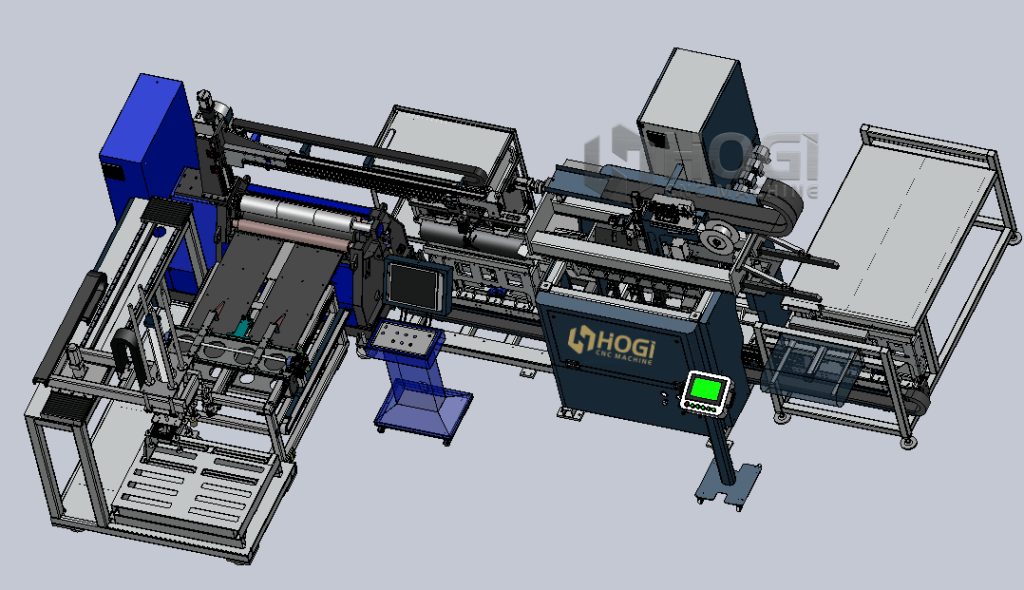
Utilizing four working rolls (one top roll, two bottom rolls, and one side support roll) to apply continuous three-point bending force to the metal sheet, the machine induces permanent plastic deformation, rolling flat sheets into cylindrical, conical, or arc-shaped components.
Top roll: Driven rotation and vertical lifting; downward pressure provides the bending force. Two bottom rolls: Synchronized rotation drives the sheet forward; capable of fine horizontal adjustment.Side roll (auxiliary roll): Assists with pre-bending, supports the sheet, and adjusts the roundness of the cylinder. Comparison with three-roll machines: The key feature of the four-roll design is that the sheet does not need to be flipped; pre-bending of both ends is completed in a single setup, eliminating straight-edge sections.
The entire system employs a closed-loop control configuration comprising servo motors or a hydraulic system, a PLC-based CNC system, and displacement sensors:
1. Operators input parameters via the touchscreen, including plate material, plate thickness, cylinder inner diameter, and plate length;
2. The CNC system automatically calculates springback compensation, upper roll downward travel, roll feed speed, and the number of rolling passes;
3. The system precisely controls the independent movement of each roll, monitoring downward displacement, rotation speed, and left-right synchronization in real time;
4. Optical or magnetic scale sensors capture roll positions in real time and feed data back to the CNC system to automatically correct for springback errors;
5. The entire process—clamping, pre-bending one end, continuous rolling, pre-bending the other end, and cylinder unloading—can operate in a fully automated cycle.
1. Plate Feeding and Automatic Centering: The plate is placed above the bottom rolls, and positioning mechanisms on both sides automatically correct its alignment. This ensures the plate’s centerline coincides with the roll centerline, preventing twisting or misalignment of the cylinder edges during rolling.
2. Edge Pre-bending (Core Process): The top roll descends to clamp the leading edge of the plate, while the bottom rolls drive the plate in a short reciprocating motion to pre-bend the edge.
3. Continuous Rolling and Forming: The CNC system controls the top roll to continuously descend to a preset depth while the two bottom rolls rotate at a constant speed to feed the plate. Subjected to continuous bending moments, the plate gradually curves and is rolled into an open-ended cylinder.
4. Secondary Compensation and Springback Elimination: To account for the metal’s elastic springback, the CNC program applies a pre-calculated compensation stroke; multiple progressive rolling passes ensure the formed diameter meets specifications.
5. Roll Release and Automatic Unloading: Upon completion of rolling, the top roll is lifted (via hydraulic or servo systems) and the tilting mechanism on one side of the machine opens. The cylinder is automatically discharged and transferred via a conveyor system to the subsequent welding process.
Core Advantages of the Integrated Intelligent Plate Rolling and Welding Production Line
1. High level of automation, significantly reducing reliance on manual labor
The entire production line—comprising plate loading, centering, rolling/forming, cylinder transfer, weld seam positioning, and welding—operates in an integrated, automated manner. Only one operator is required to oversee the process, eliminating the need for manual plate handling, cylinder alignment, seam locating, and frequent loading/unloading of workpieces. This setup mitigates safety risks such as collisions or crushing injuries associated with transferring heavy cylinders and lowers labor costs.
2. Streamlined processes and significantly improved production efficiency
Traditional Model: Standalone plate rolling machine operation → forklift transfer of cylinder shells → manual lifting onto the welding machine → manual seam alignment; this results in fragmented workflows and long waiting times.
Smart Production Line Advantages: Continuous roller conveyor transport ensures seamless workpiece flow, eliminating intermediate waiting and secondary lifting; a CNC four-roll machine completes pre-bending on both ends in a single setup without needing to flip the workpiece, offering substantial labor-hour savings compared to three-roll machines; laser-vision automatic seam tracking replaces manual visual alignment, reducing auxiliary time per unit; ideal for the large-scale mass production of cylindrical components (such as wind turbine towers, dust collector shells, stainless steel water tanks, and filter cartridges). #cncrollingmachine
3. Stable product precision and high consistency, resulting in a lower defect rate
The CNC system centrally controls plate forming parameters and incorporates built-in springback compensation, ensuring uniformity in cylinder diameter and curvature precision;
An automatic centering mechanism prevents plate misalignment, reducing cylinder distortion and weld seam mismatch; laser seam finding combined with an optional weld tracking system ensures a stable weld gap and minimizes fluctuations in welding quality; consistent dimensions across batch-produced units facilitate subsequent flange fit-up and assembly, reducing the need for remedial adjustments.
4. Integrated flexible production adaptable to various workpiece specifications
Users simply input the plate thickness, material, and cylinder diameter via the touchscreen, and the system automatically retrieves the corresponding set of process parameters. The combination of a vertical seam welding machine and a CNC plate rolling machine allows for rapid switching between cylinders of different diameters. The system supports the production of carbon steel, stainless steel, and aluminum, meeting the needs for flexible manufacturing across diverse product types; it eliminates the need for lengthy mechanical adjustments, ensuring short setup times when switching between models.
5. Improve welding and forming quality; reduce the need for rework.
The shell is formed without straight edges, ensuring a uniform gap for the longitudinal butt joint; a “piano-key” style clamping fixture secures the shell evenly, suppressing thermal deformation during welding; stainless steel models support back-side argon shielding, preventing weld oxidation and discoloration, thereby significantly reducing the grinding workload; and an integrated online visual inspection system promptly sorts out defective parts, preventing non-conforming products from proceeding to the next stage of production.
6. Digital, intelligent control and management for streamlined factory operations
The entire line features centralized, coordinated PLC control with interconnected equipment signals. It automatically records production data—such as output, processing parameters, and information on defective products—and supports integration with factory systems. Automated fault alarms and real-time monitoring of equipment status facilitate maintenance and production traceability.
7. Optimize workshop layout and improve on-site management
Move away from the chaotic practice of scattering standalone machines and using forklifts to shuttle workpieces back and forth; implement a unidirectional flow of workpieces along fixed production lines; and ensure orderly material stacking to minimize aisle obstruction and eliminate safety hazards associated with frequent overhead lifting.Common characteristics of the manufactured products include metal cylinders, cylindrical sections, conical shells, and casings; materials include carbon steel, stainless steel, and aluminum alloy. Suitable for the standardized mass production of cylindrical bodies.
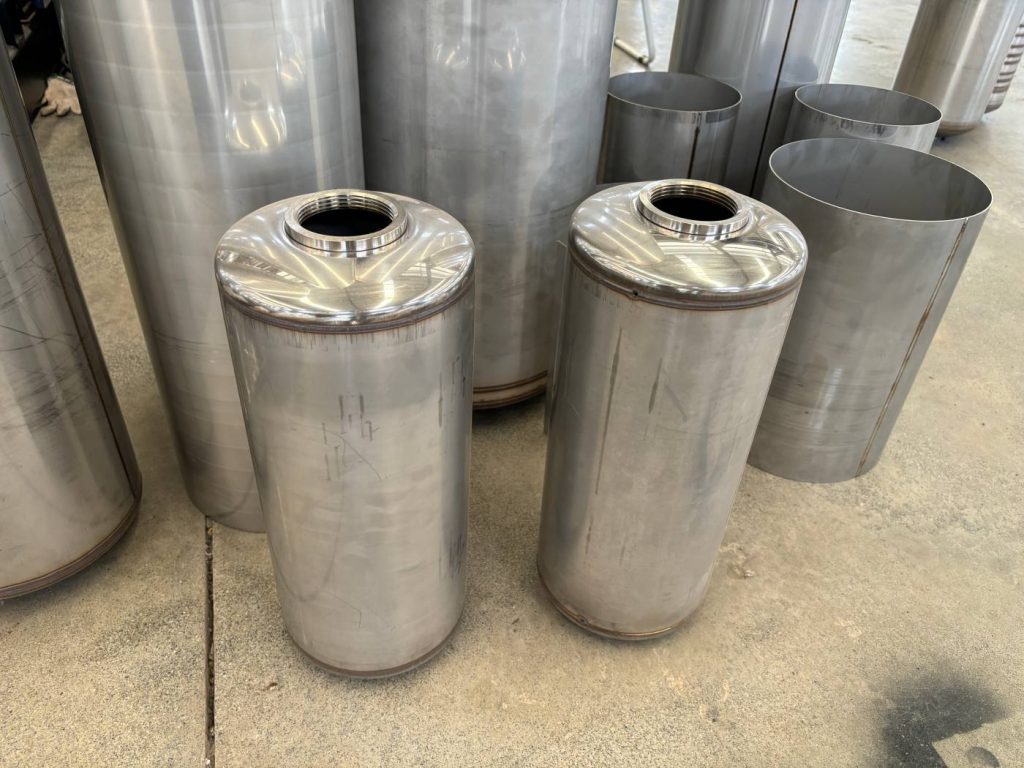
1. Environmental Protection & Dust Removal Industry
Products: Dust collection filter cartridges, dust collector housing sections, cyclone dust collectors, waste gas purification tower shells. Demand characteristics: Standardized shell specifications, high order volumes, predominantly stainless steel; strict requirements for shell roundness and weld sealing integrity.
2. Fan & Blower Industry (Centrifugal and Axial Fans)
Products: Fan casings, fan housings, air duct sections, fan barrel segments. Pain points: Traditional single-unit production often results in ovality and significant weld misalignment, affecting impeller assembly; automated production lines offer clear advantages in dimensional consistency.
3. Water Tank, Pressure Vessel, and Water Supply Equipment Industry
Products: Stainless steel insulated water tanks, pressurized water tanks, water supply tanks, heat exchanger shells, small pressure vessel sections. Requirements: Integration with flaw detection and edge milling processes to form complete, high-standard production lines; zero-leakage weld integrity.
4. Construction Machinery / Sanitation Equipment Industry
Products: Water truck tank shells, sludge treatment cylinders, construction machinery fuel/hydraulic tanks, material hoppers.
5. Photovoltaic (PV) and New Energy Auxiliary Equipment
Products: PV dust cleaning equipment, energy storage system housings, stainless steel electrolyte storage tanks, waste gas treatment cylinders.
6. Food and Pharmaceutical Machinery
Products: Food mixing vessels, fermentation tanks, stainless steel pharmaceutical reaction vessels, purification equipment housings. Requirements: Stainless steel material; smooth welds with minimal oxidation (reducing subsequent polishing workload); compliance with high sanitary standards.
1. Pipe manufacturing industry: Thin-walled steel short pipe sections, ventilation duct cylinders (not suitable for long-distance pipelines)
2. Steel structural equipment: Cylindrical supports, steel bracing cylinders
3. Kitchen equipment: Commercial stainless steel steaming barrels, large inner vessels
4. Metallurgical equipment: Small furnace shells/sleeves, material feed cylinders
5. Irrigation and water conservancy equipment: Steel filter cylinders, small pressure vessels