HOGI Robotics’ fully automated bending machines are revolutionizing traditional metalworking. With 0.01-millimeter precision and AI-driven dynamic compensation, they boost the first-pass yield rate to 98%, increase per-machine output by 300%, and achieve zero workplace injuries. Flexible production further reduces costs for small-batch orders by 40%. This dual revolution in efficiency and safety is rewriting the rules of manufacturing.
The metalworking industry is undergoing a quiet revolution. In traditional bending processes, issues such as low manual precision, limited efficiency, and safety hazards have long been prevalent. However, companies specializing in fully automated robotic bending machines are redefining production models in this field by integrating robotic arms, intelligent algorithms, and high-precision sensors. This technological innovation not only enhances processing efficiency but also drives the manufacturing sector’s transition toward smarter and more flexible operations. #bendingrobotic
Core Technology: The Transition from “Human Expertise” to “Digital Control”
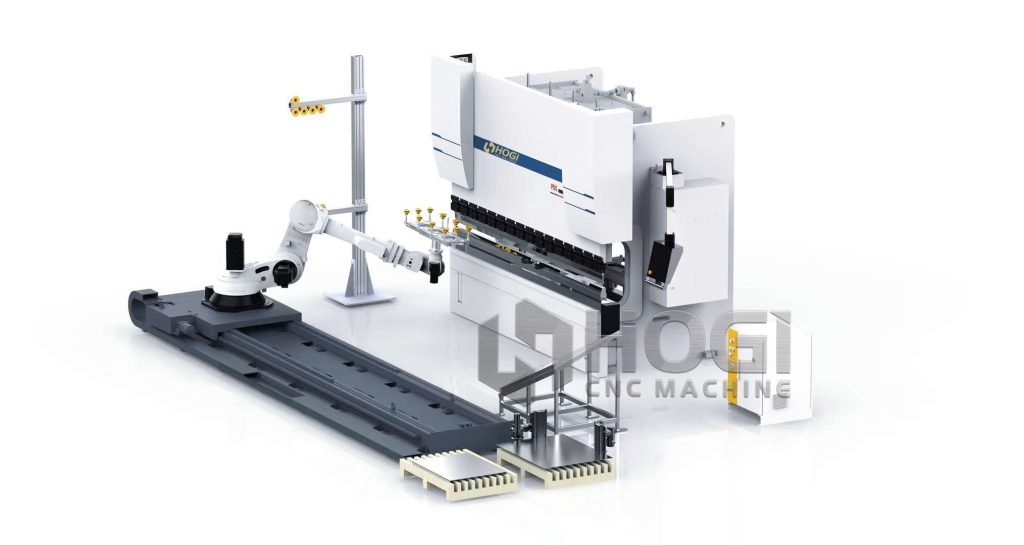
Traditional bending processes rely on workers’ judgment regarding material thickness and bending angles, often resulting in error margins exceeding 1 millimeter, while repetitive operations can lead to fatigue-related injuries. In contrast, the core of robotic fully automatic bending machines lies in converting process parameters into digital models: 3D data of the sheet metal is captured via laser scanning, combined with AI algorithms to generate the optimal bending path, and then executed by a six-axis robotic arm with 0.01-millimeter precision. For example, a dynamic compensation system developed by a Chinese company can monitor material springback in real time and automatically adjust pressure parameters, increasing the pass rate for complex, irregularly shaped parts from 75% to 98%.
HOGI Collaborative Robot Bending
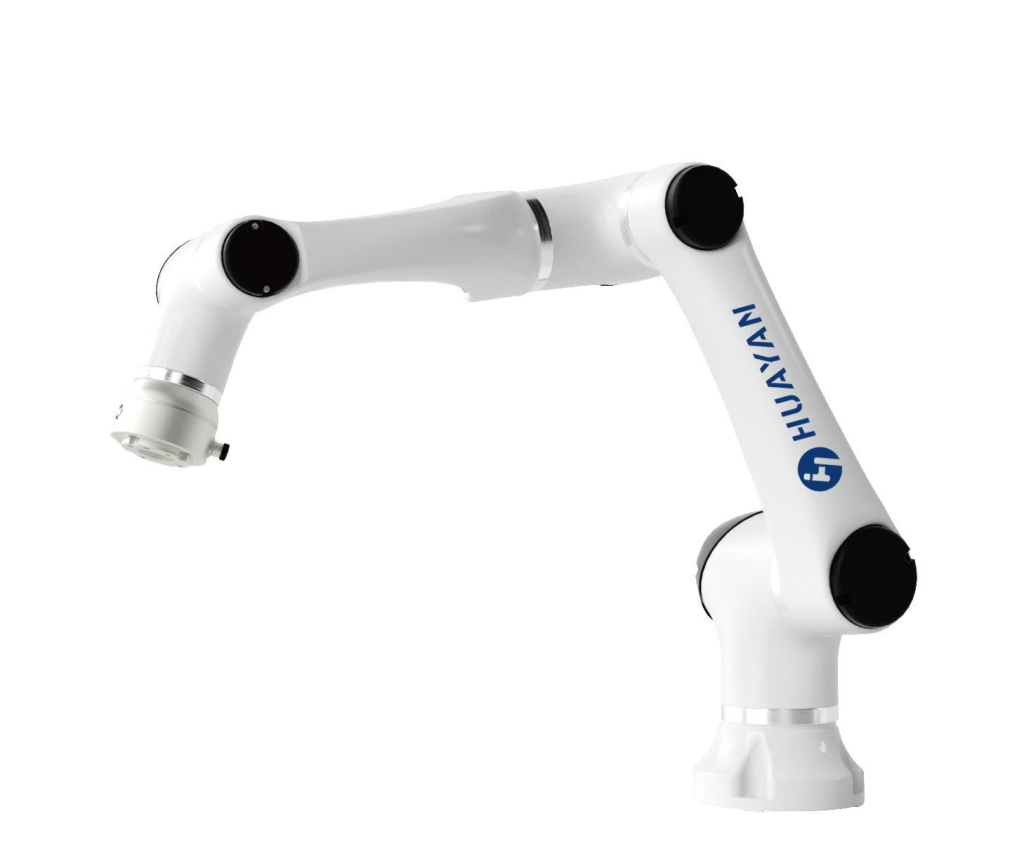
Collaborative robots enable robots and humans to work together on production lines, fully leveraging the efficiency of robots and the intelligence of humans. These robots are not only cost-effective but also safe and convenient, and they can greatly promote the development of manufacturing enterprises.
As a new type of industrial robot, collaborative robots have eliminated barriers to human-robot collaboration, freeing robots from the constraints of safety barriers or enclosures. Their groundbreaking performance and wide range of applications have ushered in a new era for the development of industrial robots.
Key Advantages
Human-robot collaboration is bringing about a fundamental transformation in industrial production and manufacturing for the factory of the future, offering decisive advantages:
① Maximum flexibility in the production process.
② Taking over manual tasks that were previously impossible to automate or ergonomically unsuitable, thereby reducing the burden on employees.
③ Reducing the risk of injury and infection, for example, through the use of specialized human-robot collaboration grippers.
④ High-quality execution of repeatable processes without the need for investment based on part type or workpiece.
⑤ Increased productivity and equipment sophistication through the use of built-in sensor systems.
Given the benefits of human-robot collaboration and in response to market demand, more flexible collaborative robots have emerged as a viable solution for assembly and picking tasks. They maximize the respective strengths of both humans and robots, enabling robots to work more effectively alongside workers and adapt to a wider range of work challenges.
Key Features
The key features of HOGI collaborative robots include:
1. Lightweight Design
This makes the robot easier to control and enhances safety.
2. User-Friendly Design
The robot’s surface and joints are smooth and flat, with no sharp corners or gaps that could trap operators.
3. Perception Capabilities
The robot perceives its surroundings and adjusts its movements in response to environmental changes.
4. Human-Robot Collaboration
Equipped with sensitive force feedback capabilities, the robot stops immediately when a preset force is reached. Following a risk assessment, safety guards may not be required, allowing humans and robots to work together.
5. Easy Programming
Programming and debugging are straightforward even for general operators and personnel without a technical background.
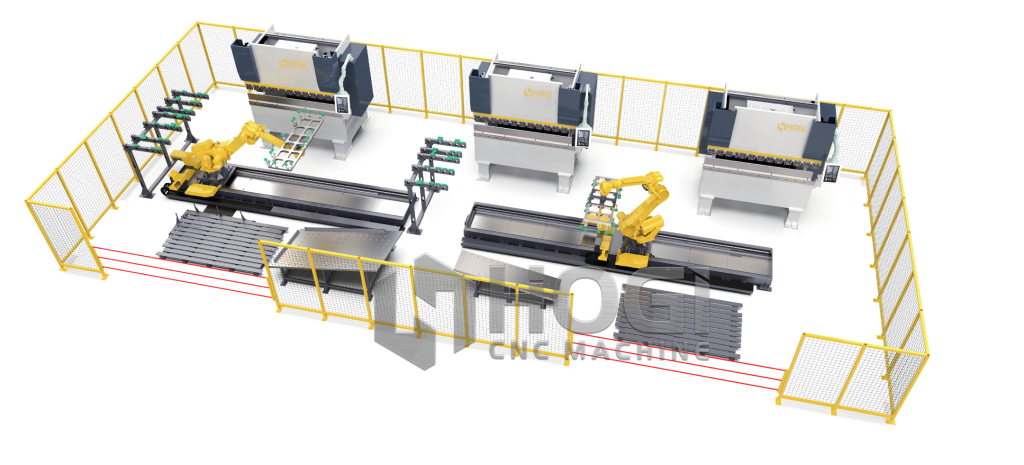
HOGI Fully automated robotic bending machine factories are emerging as a key breakthrough in the metalworking industry. By integrating industrial robots, intelligent control systems, and high-precision bending equipment, these facilities achieve end-to-end automation from raw material loading to finished product unloading. Compared to traditional manual operations, they boost processing efficiency by 3 to 5 times, maintain product dimensional accuracy within ±0.1 millimeters, and operate continuously 24 hours a day, providing efficient and reliable solutions for industries such as automotive, home appliances, and aerospace.
Hogi Advantages:
Safety: The HGCR series of collaborative robots (cobots) is equipped with 16 TÜV-certified safety features, including advanced functions such as collision detection and force/power monitoring. Additionally, the cobots are meticulously designed with built-in ESD protection. This meticulous attention to safety ensures a high level of safety during human-robot collaboration while meeting the specific requirements of various industries.
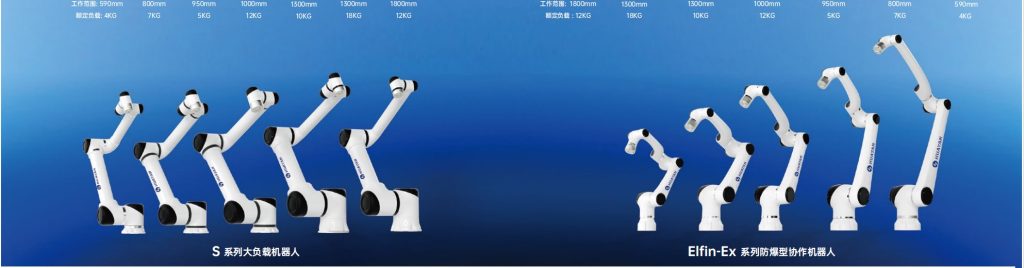
Wide Range of Applications: The GCR series collaborative robots feature a payload range of 3 kg to 25 kg and a reach range of 618 mm to 2000 mm, enhancing their performance and expanding their application scope. With precise motion control, high-speed operation, and seamless integration with other automation systems, these collaborative robots can optimize productivity and streamline workflows across various industries.
Intelligent: Equipped with software packages for various applications (bending, welding, palletizing, etc.); supports multiple external interfaces (DI, DO, I/O, etc.); enables cloud-based robot data monitoring and remote OTA updates; supports one-click deployment of multiple devices and remote data backup.
Easy Maintenance: Features a modular design, allowing individual functional modules to be removed and replaced independently without requiring extensive disassembly of the entire system.
Supports remote technical support, enabling maintenance personnel to communicate in real-time with experts via a network connection to obtain professional repair advice and guidance. Additionally, its lightweight design allows for rapid deployment and adaptation to various production lines.
Flexible Bending Capabilities
Can be programmed to adapt to various sheet metal processing tasks and workpieces, making it ideal for diverse small-batch production needs. Enables faster production line adjustments and task switching, supporting rapid responses to market demand changes.
Improved Efficiency
It can automate highly repetitive tasks such as sheet metal bending, assembly, pre-processing, and post-processing, thereby enhancing production line efficiency. Through efficient automation, collaborative robots can reduce equipment downtime, shorten production cycles, and increase overall output.
As the application of metal materials becomes increasingly widespread and innovations in high-tech equipment such as CNC machines and laser cutters advance, the processes and techniques in the metalworking industry are growing more complex, with ever-higher demands for precision and efficiency. The automation capabilities of collaborative robots demonstrate powerful synergistic effects, consistently prioritizing advancements in global industrial innovation. They exhibit exceptional efficiency and precision in metalworking and machining applications.
In the metalworking sector, collaborative robots perform tasks such as bending, loading and unloading, material handling, welding, and polishing. Not only do they boost production efficiency, but they also enable more efficient and stable production. At the same time, collaborative robots reduce the risk of accidental injuries to employees during CNC machining processes, creating significant long-term benefits. Furthermore, their safety and user-friendly features help customers achieve flexible production lines, effectively addressing the challenges of small-batch, high-frequency production.