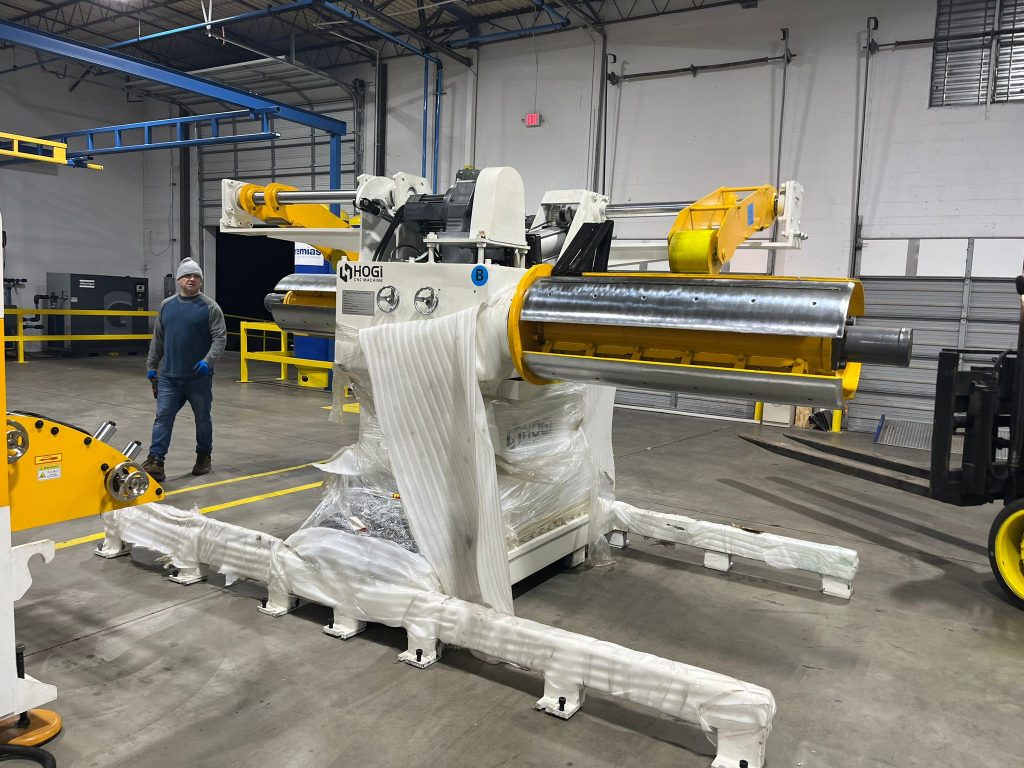
HOGI Automatic coil laser cutting line (also commonly known as a laser uncoiling and blanking line) is a fully continuous, automated production line that transforms steel coils, stainless steel coils, or aluminum coils directly from a “single coil” into “individual custom-shaped parts”: uncoiling → leveling → feeding → laser cutting → sorting and stacking. It requires no shearing, no dies, and no manual loading or unloading, and is designed for high-volume production, high flexibility, labor savings, and material efficiency. The coil uncoiling and blanking line is a sheet metal processing system designed for the uncoiling, leveling, blanking, and palletizing of surface cover panels in industries such as automotive manufacturing and steel plate distribution.
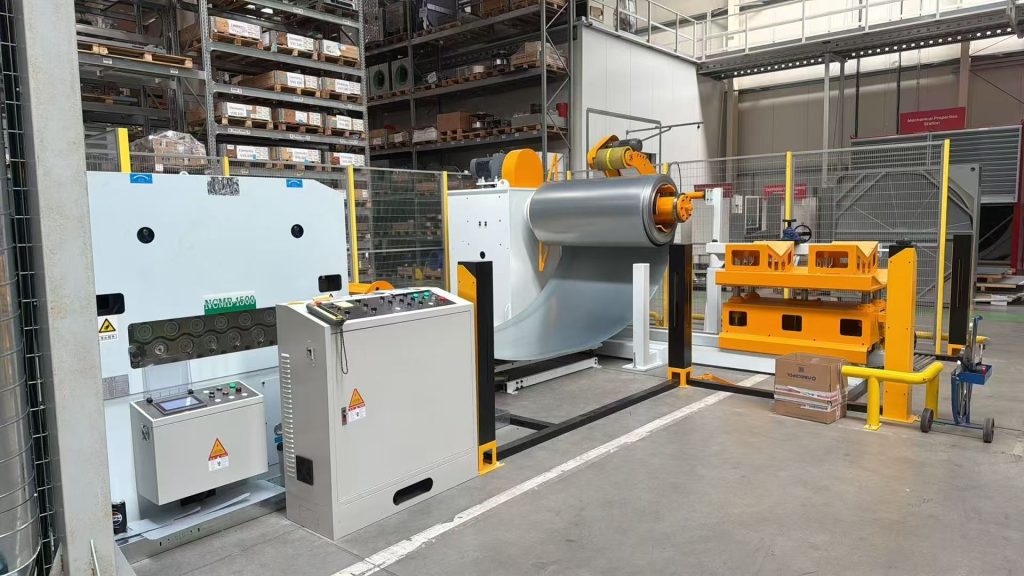
Introduction to the Laser Uncoiling and Blanking Production Process;
Laser cutting is a thermal cutting method that uses a focused laser beam as the primary heat source. Because the laser beam is concentrated in a very small area, the energy is highly concentrated, rapidly heating the localized area and causing vaporization of the processed part. Furthermore, due to the highly concentrated energy, only a small amount of heat is transferred to other parts of the steel, resulting in minimal deformation. Lasers can precisely cut complex-shaped blanks, which do not require further processing. Complex shapes can be processed without the need for molds, offering high flexibility. This laser cutting blanking line cleverly combines laser cutting machine-assisted flying cuts (follow-cutting). Its purpose is to solve the problem of rapid blanking of continuous metal strips without molds, thereby reducing investment in blanking equipment and mold consumption costs, and effectively improving material utilization.
Principles of Laser Cutting, Core Principles
Using a high-energy, high-density laser beam, the process instantly melts, vaporizes, and blows away the metal sheet, enabling rapid cutting.
Three simple steps:
Focusing the Beam:
The laser emits a strong beam of light, which is focused by a lens into an extremely small spot, concentrating the energy intensely.
High-temperature melting:
When the laser beam strikes the surface of the steel plate, the temperature instantly rises to over 1,500°C, causing the metal to melt or even vaporize.
High-pressure slag blowing:
The cutting head emits a high-pressure gas (air, oxygen, or nitrogen) to blow away molten metal slag, resulting in a smooth cut.
Three Common Cutting Methods:
Oxy-fuel cutting: Ideal for carbon steel; uses oxygen to support combustion and increase temperature; fast and cost-effective
Air cutting: Suitable for thin stainless steel and iron plates; uses only compressed air; the most economical option
Nitrogen cutting: Suitable for stainless steel and aluminum plates; produces a smooth, burr-free cut surface; highest quality
Additional Principles of Laser Cutting of metal Coil Material
The material is fed forward continuously at a constant speed, while the laser head moves in sync with it, cutting as it goes—this is known as flying cutting, which requires no material stoppage and offers extremely high efficiency.
Loading the Material: First, the metal coils to be processed must be loaded onto the laser uncoiling and blanking line. Typically, hydraulic systems or robotic arms are used to lift the metal coils from the storage area or coil racks and feed them into the uncoiling unit.
Material Leveling: After entering the uncoiler, the coil passes through a CNC leveling machine to remove any bends or wrinkles, ensuring the quality of subsequent cutting and processing.
Material Alignment: After being flattened, the roll material is precisely positioned using an alignment device, ensuring that it remains accurately aligned during the subsequent cutting process and guaranteeing cutting precision and accuracy.
CNC Programming: Configure cutting parameters for the laser uncoiling and blanking line, including cutting paths, cutting speed, and laser power, and perform CNC programming. Typically, design and programming are carried out using CAD/CAM software, and the part drawings to be processed are imported into the control system of the laser uncoiling and blanking line.
Laser Cutting: After CNC programming, the laser coil-uncoiling and blanking line automatically performs laser cutting. Laser cutting utilizes a high-energy laser beam to melt and vaporize metal coils, thereby achieving the cutting process. The laser beam is generated by a laser source, focused by an optical system, and ultimately directed onto the metal coil for cutting.
Uncoiling and Discharge: Once cutting is complete, the laser uncoiling and cutting line automatically separates the cut parts from the coil and discharges them via a conveyor system.
Data Collection and Monitoring: Laser coil-uncoiling and blanking lines are typically equipped with sensors and monitoring devices that collect and monitor relevant parameters and data during the cutting process—such as cutting speed, laser power, and cut quality—to enable automated control and quality inspection.
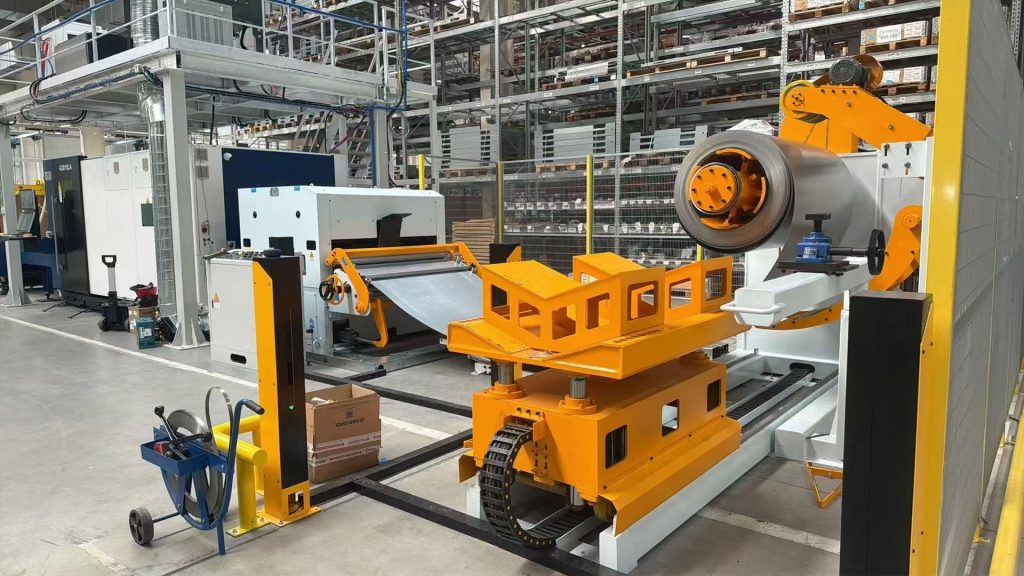
What components make up the entire line (standard configuration)?
1.Feeding cart + Uncoiler:Coil capacity (typically 5–20 tons; heavy-duty models up to 30 tons)
Hydraulic expansion + constant-tension unwinding to prevent coil unraveling and misalignment,Optional dual-head unwinding for non-stop coil changes
2. Sheet Leveling:Repeated bending using multiple rolls (7–11 rolls) to eliminate internal stress and warping
Accuracy: 0.1–0.5 mm/m, ensuring consistent cutting dimensions
3.Servo Feeder (with Web Guiding):Precision servo control, feed accuracy ±0.02 mm/m Speed up to 35 m/min, dynamically synchronized with laser cutting
4.Fiber Laser Cutting Machine (Core):Power: 2 kW–12 kW (2–4 kW for thin materials, 6–12 kW for thick materials)
Cutting method: Flying cut (dynamic synchronization) or step-by-step cut (stop-and-cut),Single / dual / multi-head configurations, doubling efficiency
5.Unloading, Sorting, and Palletizing System:Belt/roller conveyors, vision systems, robotic arms/suction cup automated gripping
Finished product palletizing, automated scrap collection, 24/7 unmanned factory
6.Intelligent Control System (Nesting Software + PLC):Integrated production line, automatic nesting, common-edge cutting, and maximized material utilization
Key Advantages (Compared to Traditional Shearing + Standalone Laser Cutting)
✅ 3–5 times more efficient: No loading/unloading or material transfer; continuous production
✅ Labor-saving: One operator supervises the entire line, replacing 5–8 workers
✅ High material utilization: No material waste at the beginning or end; shared edges in nesting save 5–10% material
✅ Extremely flexible: No dies required; rapid changeovers for complex shapes and multiple product varieties
✅ Consistent precision: Leveling + servo feeding ensures excellent batch consistency
Suitable Industries:
1. Enclosures and cabinets, electrical equipment
2. Automotive parts (lightweight)
3. Elevators, kitchen appliances, furniture
4. Medical devices, rail transit
5. Construction machinery, sheet metal fabrication
Comparison of Traditional Stamping and Blanking Lines:
✅ No tooling costs: Save hundreds of thousands on tooling—ideal for small-batch production
✅ Flexible and fast: Modify the part immediately after updating the design—no need to wait for new tools
✅ Ideal for thin-gauge materials and complex parts; still cost-effective for high-volume production of simple stamped parts