


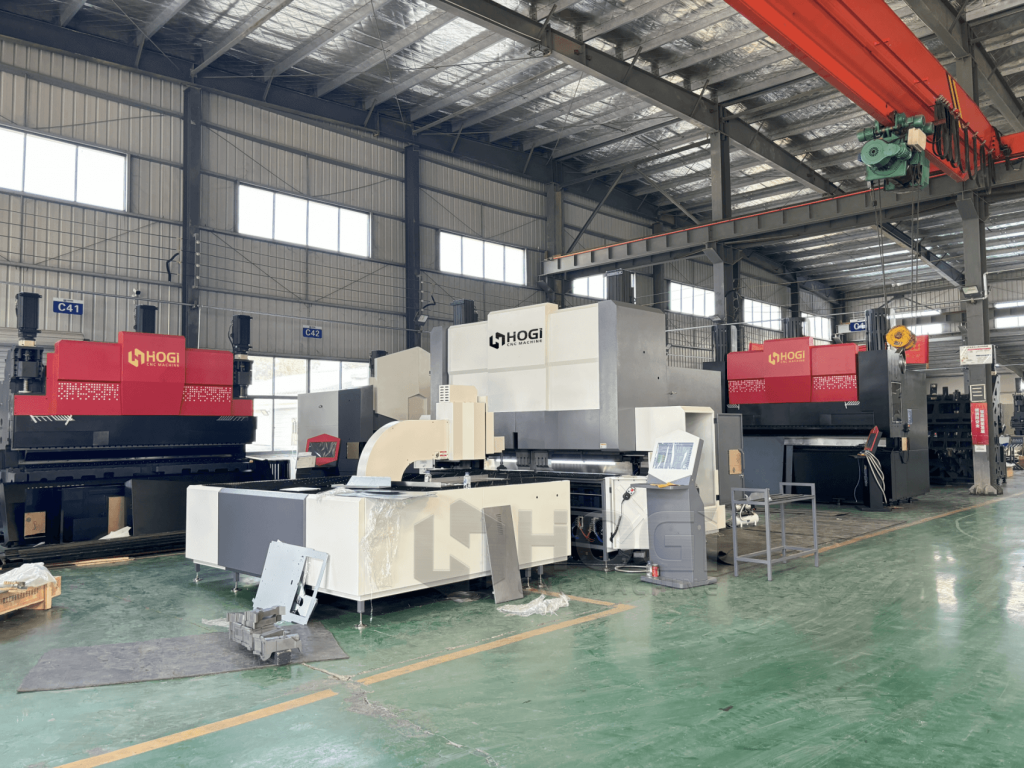
When sheet metal parts become more complex and production runs combine many different models, a panel bending center offers a way to keep bending under control instead of relying on manual experience alone. It is not just an automated press; it is a coordinated system that manages movement, clamping, and bending as one continuous process.
This kind of control is important because modern parts rarely consist of a single simple bend. Cabinet shells, appliance housings, elevator skins, and medical enclosures often include multiple flanges, return edges, and long panels where small deviations can create visible misalignment. A panel bending center is designed to handle that kind of work with less variation and fewer interruptions.
Why complex sheet metal bending is difficult
Complex bending is demanding because each bend influences the geometry for the next one. Once the first flange is formed, the sheet no longer behaves like a flat plate. It becomes harder to position, more awkward to hold, and more sensitive to small errors in alignment.
Springback is one of the main technical reasons for this difficulty. After unloading, the material partially returns toward its original shape, and the amount of springback depends on material strength, thickness, bend radius, and forming angle. In multi-step bending, these effects accumulate and can shift the final geometry away from the desired dimensions.
Manual handling adds another layer of variation. When operators flip and reposition the sheet by hand for each bend, even a small difference in grip point or support position can lead to angular or dimensional deviations. As parts become longer, wider, or more complex, it becomes harder to maintain consistent bending conditions by hand.
How a panel bending center manages complexity
A panel bending center manages these challenges by coordinating sheet motion and bending within one system. The machine positions the sheet using its own clamping or suction devices, rotates it into the correct orientation, and applies bending through a controlled motion path. The aim is to limit the number of uncontrolled movements between operations.
The programming interface supports this approach. Instead of defining each bend manually on the shop floor, the operator enters workpiece dimensions and bending requirements into a visual system. The panel bending center then calculates the required sequence and movement, which standardizes how each part is formed.
Universal tooling is another important element. Because the panel bending center uses a common bending tool for multiple shapes, it does not need to change dies for each geometry. That keeps the forming logic consistent and reduces the chance of errors introduced during tool change.
Multi-axis motion and automatic handling
Multi-axis motion is at the core of the panel bending center’s capability. The machine can move the sheet along different axes, rotate it, and align it under the tool without relying on the operator’s physical handling. This makes it easier to maintain the correct reference edges and avoid cumulative positioning error.
Automatic handling is particularly important for large or heavy panels. When operators handle such parts manually for every bend, fatigue and variation are difficult to avoid. The panel bending center uses its gripping system to carry out these movements, which frees operators from repeated heavy handling tasks and helps maintain a stable bending environment.
By combining multi-axis motion with automatic handling, the panel bending center reduces the difference between one part and the next. The same motion path can be repeated across the batch, which supports better dimensional consistency and less rework.
Engineering benefits of using a panel bending center
The engineering advantages of a panel bending center extend beyond speed. The machine provides a more predictable bending process, which allows engineers to design parts with tighter tolerances and more complex geometries while still keeping them manufacturable.
It also supports better control over bending sequence and process planning. Because the system can store and reuse bending programs, engineers can define standard processes for entire product families. That reduces the risk that process changes will be made informally on the shop floor without proper validation.
In situations where product design evolves frequently, the panel bending center helps maintain continuity. New models can reuse parts of existing bending programs, reducing the effort required to bring updated designs into stable production.
Comparison table
| Factor | Panel Bending Center | Traditional Press Brake | Robotic Press Brake Cell | Manual Bending |
|---|---|---|---|---|
| Control of multi-bend sequences | High | Medium | High | Low |
| Automatic handling of large panels | Yes | Limited | Partial | No |
| Dependence on operator skill | Moderate after setup | High | High | Very high |
| Tool change frequency | Low | High | High | High |
| Dimensional repeatability | Strong | Variable | Strong | Variable |
| Suitability for mixed orders | Strong | Moderate | Strong | Poor |
The table shows that the panel bending center combines aspects of automation and control that are harder to achieve with manual or partially automated systems. It is particularly effective when product mix and part complexity are both high.
How visual programming supports production
Visual programming is a key part of how a panel bending center fits into day-to-day production. Instead of creating long lists of numerical values, operators can define bending operations in terms of part geometry. This reduces the chance of input errors and makes the process more approachable for newer team members.
The ability to simulate bending sequences on the screen also helps. Engineers and operators can check for potential collisions, awkward handling positions, or impractical bend orders before they cut material. That prevents avoidable scrap and shortens the time needed to stabilize new programs.
Once a sequence is proven, it can be reused and adjusted. That is useful when multiple parts share a common baseline design but differ in dimension or small details. The panel bending center’s programming environment becomes a central resource for controlling bending across an entire product range.
Where panel bending centers bring the most value
Panel bending centers provide the most value in operations where part variation and quality demands are both high. Cabinet manufacturers, for example, must maintain consistent door and panel geometry while dealing with many different sizes and configurations. A panel bending center supports that requirement by standardizing the bending process.
Appliance and HVAC production also benefits because the external panels and internal structures often share common design language but differ in detail. The ability to apply the same process logic across many part types while keeping tolerances under control is a clear advantage.
Industries such as elevator manufacturing, medical equipment, and office furniture face similar conditions. In these sectors, appearance, fit, and structural alignment all depend on consistent bending quality. A panel bending center helps ensure that each part matches the design intent more closely.
Case study
A producer of elevator panels and door skins faced growing complexity in its product range. New models introduced more decorative and functional features, which increased the number of bends per part and tightened the tolerance requirements. Manual bending and standard press brakes could still make the parts, but the process became difficult to maintain at scale.
By introducing a panel bending center, the company shifted multi-step panel bending into a controlled system. The machine’s programmed sequences reduced variation between shifts, and the automatic handling system made large panel movement more consistent. Operators no longer had to manage every rotation manually, which reduced fatigue and improved safety.
Over time, the plant saw a reduction in rework related to misaligned bends and panel twist. The engineering team also found it easier to introduce new models because the existing programs could be adapted rather than replaced. The panel bending center became a core resource for managing product complexity.
Client testimonial
“Our biggest problem was not cutting. It was the bending step behind it. After introducing a panel bending center, we reduced tool change time, stabilized output, and made the entire shop easier to manage. The learning curve was shorter than we expected, and our team adapted quickly.”
— M. L., Production Manager, Sheet Metal Fabrication Industry
FAQs
What is a panel bending center designed to do?
A panel bending center is designed to bend complex sheet metal panels with multiple sides and bends while maintaining control over positioning, sequence, and repeatability.
How does a panel bending center improve consistency?
It improves consistency by controlling sheet movement, clamping, and bending through programmed motion rather than relying entirely on manual handling.
Does a panel bending center replace all press brake work?
Not necessarily. Many factories use panel bending centers for complex or high-variation parts and keep press brakes for simpler or heavy-duty jobs.
Is a panel bending center difficult to learn?
The programming environment is designed to be visual and guided, so once the initial setup and training are complete, operators can learn to use it more quickly than fully manual systems.
Which industries benefit most from a panel bending center?
Industries such as cabinet manufacturing, appliance production, elevator fabrication, ventilation systems, medical equipment, and office furniture benefit the most because they combine high part variation with strict quality expectations.
HOGI panel bending center in complex sheet metal applications
HOGI CNC Machine develops intelligent sheet metal equipment with an emphasis on multi-axis bending control, automatic sheet handling, and practical stability for daily production. Its panel bending center is aimed at factories that must manage complex panels, frequent model changes, and demanding quality requirements without depending solely on manual bending expertise.
For manufacturers working with cabinet shells, appliance panels, elevator skins, ventilation components, and similar sheet metal products, the HOGI panel bending center offers an engineering-focused approach to bending control. By combining programmable logic with robust handling systems, it supports more consistent geometry, smoother production, and a better balance between flexibility and process discipline.
Authoritative sources
Analytical prediction of springback based on residual stress in sheet metal bending
http://wpfiles.mines.edu/wp-content/uploads/aspprc/ResearchMaterials/Publications/352-Yi.pdf
The Bauschinger Effect of Sheet Metal Under Cyclic Reverse Pure Bending
https://digitalcommons.mtu.edu/michigantech-p/7206/
Sheet Metalworking: Process, Risks, and Safety Practices
https://www.oshatrainingschool.com/blog/sheet-metalworking-safety-practices
Precision Sheet Metal Forming Solutions
https://www.metalforming-usa.com/precision-metal-forming/
Mastering Springback: A Guide to Sheet Metal Bending Accuracy
https://www.vicla.eu/en/blog/springback-in-metal-bending