


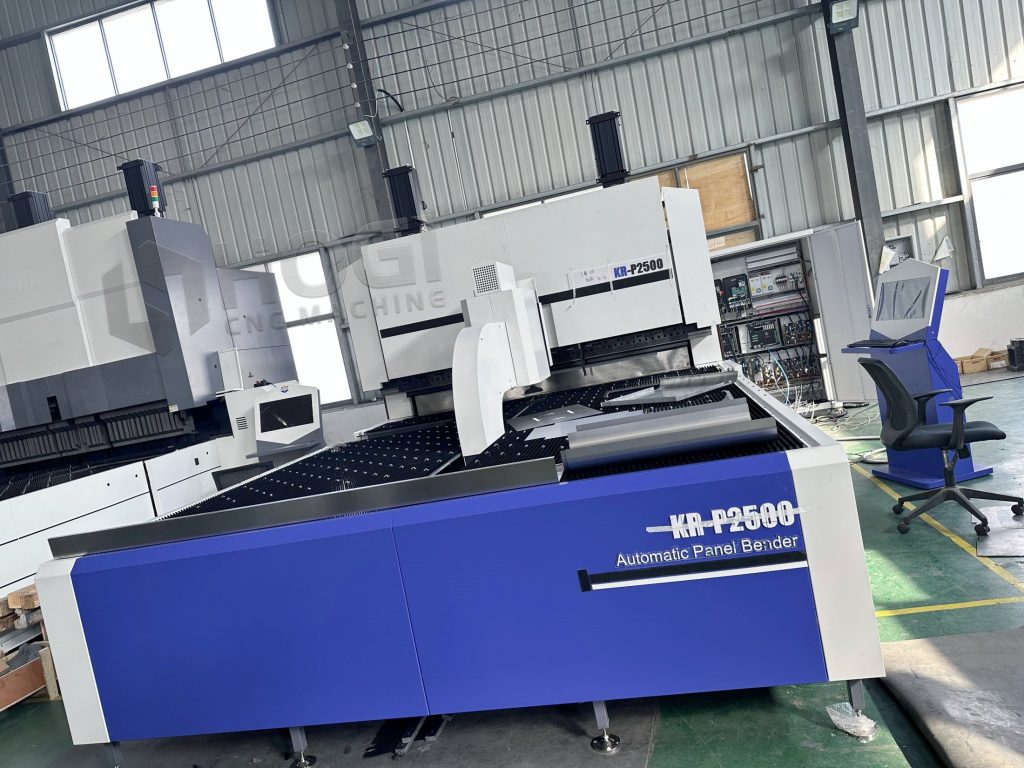
In many shops, bending is no longer a simple follow-up step after cutting. It is the point where schedules slow down, quality variation begins, and operator experience has the biggest impact on output. That is why the panel bending center is not just another machine; it is a different production logic for modern sheet metal fabrication.
Why Bending Has Become the Bottleneck
Laser cutting systems have made blank preparation faster and more precise, but the improvement has exposed a weakness in many factories: bending has not kept pace. Parts can now be produced quickly at the cutting stage, yet they still require multiple bends, flips, and manual checks before they become finished components. The bottleneck has simply shifted downstream.
Traditional bending relies heavily on skilled operators who know how to position the sheet, choose the right die, and compensate for springback. That skill is valuable, but it also creates a production ceiling. When one person becomes the main source of process control, throughput, consistency, and workforce availability all become risk factors.
This is especially visible in mixed-order production. A batch may contain cabinet shells, enclosure parts, and structural panels in the same shift. Each geometry can require a different tool setup or handling method, and every transition adds delay. Over time, the bending department becomes the pace-setting station for the entire shop.
What a Panel Bending Center Changes
A panel bending center changes the bending process from a manually managed sequence into a coordinated machine-led operation. Instead of asking an operator to perform every repositioning step, the system handles feeding, rotation, clamping, and bending through linked axes and programmed motion. That makes the process more repeatable and easier to standardize.
The most important shift is that the machine does not treat each bend as an isolated manual action. The sheet is presented to the tool, adjusted automatically, and bent according to a programmed sequence. This reduces the chance of handling error and shortens the time between operations.
Universal tooling is another major advantage. In many applications, one bending tool set can support arcs, return edges, dead edges, and closed shapes. That means the factory does not need to maintain a large library of custom dies for every product variation, which helps both cost control and scheduling.
How the Process Works
The workflow usually starts with graphical programming. The operator enters the part dimensions and the system calculates the bending logic automatically. That is a major difference from conventional bending, where the operator often has to decide the sequence step by step while managing the sheet by hand.
After programming, the machine handles the sheet with its gripping or suction mechanism. This stage matters because stable handling determines whether the part stays aligned throughout the sequence. Once the sheet position is controlled, the bending center can move it accurately between operations without manual flipping.
The bending action is then carried out with synchronized multi-axis motion. Because the sheet can be rotated and repositioned automatically, the machine can complete multi-sided forming in a more controlled cycle. The result is less handling time, fewer setup interruptions, and more consistent output across the batch.
Many systems also include detection and alarm functions. If the bending parameters are outside the expected range, the system can stop or warn the operator before the error becomes a batch-level quality issue. That kind of control is one reason the panel bending center is attractive in high-mix environments.
Why This Matters for Sheet Metal Factories
For factories making cabinets, enclosures, appliance housings, elevator panels, ventilation parts, or furniture components, the real challenge is rarely whether a bend can be made. The challenge is how many different bends must be made, how quickly the product mix changes, and how consistently the shop can keep output on schedule. A panel bending center addresses all three.
It also reduces dependence on scarce labor. Skilled bending operators are harder to hire and retain than many managers expect, and the learning curve for complex manual work can be long. A system that reduces manual dependence can make staffing easier while protecting output quality.
Safety is another operational reason to move toward automated bending. Large sheets, repeated manual positioning, and heavy tool interactions all increase the chance of injury and fatigue. A machine-centered workflow reduces direct handling and can improve the overall safety profile of the bending area.
Comparison Table
| Factor | Panel Bending Center | Traditional Press Brake | Manual Bending Workflow |
|---|---|---|---|
| Labor dependence | Low | High | Very high |
| Tooling changes | Minimal | Frequent | Frequent |
| Positioning accuracy | High | Operator dependent | Operator dependent |
| Repeatability | Strong | Moderate | Weak |
| Mixed-order production | Well suited | Partially suited | Limited |
| Safety level | Higher | Medium | Lower |
| Production consistency | Strong | Variable | Variable |
The comparison makes one point clear: the panel bending center is not mainly about brute force. It is about removing variation from the process and making bending less dependent on human timing, memory, and fatigue.
Where the Efficiency Gains Come From
The efficiency gains are usually cumulative rather than dramatic in a single step. Less tool changing means less downtime. Less manual repositioning means fewer opportunities for geometric error. Less rework means more good parts leave the line on the first pass.
Training efficiency also matters. If a machine can be programmed through a visual interface and the process logic is standardized, new operators do not need years of bending experience before contributing productively. That is a major advantage in factories facing labor turnover or rapid expansion.
Another gain comes from planning. Because the bending center can handle multiple shapes with one tool strategy, production managers can schedule work with fewer interruptions. That makes the bending department easier to manage and easier to synchronize with cutting and assembly.
Case Study
A sheet metal factory producing electrical cabinet shells was struggling to keep pace with its laser cutting output. Parts moved quickly through cutting, but the bending area became overloaded because each model required manual setup, repeated positioning, and careful attention from a limited number of experienced operators.
The factory introduced a panel bending center to handle the more repetitive and geometry-sensitive parts. The new workflow reduced the number of manual flips and tool changes, which made daily output more predictable. It also lowered operator fatigue during long shifts because the machine handled much of the movement and alignment work.
After the change, the factory was able to maintain a steadier flow between cutting, bending, and assembly. The improvement was not simply about faster cycle time; it was about smoother process balance across the entire production line.
Client Testimonial
“Our biggest problem was not cutting. It was the bending step behind it. After introducing a panel bending center, we reduced tool change time, stabilized output, and made the entire shop easier to manage. The learning curve was shorter than we expected, and our team adapted quickly.” — M. L., Production Manager, Sheet Metal Fabrication Industry
When a Panel Bending Center Is the Best Fit
A panel bending center is especially effective when a factory handles multiple product types, short-to-medium production runs, or parts with many bends per sheet. It is also a strong fit when repeatability matters more than operator improvisation. In those environments, the biggest gains usually come from process control rather than raw forming force.
It is commonly used for cabinet shells, electrical enclosures, appliance panels, ventilation components, and similar sheet metal products. These are the kinds of jobs where a small variation in bending can affect fit-up, assembly, or final product appearance. A controlled bending process is therefore not only a productivity advantage but also a quality advantage.
FAQs
What is a panel bending center?
A panel bending center is an automated sheet metal bending system that uses coordinated motion, automatic handling, and a universal tool set to form complex parts with less manual intervention.
How is it different from a press brake?
A press brake depends more heavily on manual positioning and tool changes, while a panel bending center automates more of the sequence and reduces operator dependence.
Does it need custom dies for each shape?
Not usually. One of the main benefits is that a universal bending tool can handle multiple shapes, which lowers tooling complexity and cost.
Is it suitable for cabinet and enclosure work?
Yes. It is often a strong fit for cabinet shells, electrical enclosures, appliance panels, and similar sheet metal products.
Does it help reduce scrap?
Yes. Better positioning control and automated sequence handling usually improve consistency and reduce error-related scrap.
Why Choose HOGI Panel Bending Center
HOGI CNC Machine focuses on intelligent sheet metal processing equipment, including panel benders, CNC press brakes, laser cutting machines, welding systems, robots, and flexible production units. For panel bending center applications, HOGI’s strength is in multi-axis linkage, universal bending die design, and automated handling that helps factories reduce labor dependence and improve production stability.
HOGI’s panel bending center is especially relevant for factories that need efficient bending of cabinet shells, appliances, ventilation parts, and other complex sheet metal products. Its value lies in combining practical automation with engineering-focused process control, making it a strong option for modern sheet metal production environments.
Authoritative sources
Computer simulation and experimental investigation of sheet metal bending
https://www.smu.edu/-/media/site/lyle/rcam/publications/3-computer-simulation-and-experimental-investigation-of-she.pdf
Measurement of springback
https://wpfiles.mines.edu/wp-content/uploads/aspprc/ResearchMaterials/Publications/216-Carden.pdf
Keeping metal fabrication shops safe and OSHA-compliant
https://www.tdi.texas.gov/tips/safety/metal-fabrication.html
Description for 3444: Sheet Metal Work
http://www.osha.gov/sic-manual/3444
Precision Metal Forming Services
https://www.tbsi.org/forming/