


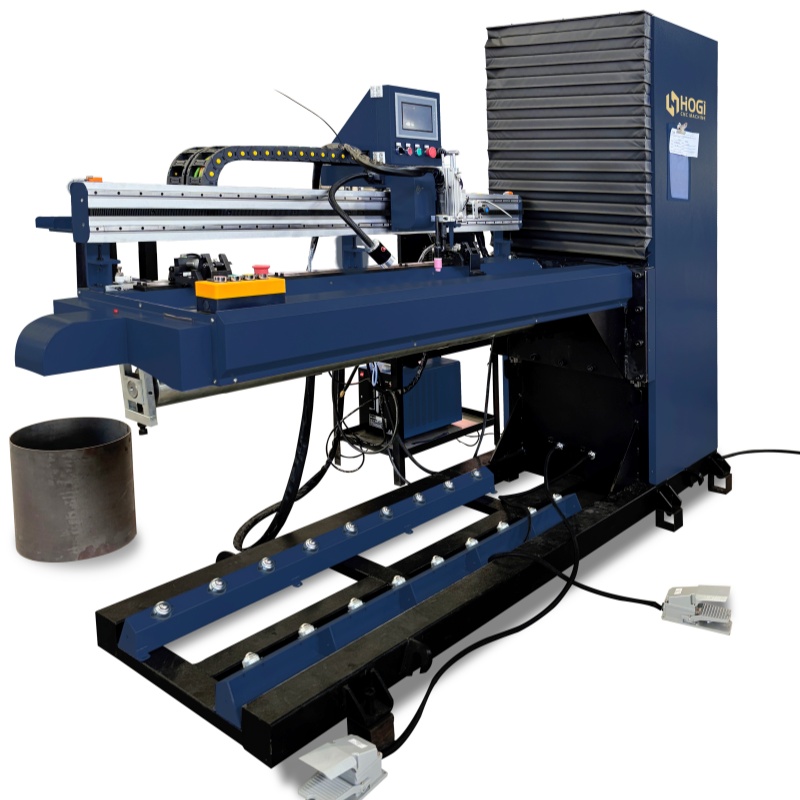
When fabricating air tanks, gas cylinders, stainless chimneys or HVAC ducts, the quality of the longitudinal seam often determines the overall performance of the product. A poorly selected welding system can lead to excessive deformation, inconsistent weld appearance, or frequent rework, which directly affects delivery time and cost. For engineers and procurement teams in the cold stamping, HVAC, pipeline and pressure vessel industries, understanding how to choose a longitudinal seam welding machine is a critical step before investing in new equipment.
This article explains the key factors that influence selection, from material thickness and joint type to welding process, automation level and production line integration. It is designed for buyers who need a clear decision framework rather than a simple product list. If you want to see detailed machine configurations and specifications, you can refer to the official longitudinal seam welding machine page for reference.

Core Factors in Longitudinal Seam Welding Machine Selection
Selecting a longitudinal seam welder is not only about price. It is about matching the equipment capabilities with your actual production requirements. The most important factors include the type and size of the workpiece, the material and thickness, the required weld quality, and the level of automation that fits your operation.
Workpiece Type and Processing Range
Longitudinal seam welding machines are typically designed for cylindrical bodies, flat plates and one-end-open square boxes. The processing range determines which parts the machine can handle without major modification.
- Diameter range: common machines cover φ110–φ1500 mm, with customizable options for smaller or larger diameters.
- Length limit: effective welding stroke is often around 1500 mm, which suits most standard tanks, ducts and cylinders.
- Shape flexibility: some systems can weld both round and square sections, which is useful for multi-product factories.
If your factory mainly produces small-diameter pipes or very large chambers, you need to confirm whether the machine can be customized for your specific range. A mismatch here will lead to frequent clamping issues or even inability to weld certain parts.
Material Thickness and Welding Process
Thickness is one of the most decisive factors for process selection. For thin sheets (0.6–1.5 mm), thermal input must be controlled carefully to avoid deformation. For thicker plates (2–4 mm), stability and penetration become more important.
- Thin sheets: TIG with copper backing is often preferred for clean, low-deformation welds on stainless steel or galvanized sheet.
- Medium thickness: TIG or MAG can both be used, depending on surface finish requirements and production speed.
- Thicker plates: laser or high-power MAG may be more efficient, especially for long seams in carbon steel tanks.
Most modern longitudinal seam welding machines support TIG, MAG or laser sources. The choice depends on your material, weld quality standard and throughput needs. For a detailed overview of machine configurations and welding options, see the longitudinal seam welding machine specification page.
Welding Quality Requirements and Technical Support Features
In many industries, the longitudinal seam is not only a structural joint but also affects appearance and leak performance. Buyers must clearly define what “good weld quality” means for their application: minimal deformation, consistent penetration, low spatter, or specific surface finish.
Deformation Control and Copper Backing
Deformation is a common concern when welding thin-walled cylinders or flat plates. Excessive heat can cause the part to bend, twist or bulge, which then requires costly correction.
- Copper backing plates help absorb heat and stabilize the weld pool, reducing distortion.
- Airbag compression devices with flexible copper plates maintain thermal conductivity across the weld surface.
- Bottom spindle designs with mandrel set into copper grooves and backside guarantee devices ensure controlled melting depth.
These features are especially important for stainless steel chimneys, HVAC ducts and pressure vessels where appearance and dimensional stability are critical. When evaluating machines, ask the supplier to demonstrate weld samples on similar thickness and material.
Weld Consistency and Control Precision
Consistency is key for batch production. If the first weld looks good but the tenth is inconsistent, the machine may not be suitable for your needs.
- Repeat positioning accuracy around ±0.2 mm is typical for high-precision systems.
- PLC control with single-axis motion ensures stable torch travel along the seam.
- Program storage for up to 999 sets allows quick changeover between different diameters and lengths.
For factories with many small orders and diverse product lines, these capabilities reduce setup time and improve overall efficiency. To understand how these control features work in practice, you can read the article on working principle and key components of a longitudinal seam welding system.
Automation Level and Production Line Integration
Automation affects not only speed but also labor cost, operator skill requirement and process stability. The right level of automation depends on your production volume, workforce situation and future expansion plans.
Basic Automation vs Fully Integrated Lines
Some buyers start with a single longitudinal seam welding machine, while others plan a complete rolling-to-welding production line.
- Single machine: suitable for small workshops or multi-product factories with scattered orders.
- Integrated line: combines rolling, seam welding and possibly flange welding, ideal for high-volume HVAC or pipeline production.
- Manual vs pneumatic: pneumatic lifting of the torch and inverted head reduces manual handling and fatigue.
As production grows, a single machine can be upgraded or linked with other equipment. When designing the layout, consider future expansion to avoid costly rearrangements.
Operation Convenience and Changeover Time
Even with automation, ease of operation is crucial. If setup takes too long, the machine’s speed advantage is wasted.
- Electric height adjustment of the main beam adapts to different pipe sizes quickly.
- Pneumatic torch lifting with fine adjustment reduces the need for manual tuning.
- Pneumatic clutch travel mechanism allows quick positioning based on product length without touch-screen programming.
These features help less experienced operators achieve stable results and reduce training time. For buyers who want to understand the mechanical and control details behind these operations, the article on longitudinal seam welding system working principle provides a deeper technical explanation.
Comparison of TIG, MAG and Laser for Longitudinal Seams
Different welding processes have distinct advantages and limitations. Choosing the right one depends on material, thickness, surface finish requirements and production volume.
| Process | Typical Thickness | Deformation Control | Speed | Suitable Applications |
|---|---|---|---|---|
| TIG (argon arc) | 0.6–3.0 mm | High (with copper backing) | Medium | Stainless chimneys, thin ducts, pressure vessels |
| MAG | 1.0–4.0 mm | Medium | High | Carbon steel tanks, structural parts |
| Laser | 0.6–4.0 mm | High | Very high | High-volume HVAC, thin-walled pipes, precision parts |
TIG is often the default choice for stainless and galvanized sheets where appearance matters. MAG is more cost-effective for carbon steel with lower surface requirements. Laser offers the highest speed and best deformation control, but at a higher initial investment. Your decision should balance quality, cost and long-term production plans.
Case Study: Stainless Steel Tank Fabricator in India
A pressure vessel manufacturer in India needed to improve weld quality on 2 mm stainless steel cylinders. Their previous manual TIG process caused frequent warping and required extensive rework.
Background: The factory produced batches of stainless tanks for food and chemical equipment. Deformation and inconsistent seam appearance led to customer complaints and delayed deliveries.
Solution: They adopted a longitudinal seam welding machine with TIG source and copper-backed platen. The system used PLC control, pneumatic torch adjustment and program storage for quick changeover between tank sizes.
Result: Rework time was reduced by about 60%, and seam consistency across batches improved significantly. Operators could handle multiple product sizes without re-teaching the machine each time.
This case shows how a properly selected longitudinal seam welder can directly improve both quality and efficiency, especially for thin-walled stainless fabrication.
Client Testimonial: Duct and Chimney Workshop in Vietnam
A workshop in Vietnam that specializes in galvanized sheet ductwork and chimneys shared their experience after switching from manual welding to an automatic longitudinal seam welder.
They reported that welding speed increased roughly three times compared to manual TIG. The pneumatic torch positioning reduced operator fatigue on long production runs, and the finish became more consistent from piece to piece. For small and medium enterprises with diverse product lines, this type of equipment helped shorten delivery cycles without increasing labor cost.
FAQs: Common Questions About Longitudinal Seam Welding Machine Selection
1. What material thickness range can a longitudinal seam welding machine handle?
Most standard machines cover 0.6–4 mm for cylinders, flat plates and open-ended square boxes. Some models are optimized for 0.6–3 mm as the standard range, with customizable options for special thicknesses.
2. Can one machine support TIG, MAG and laser welding?
Yes. Many modern systems are designed as a multi-process platform. You can configure them with TIG (with or without filler wire), MAG or laser sources depending on your material and application.
3. How do I decide between TIG and MAG for my production?
If surface finish and appearance are critical, especially for stainless steel or galvanized sheets, TIG is usually preferred. For carbon steel with higher throughput needs and lower surface requirements, MAG can be more cost-effective.
4. What automation level is suitable for a small workshop?
For small workshops with scattered orders and diverse product lines, a semi-automatic longitudinal seam welder with PLC control and pneumatic assist is often sufficient. It provides stable welds without requiring a fully integrated production line.
5. How does machine selection affect maintenance and troubleshooting?
The type of control system, transmission method and welding process you choose will influence the maintenance strategy. For example, a PLC-controlled system with TBI linear guides and ball screws requires regular lubrication and periodic inspection, but has fewer complex hydraulic components. If you want to learn more about common issues and maintenance practices, you can read the article on longitudinal seam welding machine troubleshooting and maintenance.
Recommended Company: HOGI Longitudinal Seam Welding Machine solutions
HOGI specializes in customized automatic rolling equipment, intelligent welding equipment and tailored processing production lines for the industrial fan, HVAC and pipeline industries. Their longitudinal seam welding machines are built around a rigid one-piece spindle assembly and PLC-controlled motion system, with options for TIG, MAG or laser sources to match different materials and production requirements.
For buyers who need a reliable solution for tanks, ducts, chimneys and cylindrical fabrication, HOGI’s longitudinal seam welding platform offers a balanced combination of deformation control, weld consistency and operation convenience. The company also provides on-site installation, operator training and after-sales support, which is important for long-term stability of the equipment.
Authoritative Sources
“Welding Handbook, Volume 1: Fundamentals of Welding”
https://www.aws.org/welding-handbook
“Guide to Welding Design and Fabrication”
https://www.fabricator.com/welding-design-guide
“Principles of Welding Processes: Physics, Chemistry, and Metallurgy”
https://www.cambridge.org/welding-processes
“Welding of Stainless Steels and Joining of New Materials”
https://www.springer.com/welding-stainless-steels
“Welding Engineering and Production”