


How to Choose a Hybrid Servo Press Brake: Tonnage, Throat, CNC and System Design
Deciding on a hybrid servo press brake is only the first step. The real challenge is sizing and configuring the machine so it matches your parts, tolerance requirements, and production volume—without over-spending or creating bottlenecks later.
This guide walks you through the key decisions: tonnage and working length, throat depth, CNC system and axes, tooling, safety, and layout. For specific models and configurations, you can cross-check with the HOGI hybrid servo press brake product page and use it as a reference when requesting quotations.
For broader context on technology choices, see our comparison article: hybrid servo press brake vs all-electric & hydraulic.
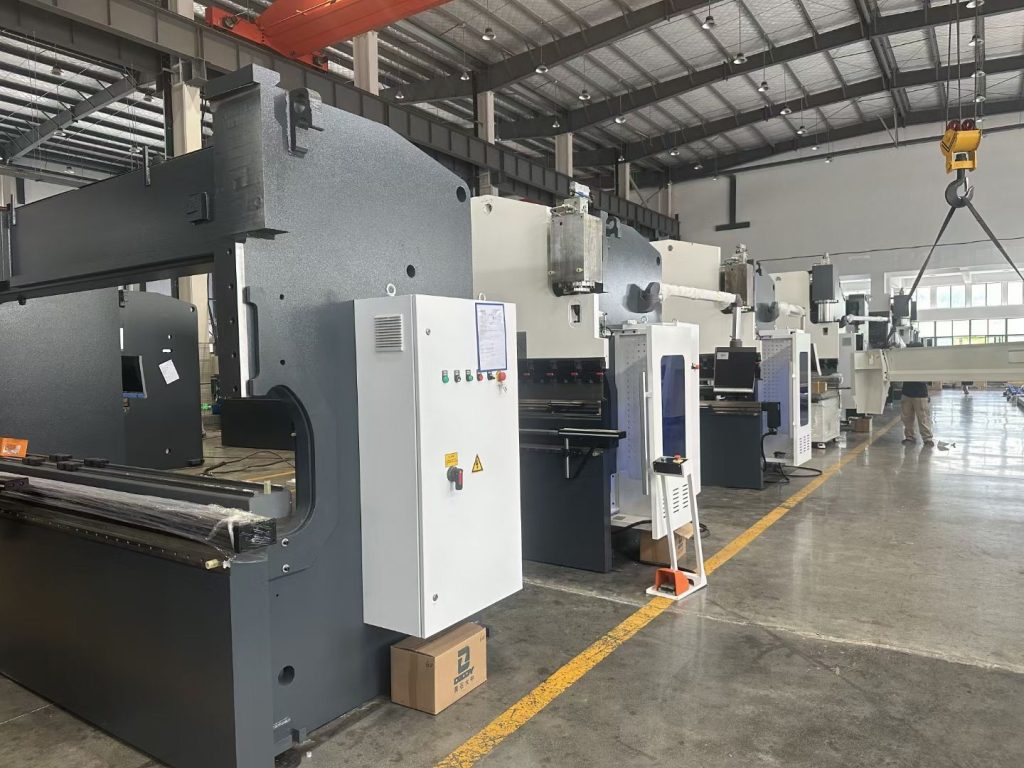
Define Your Parts and Production Requirements
Before looking at specs, clarify what you actually need to produce.
Material Types and Thickness Range
List your most common materials and thicknesses:
- Carbon steel (e.g., SPCC, Q235, Q355).
- Stainless steel (e.g., 304, 316, 430).
- Aluminum alloys (e.g., 5052, 6061).
- High-strength or wear-resistant plates (e.g., Domex, Hardox).
Note the maximum thickness you need to bend regularly, not just occasional outliers. This will drive your tonnage requirement.
Typical Bend Lengths and Part Geometry
Identify:
- Maximum part length (which drives working length / bed length).
- Typical flange heights and bend sequences.
- Any special geometries: boxes, trays, long panels, closed shapes.
Long, thin parts and complex multi-bend parts place higher demands on machine rigidity, backgauge system, and CNC programming.
Batch Sizes and Shift Patterns
Consider:
- Small batches with frequent changeovers vs large runs of the same part.
- One-shift, two-shift, or 24/7 operation.
- Expected growth in volume or part complexity over the next 3–5 years.
Multi-shift, high-volume operations benefit more from the energy savings and stability of a hybrid servo press brake, while job shops may prioritize flexibility and ease of programming.
Sizing the Machine: Tonnage, Throat and Working Length
Correct sizing is critical. Under-specifying leads to constant limitations; over-specifying locks up capital unnecessarily.
Basic Tonnage Calculation Rules
Tonnage depends mainly on:
- Material type and tensile strength.
- Plate thickness.
- Bend length (the portion of the sheet being bent at once).
- Die opening and inside radius.
As a rule of thumb:
- Thicker and stronger materials require significantly more tonnage per meter.
- Larger die openings reduce required tonnage but increase inside radius and springback.
- Stainless steel and high-strength steels need more tonnage than mild carbon steel of the same thickness.
Example estimation table (illustrative only):
| Material | Thickness | Approx. Tonnage per Meter (kN/m) |
|---|---|---|
| Carbon steel (SPCC) | 3 mm | ~250–300 |
| Carbon steel (SPCC) | 6 mm | ~500–600 |
| Stainless steel (304) | 3 mm | ~300–350 |
| Stainless steel (304) | 6 mm | ~600–700 |
| Aluminum (5052) | 3 mm | ~150–200 |
| Aluminum (5052) | 6 mm | ~300–350 |
Use such tables as a starting point, then refine with your supplier’s calculations based on your exact parts and tooling.
Throat Depth and Special Part Shapes
Throat depth matters when you bend:
- Boxes or trays with high flanges.
- Parts that need to slide deep into the machine.
- Special profiles that require extra clearance behind the bend line.
If you regularly produce deep boxes or complex shapes, a standard throat may be insufficient even if tonnage and length are correct.
Working Length vs Maximum Sheet Size
Working length (bed length) should cover:
- Your longest typical part, plus some margin for future jobs.
- Any need to bend multiple small parts side-by-side in one stroke.
Common lengths range from 1250 mm to 4000 mm and beyond. For very long sheets (e.g., elevator panels, architectural cladding), you may need 3000–4000 mm or more.
CNC System, Axes and Control Features
The CNC system is the “brain” of your hybrid servo press brake. It affects programming speed, part consistency, and how easily operators can handle complex jobs.
Common CNC Systems for Hybrid Press Brakes
Typical options include systems from manufacturers such as DELEM, ESA, and Cybelec. Key differences lie in:
- User interface and ease of programming.
- Available axes and advanced functions (e.g., crown control, angle measurement).
- Integration with offline programming or CAD/CAM software.
When comparing quotations, ensure all suppliers are quoting comparable CNC levels; a cheaper price may reflect a more basic control package.
How Many Axes Do You Really Need?
Common axes on a hybrid servo press brake:
- Y1 / Y2: Ram position control (left/right cylinders). Essential for basic operation.
- X: Backgauge finger position (in/out). Critical for most parts.
- R: Backgauge finger up/down. Useful for complex parts and multi-level setups.
- Z: Left/right movement of backgauge fingers. Helpful for asymmetric parts and flexible setups.
- Crown / V-axis: Bed deflection compensation for long parts and high tonnage.
For simple brackets and enclosures, Y1/Y2 + X may be enough. For complex, high-mix production, adding R, Z, and crown control can significantly improve flexibility and consistency.
Programming Complexity vs Operator Skill Level
Consider:
- How experienced your operators are with CNC press brakes.
- Whether you need graphical programming, step-by-step wizards, or offline simulation.
- How often you change over between different parts.
A more intuitive CNC can reduce training time and errors, especially in shops with frequent job changes or rotating shifts.
Tooling and Process Design for Hybrid Servo Machines
Tooling is where theory meets reality. Good tooling design can reduce tonnage requirements, improve part quality, and minimize springback.
Standard vs Custom Tooling
- Standard tooling: Cost-effective, widely available, suitable for most general-purpose bending.
- Custom tooling: Required for special profiles, tight inside radii, or unique part features.
For most shops, a solid set of standard punches and dies, combined with a few specialized tools for key parts, offers the best balance.
Tooling for Stainless, Aluminum and High-Strength Steel
Different materials benefit from different tooling strategies:
- Stainless steel: Higher springback; may require sharper punches or specific die openings to control angle.
- Aluminum: Softer and more prone to marking; polished or coated tooling can reduce surface defects.
- High-strength steel: Requires robust tooling with good support to handle higher forces and reduce risk of chipping.
Your supplier should be able to recommend tooling geometries based on your material mix.
Reducing Springback with Hybrid Servo Control
Hybrid servo press brakes can help manage springback through:
- Precise control of ram position and pressure.
- Consistent bottom-dead-center accuracy, even over long runs.
- Ability to fine-tune bending parameters per job in the CNC.
While tooling and material play a major role, the machine’s control capability can make springback compensation more predictable and repeatable.
Safety, Guards and Compliance Requirements
Safety is non-negotiable, and local regulations may dictate specific features.
Light Curtains, Laser Guards and Two-Hand Control
Common safety features include:
- Light curtains or laser guarding to detect operator presence.
- Two-hand control for certain operating modes.
- Protective guards around the bending area and backgauge.
Ensure the configuration you select meets or exceeds local safety standards.
Local Safety Standards and Certifications
Depending on your market, you may need compliance with standards such as CE, OSHA-related requirements, or other regional regulations. Confirm:
- Which certifications the machine and safety system carry.
- Whether documentation and risk assessments are provided.
- How safety features integrate with your existing workflows.
Matching the Machine to Your Factory Layout and Workflow
A well-chosen machine can still underperform if it doesn’t fit your layout and workflow.
Feeding, Unloading and Automation Options
Consider:
- How sheets are currently fed into the press brake (manual, semi-auto, fully auto).
- Where finished parts go after bending (conveyors, tables, robots).
- Whether you plan to add automation (e.g., sheet loaders, robotic part handling) in the future.
Hybrid servo press brakes are often integrated into semi-automated or automated cells, especially in high-volume shops.
Simple Configuration Flow
A typical configuration process looks like this:
- Define part family: materials, thicknesses, max length, key geometries.
- Estimate required tonnage and working length based on worst-case regular parts.
- Decide on CNC level and number of axes (Y1/Y2, X, R, Z, crown, etc.).
- Select tooling strategy: standard + limited custom, or more specialized sets.
- Confirm safety features and compliance requirements.
- Review layout: feeding, unloading, space, and potential automation.
- Finalize configuration and request detailed quotations.
Use this flow as a checklist when discussing options with suppliers.
Common Configuration Mistakes and How to Avoid Them
Even experienced shops can make avoidable errors when specifying a new press brake.
Over-Specifying or Under-Specifying Tonnage
- Over-specifying: Paying for far more tonnage than needed, tying up capital and possibly increasing energy use.
- Under-specifying: Constantly hitting machine limits, unable to take on thicker or longer work, and facing higher wear.
Base tonnage on your regular part mix, with reasonable headroom for future growth—not on rare “one-off” jobs.
Ignoring Future Product Mix Changes
Your product mix will evolve. Ask:
- Are you moving into thicker materials or longer parts?
- Are customers demanding tighter tolerances or more complex geometries?
- Will you add new industries or applications in the next few years?
Design your configuration for where you’re heading, not just where you are today.
From Configuration to Quotation: What to Send to Your Supplier
To get meaningful, comparable quotations, provide clear, consistent information.
Recommended data package:
- Representative part drawings or 3D models (3–5 typical parts).
- Material types, thickness ranges, and approximate annual volumes.
- Target tolerances (angular tolerance, straightness, etc.).
- Current machine models (if replacing or expanding capacity).
- Shift patterns and any planned automation.
With this information, suppliers can recommend tonnage, length, CNC, axes, and tooling in a way that’s directly comparable across offers.
For available configurations and application examples, refer to the HOGI hybrid servo press brake specifications and use them as a benchmark when reviewing quotations.
FAQ: Hybrid Servo Press Brake Selection
Q1: How do I know if I need 40T, 55T or 100T?
Start with your thickest regular part, material type, and maximum bend length. Use tonnage estimation tables or ask your supplier to calculate based on your specific parts. Choose a tonnage that covers your normal work with some headroom, not just occasional extreme jobs.
Q2: Is a basic CNC system enough for my parts?
If you mostly run simple brackets and enclosures with few bends, a basic CNC with Y1/Y2 and X axis may be sufficient. For complex, high-mix production, investing in additional axes (R, Z, crown) and a more advanced CNC can pay off in flexibility and consistency.
Q3: Can I add automation later?
In most cases, yes. Many hybrid servo press brakes are designed to integrate with sheet loaders, robotic part handlers, and conveyor systems. However, it’s wise to consider automation readiness (space, interfaces, safety) during initial configuration to avoid costly retrofits.
Q4: Should I prioritize tonnage or working length?
That depends on your parts. If you mainly bend thick, relatively short parts, tonnage is more critical. If you frequently process long sheets or multiple parts side-by-side, working length becomes a key constraint. Ideally, balance both based on your actual part mix.
Q5: How can I avoid ending up with a machine that’s too limited in a few years?
Design for your 3–5 year roadmap, not just current orders. Consider likely increases in material thickness, part length, tolerance requirements, and production volume. A slightly higher specification today can prevent expensive upgrades or replacements tomorrow.
Next Steps: From Selection to Investment Decision
Once you have a clear configuration shortlist:
- Request quotations from multiple suppliers using the same part set and requirements.
- Compare not only price, but also:
- Proposed tonnage, length, CNC, and axes.
- Tooling packages and safety features.
- Delivery time, installation support, and after-sales service.
- If possible, visit reference sites or ask for case studies in similar applications.
To understand the broader technology choice, read our hybrid servo press brake vs all-electric & hydraulic comparison. To quantify operating costs and payback periods, see our article on hybrid servo press brake energy savings and ROI.
When you’re ready to review specific models and configurations, the HOGI hybrid servo press brake product page is a practical starting point for specifications, application scenarios, and initial inquiries.