


Many shops know that a hybrid servo press brake can save energy compared to a traditional hydraulic machine. The harder question is: how much will your factory actually save, and how long will it take to pay back the investment?
This article shows you how to calculate real energy savings, operating costs and ROI for a hybrid servo press brake, with formulas, example calculations and typical payback scenarios. For specific machine specs and configurations, refer to the HOGI hybrid servo press brake product page.
If you are still deciding between technologies, start with our hybrid servo press brake vs all-electric & hydraulic comparison. If you are already leaning toward hybrid, see our selection and configuration guide for sizing and CNC choices.
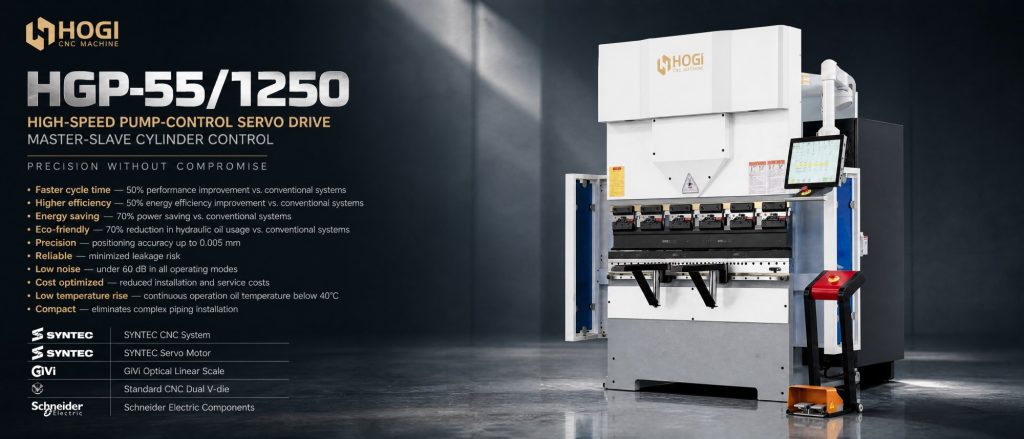
Introduction: Why Energy and ROI Matter for Hybrid Servo Press Brakes
Purchase price is only part of the story. Over 5–10 years, operating costs—especially electricity, hydraulic oil, maintenance and scrap—can equal or exceed the initial investment.
A hybrid servo press brake typically costs more upfront than a basic hydraulic machine, but delivers:
- Lower electricity consumption through power-on-demand operation.
- Reduced hydraulic oil volume and longer oil change intervals.
- Better precision stability, which can lower scrap and rework.
- Lower noise and heat, improving workshop conditions.
The key is to quantify these benefits in your own context, so you can present a clear business case to management or finance.
Where Does a Press Brake Consume Energy?
Understanding where energy goes makes it easier to estimate savings.
Main Motor and Hydraulic System
In a traditional hydraulic press brake:
- The main oil pump motor often runs continuously, even when the ram is not moving.
- Energy is lost as heat due to overflow and pressure losses in the hydraulic system.
- Long runs cause oil temperature rise, which can affect accuracy and require additional cooling.
In a hybrid servo system, the servo motor drives the pump only when pressure and motion are required, significantly reducing idle and partial-load losses.
Idle Power and Standby Losses
Even when not bending, machines consume power:
- CNC system, drives and control electronics remain on.
- Hydraulic pumps may circulate oil during idle periods.
- Operators often leave machines running during breaks or shift changes.
Hybrid servo press brakes can stop the servo motor completely when the ram is idle, cutting standby power to a fraction of traditional hydraulic machines.
Auxiliary Systems (CNC, Cooling, Lighting)
Don’t forget auxiliary loads:
- CNC and control systems (relatively small but continuous).
- Cooling fans or chillers for hydraulic oil or electronics.
- Workshop lighting and ventilation around the machine.
While these are not directly part of the press brake drive, they contribute to the overall energy picture, especially in multi-shift operations.
How Hybrid Servo Technology Reduces Energy Use
You don’t need a deep dive into hydraulic schematics to understand the main advantages.
Power-On-Demand vs Continuous Motor Operation
In simple terms:
- Traditional hydraulic: Motor runs most of the time, consuming power even when the ram is stationary.
- Hybrid servo: Servo motor runs only when the ram moves or pressure is needed; it stops completely during idle periods.
This “power on demand” approach is the primary source of energy savings in hybrid servo press brakes.
Reduced Overflow Losses and Heat Generation
Hybrid systems:
- Generate pressure only when required for bending or ram movement.
- Reduce high-pressure overflow, which is a major source of heat in traditional hydraulic systems.
- Keep oil temperature more stable, reducing or eliminating the need for oil coolers in many cases.
Less heat means less energy wasted and better long-term precision stability.
Step-by-Step: Calculating Energy Savings for Your Shop
The goal is to compare annual electricity costs between your current (or baseline) hydraulic press brake and a proposed hybrid servo machine, using your actual operating data.
Data You Need to Collect
Gather the following information:
- Motor power of current hydraulic press brake (kW, from nameplate or documentation).
- Average load factor (what percentage of rated power the motor actually uses during typical operation).
- Operating hours per day and days per year (including shifts, breaks, and typical idle time).
- Electricity price (per kWh, including any demand charges if applicable).
- Estimated idle ratio (percentage of time the machine is on but not bending).
If you don’t have precise measurements, you can use reasonable estimates based on operator feedback and typical job patterns.
Simple Calculation Approach
Step 1: Estimate annual energy consumption for the hydraulic machine
Formula:
Annual energy (kWh) = Motor power (kW) × Load factor × Operating hours per year
Example:
- Motor power: 15 kW
- Load factor: 0.7 (motor runs at about 70% of rated power on average)
- Operating hours: 2 shifts × 8 hours × 250 days = 4,000 hours/year
Annual energy = 15 kW × 0.7 × 4,000 h = 42,000 kWh/year
Step 2: Estimate annual energy consumption for the hybrid servo machine
Hybrid servo machines typically consume 30%–70% less energy, depending on part mix and idle ratio. For a conservative estimate, assume 40% savings.
Hybrid annual energy = 42,000 kWh × (1 − 0.40) = 25,200 kWh/year
Step 3: Calculate annual energy savings
Energy savings = 42,000 − 25,200 = 16,800 kWh/year
If electricity costs $0.12/kWh:
Annual cost savings = 16,800 kWh × $0.12 = $2,016/year per machine
For multiple machines or higher electricity prices, the savings scale proportionally.
Example Comparison Table
The table below shows a simplified comparison for a single machine, two-shift operation.
| Item | Traditional Hydraulic | Hybrid Servo Press Brake |
|---|---|---|
| Motor power | 15 kW | Equivalent servo system |
| Load factor (average) | 0.7 | ~0.4–0.5 (due to power-on-demand) |
| Operating hours | 4,000 h/year | 4,000 h/year |
| Annual energy consumption | ~42,000 kWh | ~21,000–25,000 kWh (approx. 40–50% less) |
| Electricity price | $0.12/kWh | $0.12/kWh |
| Annual electricity cost | ~$5,040 | ~$2,520–$3,000 |
| Estimated annual savings | ~$2,000–$2,500 per machine (depending on actual usage) | |
Adjust these numbers to your own motor power, shifts, electricity price and part mix to get a realistic estimate.
Beyond Electricity: Other Cost Factors in ROI
Energy is only one part of the equation. To build a complete business case, consider other operating cost differences.
Hydraulic Oil Consumption and Disposal
Hybrid servo press brakes typically use 50%–70% less hydraulic oil than conventional hydraulic machines. This affects:
- Initial oil fill volume (lower cost).
- Oil change frequency (often extended due to lower temperatures and contamination).
- Waste oil disposal costs and environmental compliance.
Over 5–10 years, reduced oil usage and disposal can add up to a meaningful amount, especially in larger machines or multi-machine shops.
Maintenance Labor and Spare Parts
Lower average pressure and temperature in hybrid systems can lead to:
- Slower aging of seals, hoses and valves.
- Fewer leaks and less unplanned downtime.
- Longer intervals between major overhauls.
While exact figures depend on your maintenance practices and machine utilization, many shops report lower annual maintenance costs and fewer emergency repairs with hybrid servo machines.
Scrap Rate and Rework Due to Precision Issues
Better precision stability can reduce:
- Angle drift over long runs, especially as oil temperature changes.
- Part-to-part variation in multi-shift operation.
- Time spent on adjustments and rework.
Even a small reduction in scrap or rework can have a significant financial impact when you run large batches or high-value parts.
Realistic Payback Periods for Different Shop Profiles
Payback period depends on three main factors:
- Additional upfront cost of the hybrid servo machine vs a basic hydraulic alternative.
- Annual operating cost savings (energy, oil, maintenance, scrap).
- Number of machines upgraded and their utilization levels.
Single-Shift Job Shops
Typical characteristics:
- One shift, moderate utilization.
- Lower absolute energy consumption per machine.
- More varied part mix, smaller batches.
In this scenario:
- Energy savings per machine are smaller than in multi-shift operations.
- Payback periods tend to be longer, often in the range of several years.
- Other benefits (precision, noise, oil reduction) may still justify the investment, especially if you plan to grow or move into higher-value work.
Two-Shift and 24/7 Production Lines
Typical characteristics:
- Two or three shifts, high utilization.
- Large annual operating hours per machine.
- Repetitive or semi-repetitive part families.
In this scenario:
- Energy savings per machine are substantial due to high running hours.
- Reduced scrap and maintenance costs have a larger absolute impact.
- Payback periods are often significantly shorter, sometimes within a few years, depending on the price difference and local electricity costs.
For shops running multiple machines under these conditions, upgrading the entire fleet can multiply the savings and shorten the overall payback at the facility level.
How to Present the Business Case to Management or Finance
To get approval, your analysis needs to be clear, conservative and easy to understand.
Simple One-Page ROI Summary
Create a one-page summary that includes:
- Current situation: number of machines, shifts, estimated annual energy use and costs.
- Proposed investment: number of hybrid servo press brakes, approximate additional cost vs baseline hydraulic option.
- Estimated annual savings: energy, oil, maintenance, scrap (with assumptions clearly stated).
- Payback period: additional investment divided by annual savings.
- Sensitivity analysis: how payback changes if electricity prices or utilization differ from your base case.
Keep the numbers realistic and document your assumptions so they can be reviewed and adjusted if needed.
Sensitivity Analysis (Electricity Price, Shift Changes)
Show at least two or three scenarios:
- Base case: Your best estimate of shifts, energy price and savings.
- Conservative case: Lower utilization or smaller energy savings.
- Optimistic case: Higher electricity prices or higher utilization (e.g., adding a shift).
This demonstrates that the investment remains reasonable even if conditions change slightly.
FAQ: Energy Savings and ROI for Hybrid Servo Press Brakes
Q1: What is a typical payback period for a hybrid servo press brake?
Payback periods vary widely based on shifts, electricity prices and machine utilization. Single-shift shops may see payback over several years, while two-shift or 24/7 operations often achieve significantly shorter payback, sometimes within a few years, especially when multiple machines are upgraded.
Q2: Do energy savings depend on material type?
Indirectly, yes. Material type affects cycle times, tonnage usage and part complexity, which in turn influence how often the motor is under load versus idle. However, the main driver of savings is operating time and idle ratio, rather than material alone.
Q3: How do shift patterns affect ROI?
More shifts mean more operating hours, which increases absolute energy savings per year. Hybrid servo press brakes show the strongest ROI in multi-shift or 24/7 environments where the machine is running most of the time.
Q4: Should I include oil and maintenance savings in my calculation?
Yes. While energy is usually the largest component, including reduced oil consumption, extended oil change intervals, and lower maintenance costs gives a more complete picture of total savings and shortens the calculated payback period.
Q5: What if my electricity price is relatively low?
Even with lower electricity prices, hybrid servo press brakes can still be attractive when you factor in precision improvements, reduced scrap, lower noise and better workshop conditions. The energy savings will be smaller in monetary terms, but other operational benefits may still justify the investment.
Next Steps: From Calculation to Quotation
Once you have a rough estimate of energy savings and payback:
- Refine your assumptions with real data from your shop (meter readings, maintenance records, scrap reports).
- Request quotations for both hydraulic and hybrid servo options based on the same part set and configuration level.
- Compare total cost of ownership over 5–10 years, not just purchase price.
- Use the HOGI hybrid servo press brake product page as a reference for specifications, configurations and initial inquiries.
To put the energy discussion in context with other technology choices, read our hybrid servo press brake vs all-electric & hydraulic comparison. For help sizing and configuring a machine for your parts, see our hybrid servo press brake selection guide.