


Choosing the right press brake technology is one of the most important decisions a sheet metal shop can make. Today, three main options dominate the market: traditional hydraulic press brakes, all-electric servo press brakes, and hybrid servo press brakes.
This article focuses on practical comparison and selection logic—not marketing slogans. By the end, you should have a clear view of when a hybrid servo press brake is the best fit, and when it makes more sense to stay with hydraulic or move to all-electric. For specific models, configurations and quotations, the HOGI hybrid servo press brake product page is the right starting point.
Quick Overview: How the Three Technologies Differ
Hydraulic Press Brakes – Strengths and Weaknesses
Traditional hydraulic press brakes have been the backbone of sheet metal fabrication for decades.
Typical strengths:
- Very high tonnage availability at relatively low initial cost.
- Robust structure, proven reliability in heavy-duty applications.
- Wide range of used machines and third-party support.
Common weaknesses:
- High energy consumption: main oil pump motor often runs continuously.
- Oil temperature rise affects bending accuracy during long runs.
- Higher noise levels and more hydraulic oil to maintain and dispose of.
Hydraulic machines are still a solid choice for some shops, especially where initial budget is tight and precision/energy efficiency are secondary.
All-Electric Servo Press Brakes – Where They Shine
All-electric press brakes use servo motors to directly drive the ram (via ball screws or similar mechanisms), with no hydraulic oil.
Typical strengths:
- Extremely high precision and repeatability, ideal for small, high-value parts.
- Very low energy consumption, especially in light-load or intermittent operation.
- Clean, oil-free operation—suitable for cleanrooms and sensitive environments.
Common weaknesses:
- Tonnage is usually limited compared to hydraulic and hybrid machines.
- Higher initial cost per ton in many cases.
- May be over-specified for heavy, thick-plate work where extreme precision is less critical.
All-electric machines excel in industries like electronics, medical devices, and precision instrumentation.
Hybrid Servo Press Brakes – The Middle Ground
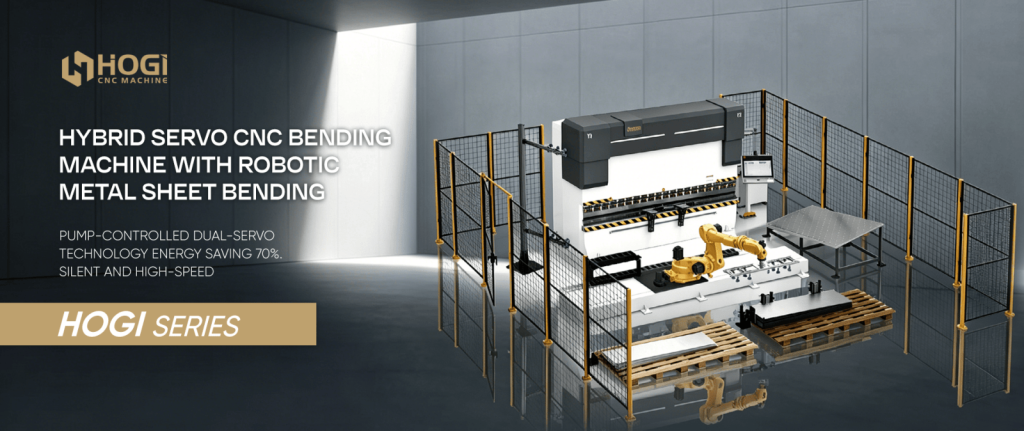
A hybrid servo press brake combines a hydraulic structure with a servo-driven pump system. Instead of a constantly running motor, a servo motor drives a bidirectional fixed-displacement pump, generating pressure only when needed.
Typical strengths:
- High tonnage capability closer to traditional hydraulic machines.
- Significant energy savings (often 30%–70%) through power-on-demand operation.
- Better precision stability than conventional hydraulic presses, with slower oil temperature rise.
- Lower noise and reduced oil volume compared to traditional hydraulic designs.
Hybrid servo press brakes are designed for shops that need both power and precision, with much better energy efficiency than old-school hydraulic machines.
Head-to-Head Comparison: Hybrid Servo vs All-Electric vs Hydraulic
The table below summarizes the key differences that matter in daily production and long-term cost of ownership.
| Criterion | Hydraulic Press Brake | All-Electric Servo Press Brake | Hybrid Servo Press Brake |
|---|---|---|---|
| Tonnage range | Very high (hundreds to 1000T+) | Typically lower to medium | Medium to very high |
| Positioning accuracy | Good, but affected by oil temperature | Excellent, very stable | Very good, much better than conventional hydraulic |
| Energy consumption | High (motor often runs continuously) | Very low, especially at light load | Low to medium; 30%–70% savings vs traditional hydraulic |
| Noise level | Higher, continuous pump noise | Very low | Low; silent when idle, typically <65–70 dB during bending |
| Hydraulic oil | Large volume, regular changes | None | Reduced volume (often 50%–70% less than conventional) |
| Initial investment | Often lowest per ton | Often highest per ton | Mid to high, but competitive for the performance |
| Best-fit applications | Heavy plates, rough tolerance, budget-driven | High-precision, low-to-medium tonnage, clean environments | High tonnage + high precision, multi-shift, energy-conscious |
Energy Consumption and Operating Costs
Energy cost is often the biggest differentiator over the machine’s lifetime.
- Hydraulic: Main motor runs even when the ram is not moving; significant energy is lost as heat in the hydraulic system.
- All-electric: Power is used mainly during actual motion; standby consumption is minimal.
- Hybrid servo: Servo motor stops when the ram is idle; pressure is generated only during bending and ram movement. In real production, this typically translates to 30%–70% lower electricity costs compared to conventional hydraulic press brakes.
For multi-shift factories, these savings compound quickly and can dominate the total cost of ownership.
Precision, Repeatability and Part Quality
Part consistency is critical when you run large batches or tight-tolerance jobs.
- Hydraulic: Accuracy can drift as oil temperature changes during long runs.
- All-electric: Excellent repeatability; ideal for micro-parts and tight angular tolerances.
- Hybrid servo: Closed-loop control with linear encoders and slower oil temperature rise gives much better stability than traditional hydraulic machines, with repeatability often in the ±0.005–0.01 mm range.
If your main pain point is rework due to angle variation over long shifts, hybrid or all-electric technologies are worth serious consideration.
Tonnage Range and Application Flexibility
Your part mix and maximum plate thickness largely determine the tonnage you need.
- Hydraulic: Still the go-to for very high tonnage (e.g., thick-plate structural work).
- All-electric: Commonly used for lower to medium tonnage, where precision and cleanliness are priorities.
- Hybrid servo: Available from medium to very high tonnage, making them suitable for automotive structures, elevator panels, heavy machinery components, and high-end enclosures.
For shops that bend both thick and thin materials and need flexibility, hybrid servo press brakes often hit a sweet spot.
Noise, Heat and Workshop Environment
Workshop conditions affect operator comfort, safety compliance and even recruitment.
- Hydraulic: Continuous pump noise and higher heat generation are common complaints.
- All-electric: Very quiet; minimal heat.
- Hybrid servo: Silent when idle; bending noise typically below 65–70 dB. Reduced heat generation improves comfort and reduces cooling requirements.
If you are under pressure to meet environmental or noise regulations, hybrid and all-electric options have a clear advantage.
Maintenance Requirements and Lifetime Costs
Maintenance is more than just “fixing breakdowns”; it includes oil changes, seal replacements, and downtime.
- Hydraulic: More hydraulic components under continuous high pressure and temperature; seals and hoses age faster; larger oil volume to monitor and replace.
- All-electric: Fewer hydraulic components; maintenance focuses on mechanical guides and electrical systems.
- Hybrid servo: Lower average pressure and temperature slow component aging; reduced oil volume extends oil change intervals; modular hybrid units simplify inspection and service.
Over 5–10 years, reduced maintenance and downtime can significantly improve ROI for hybrid servo machines.
When a Hybrid Servo Press Brake Is the Right Choice
No single technology is best for everyone, but there are clear scenarios where a hybrid servo press brake is often the optimal choice.
Multi-Shift or 24/7 Production
If your press brakes run two or three shifts, or even 24/7:
- Energy savings become massive: 30%–70% lower electricity use directly improves monthly cash flow.
- Stable oil temperature means consistent precision around the clock, reducing scrap and rework.
- Lower noise and heat improve operator comfort during long shifts.
In such environments, the higher initial investment in hybrid technology often pays back quickly through lower operating costs and better part consistency.
High-Tonnage, High-Precision Requirements
Some applications demand both power and accuracy:
- Automotive structural components and chassis parts.
- Elevator wall panels and long architectural sheet metal.
- Heavy machinery body panels and thick-plate structures.
Here, all-electric machines may be limited by tonnage, while traditional hydraulic machines struggle with precision stability and energy use. A hybrid servo press brake can deliver the required force while maintaining tight tolerances and lower operating costs.
Strict Environmental and Noise Regulations
If your customers or local regulations require:
- Lower workshop noise levels.
- Reduced risk of oil leaks and waste oil disposal.
- Compliance with green factory or ISO 14001-style standards.
Hybrid servo press brakes, with reduced oil volume, lower noise and better energy efficiency, make it easier to meet these requirements without sacrificing productivity.
When to Consider All-Electric or Traditional Hydraulic Instead
Hybrid servo technology is powerful, but not always the best fit.
Low-Tonnage, Ultra-High Precision Micro Parts
If your work is dominated by:
- Very thin materials (e.g., electronics enclosures, medical device components).
- Extremely tight angular tolerances and small bend radii.
- Cleanroom or oil-free environment requirements.
An all-electric servo press brake may be a better match, as it offers maximum precision and zero hydraulic oil in a compact package.
Budget-Driven Projects with Moderate Precision Needs
In some job shops or start-up scenarios:
- Initial capital is the primary constraint.
- Parts have moderate tolerance requirements.
- Energy costs are relatively low or production volume is small.
A well-maintained traditional hydraulic press brake can still be a cost-effective solution, especially if you can accept higher energy use and more frequent accuracy adjustments.
Real-World Scenarios: Three Typical Shop Profiles
To make this more concrete, consider three simplified examples.
Case 1 – HVAC and Enclosure Fabricator (Two Shifts)
Profile:
- Materials: 1.5–6 mm carbon steel and stainless.
- Parts: Server racks, control cabinets, HVAC components.
- Pain points: High electricity bills, angle drift in long runs.
Evaluation:
- All-electric: Excellent precision, but tonnage may be limiting for some thick parts.
- Hydraulic: Adequate tonnage, but high energy use and accuracy drift.
- Hybrid servo: Sufficient tonnage, much better energy efficiency, improved precision stability.
Typical choice: Hybrid servo press brake to balance tonnage, precision and operating cost across two shifts.
Case 2 – Automotive Structural Parts Supplier (Three Shifts)
Profile:
- Materials: 4–12 mm high-strength steel and aluminum.
- Parts: Chassis components, brackets, structural reinforcements.
- Pain points: Rework due to angle variation, high energy consumption.
Evaluation:
- All-electric: Tonnage constraints for thicker, high-strength parts.
- Hydraulic: Can handle tonnage, but precision and energy use are problematic.
- Hybrid servo: High tonnage with better repeatability and large energy savings.
Typical choice: Hybrid servo press brake, often in multiple units, to standardize performance and reduce per-part cost.
Case 3 – Heavy Machinery and Agricultural Equipment Plant
Profile:
- Materials: 6–16+ mm thick plates.
- Parts: Excavator/loader body panels, agricultural machine structures.
- Pain points: Continuous heavy-load operation, oil overheating, maintenance.
Evaluation:
- All-electric: Generally not suitable for highest tonnage ranges.
- Hydraulic: Proven in heavy-duty use, but high heat and maintenance.
- Hybrid servo: Designed for high tonnage with reduced heat, lower oil volume and better component life.
Typical choice: Hybrid servo press brake for new lines, while retaining some older hydraulic machines for less critical work.
How to Use This Comparison in Your Procurement Process
This comparison is meant to support, not replace, your internal evaluation.
Internal Evaluation Checklist
When discussing new press brakes with your team, consider:
- Maximum material thickness and typical bend lengths.
- Required angular tolerance and rework rates.
- Current energy consumption and electricity costs.
- Shift patterns and future production growth plans.
- Workshop noise and environmental constraints.
Questions to Ask Your Supplier
To move from concept to concrete offers:
- What tonnage and working length do you recommend for my part mix?
- What energy savings can I realistically expect in my specific scenario?
- How does your hybrid servo system control oil temperature and precision?
- What is the expected maintenance schedule and component lifespan?
- Can you provide references from similar shops or industries?
For detailed specifications and configuration options, you can review the HOGI hybrid servo press brake product page and use it as a benchmark when talking to suppliers.
Next Steps: From Comparison to Quotation
Once you have a clear view of your requirements and how each technology fits, the next step is to translate that into real quotations.
A practical workflow:
- Define your top 3–5 representative parts (material, thickness, bend length, tolerance).
- Estimate your current energy use and operating hours per shift.
- Request quotations for hydraulic, all-electric and hybrid servo options based on the same part set.
- Compare not only purchase price, but also:
- Estimated energy consumption.
- Expected scrap/rework rates.
- Maintenance intervals and costs.
If you are specifically evaluating hybrid technology, the HOGI hybrid servo CNC press brake page provides an overview of available tonnages, key specifications and application scenarios. You can use that information to frame your RFQ and ensure suppliers are quoting comparable configurations.
For a deeper dive into how to size and configure a hybrid machine for your parts, see our hybrid servo press brake selection guide. To understand how to quantify energy savings and payback periods, see our article on hybrid servo press brake energy savings and ROI.
FAQ: Hybrid Servo Press Brake vs Electric & Hydraulic
Q1: Is a hybrid servo press brake suitable for 24/7 operation?
Yes. Hybrid servo press brakes are particularly well-suited to multi-shift and 24/7 production. The servo motor stops when the ram is idle, reducing energy use and heat generation, while closed-loop control helps maintain consistent precision over long runs.
Q2: Can I upgrade from hydraulic to hybrid without changing my workflow?
In most cases, yes. Hybrid servo press brakes are designed to fit into existing sheet metal workflows. Operators use similar bending practices, while benefiting from improved precision, lower noise and reduced energy consumption. Your tooling and programming concepts can often be carried over with minor adjustments.
Q3: What tonnage range is available for hybrid servo bending machines?
Hybrid servo press brakes are available from medium to very high tonnage, covering many applications from enclosures and HVAC to automotive structures and heavy machinery. For exact tonnage options and configurations, refer to the HOGI hybrid servo press brake specifications.
Q4: Will a hybrid servo press brake eliminate all rework?
No machine can guarantee zero rework, but hybrid servo technology can significantly reduce angle drift and inconsistency caused by oil temperature changes and imprecise control. Combined with good process design and operator training, it often leads to a noticeable drop in scrap and rework rates.
Q5: How does the initial cost of a hybrid servo press brake compare to hydraulic and all-electric?
Hybrid servo press brakes typically sit between traditional hydraulic and high-end all-electric machines in terms of initial cost. However, when you factor in energy savings, reduced maintenance and better part consistency, the total cost of ownership over 5–10 years can be very competitive, especially in multi-shift operations.